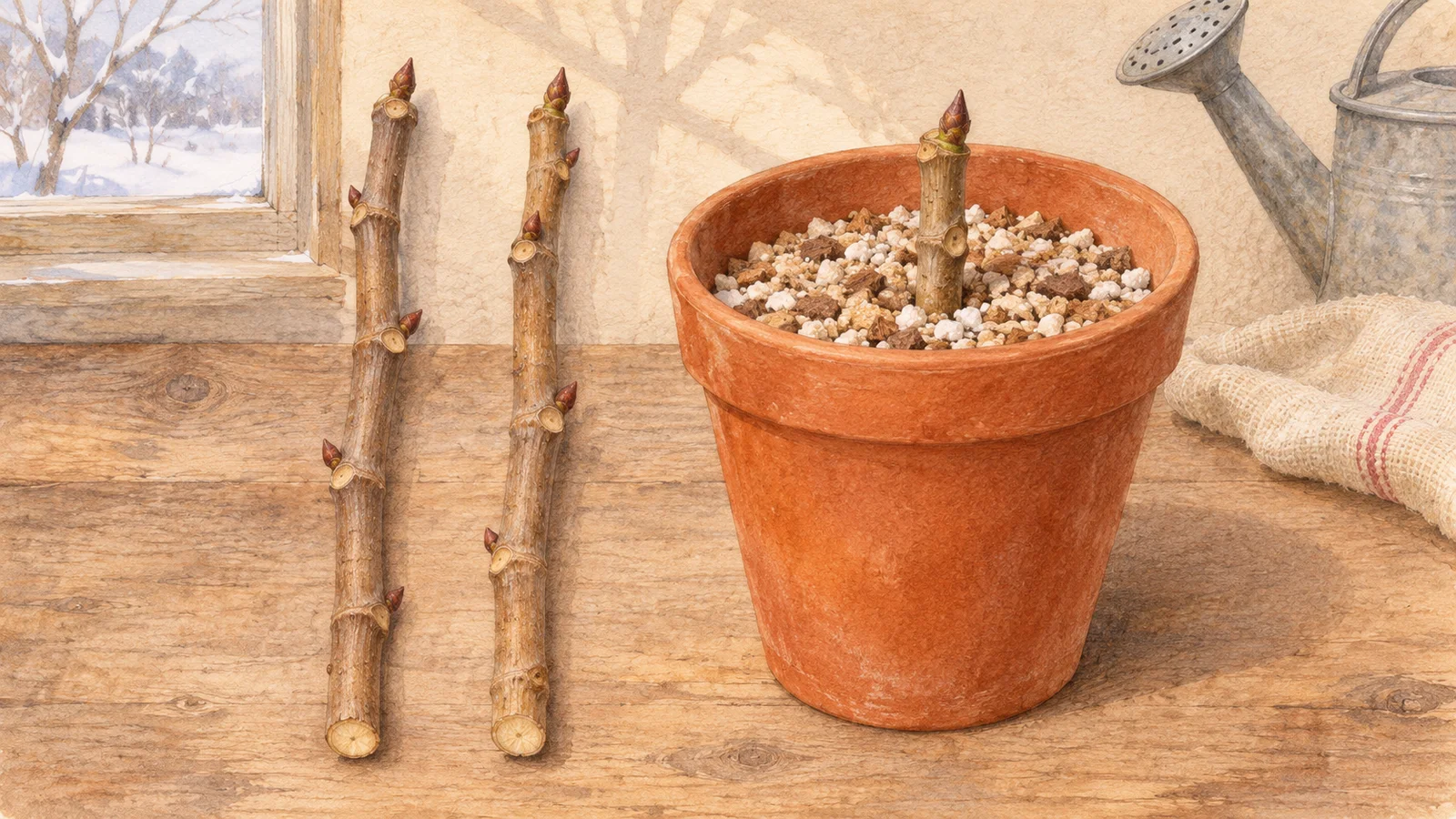
Before you cut a leafless branch from a common fig, find the end that grew toward the sky. A pencil-thick stick with a bud at each knuckle looks much the same from either end once it is lying on the bench. Keep track of the top now. The base goes into the rooting mix, with a bud left above the surface to make the new shoot.
Choose a branch while the tree is asleep
Use a fruiting common fig (Ficus carica) that you can identify. A cutting lets you keep a variety you like, even if the only name you have for it is the one on the parent tree’s tag. The tropical fiddle-leaf fig sold as a houseplant is a different species. A cutting from your fruiting tree will grow on its own roots.
Look for firm wood that grew during the past season, with its leaves gone and its buds still closed. Late winter, before growth resumes, is a practical time to cut and pot on the same day. The Connecticut Agricultural Experiment Station uses dormant wood for fig propagation. If the fig is still green and leafy in November, mark a promising branch and leave it on the tree. Your local season matters more than the date on the calendar.
Choose a straight, healthy section with several buds. Pass over wood that is shriveled, damaged or discolored. Use clean pruning shears and wear gloves. Fig sap can irritate skin. Set a clean pot beside your tools so you can plant the wood promptly.
Make the lower cut just below a node
Look closely at the stem. Each place where a leaf once joined it leaves a scar, with a bud nearby. This joint is a node. Choose a piece roughly as thick as a pencil and about eight to ten inches long, with several of those joints along its length. Make the lower cut just beneath a node. Leave an intact bud near the top. Rutgers’ fig guide describes using straight, vigorous wood and making that basal cut below the joint.
Lay each piece down with the tips pointing the same way. Put the parent name and the date on its pot label. For two similar figs, fill and label the first pot before moving on to the second tree. Two dormant twigs may look identical after a few minutes on the bench, and neither the bark nor the first leaf will tell you which fruit you liked.
Give the base moisture and air
Use a clean container with drainage holes, deep enough to hold most of the stem without bending it. Fill it with fresh, evenly moistened rooting mix. A mix of equal parts peat and perlite is one option used in the Connecticut fig work. Moisten it before planting so a flush of water won’t wash dry mix away from the cutting. Let surplus water drain out. A container standing in water defeats the purpose of a porous mix.
Make a planting hole first, then slide the cutting in base down. Set it vertically with the lower nodes buried and at least one good bud above the mix. NC State’s fig propagation instructions describe the same orientation. Gently settle the mix around the base until the stem stands on its own. One cutting per pot gives you room to move an early rooter without disturbing its neighbors.
Set the pot somewhere bright, protected from freezing and out of direct sun. A loosely draped clear bag can help keep the stem from drying while it has no roots. Direct sun can overheat a covered pot. Check the mix itself when deciding whether to water. Droplets on the cover tell you there is moisture in the air, but they can’t tell you how wet the base of the cutting is. Keep the mix damp enough to stay in contact with the wood and let the pot drain each time you water.
Wait for roots before moving up a pot
A bud may swell and unfold while the stem is still making roots. Leave the cutting in place when that first green leaf appears. Pulling it out for a look can break the tender roots you’re hoping to find. A clear nursery cup with holes makes progress easier to see. In an opaque pot, check the drainage holes for roots before trying to slide out the root ball. Ask Extension’s fig guidance uses roots reaching the sides of the pot as a sign the plant is ready to move.
Give neighboring cuttings time to develop at different speeds. If a stem is firm and the pot drains well, an unopened bud alone is a poor reason to discard it. A soft, collapsing base is a different matter. Remove that cutting and check whether its container has been sitting in water. Use fresh mix and a clean pot for another attempt.
Once roots hold the mix together, support the whole root ball from below as you move it into a slightly larger pot. Bring a covered plant gradually into ordinary room humidity. When frost danger has passed, give it a sheltered, shaded spot outdoors before easing it toward stronger light. Keep the label with it. Where an established fig needs winter protection in a container, make room for the young tree too. If your winter space fits just one more pot, choose which rooted cutting to keep while the others are still small enough to share.
Sources
- Fig Culture in North Carolina (NC State Extension). Accessed November 3, 2026.
- Figs in the Home Garden (Rutgers New Jersey Agricultural Experiment Station). Accessed November 3, 2026.
- Overwintering and Propagation of Figs in Connecticut (Connecticut Agricultural Experiment Station). Accessed November 3, 2026.
- Ficus carica (Common Fig) (NC State Extension Gardener Plant Toolbox). Accessed November 3, 2026.
- Fig trees from cuttings (Ask Extension). Accessed November 3, 2026.
- Propagation (NC State Extension Gardener Handbook). Accessed November 3, 2026.