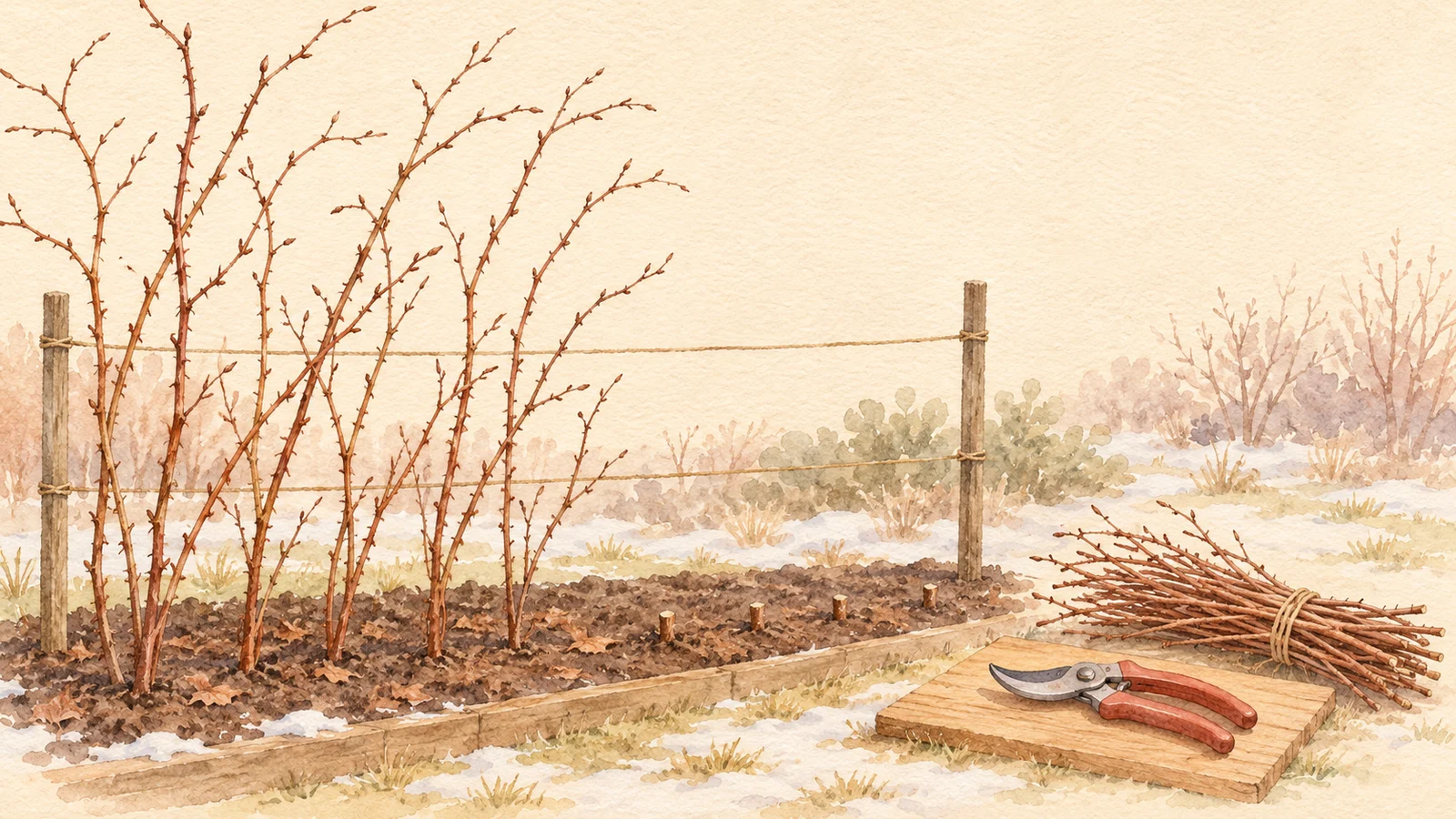
The easiest raspberry pruning job begins with a decision about next year’s harvest. If you grow fall-bearing raspberries and want one late-season crop, you can remove all the old canes during dormancy. New shoots will carry the next crop. There is no need to preserve a tangle of stems just because some of them still look sturdy.
But check the plant’s identity before making that first cut. The same treatment on summer-bearing raspberries removes the canes that would have fruited next summer.
Confirm which canes carry your fruit
Raspberry roots and crowns live for years; individual canes normally live for two growing seasons. A primocane is a first-year cane. A floricane is in its second year. University of Minnesota Extension explains this distinction and the different fruiting patterns.
Summer-bearing raspberries crop on second-year canes. Fall-bearing, also called autumn-fruiting or primocane-fruiting, types can fruit near the tops of new canes in their first year. If those canes remain, their lower portions can produce a summer crop the following year. That is why a plant sold as “everbearing” may be managed for either one crop or two; the word does not mean uninterrupted fruit all year.
Find the cultivar name on the plant label, nursery receipt or planting notes. If the patch was inherited and its type is unknown, keep the canes while you establish its fruiting pattern. Photograph where flowers and berries appear, and ask a local Extension office for help. Fruit color alone is not enough: both red and yellow raspberries have summer- and fall-bearing forms.
Decide whether a single crop suits the patch
Removing every cane gives up the early crop on overwintered stems. In return, the annual pruning job is straightforward, and you manage one generation of canes through the growing season.
Utah State University’s raspberry guide describes both systems. For two crops, growers retain the unfruited lower portions of suitable canes; for one fall crop, they cut the canes to the ground during dormancy. Those are different plans, not two heights to mix at random within an unidentified patch.
Consider your autumn weather as well as your appetite for summer berries. In a short growing season, early freezes can end a late crop before it finishes. Ask about cultivars proven in your area rather than assuming any fall-bearing plant will ripen well in every climate. If frost repeatedly catches most of your fruit, a different cultivar or summer-bearing planting may be more useful than another pruning adjustment.
Wait for the dormant window
Let the current crop finish and the plants become dormant. A practical target is late winter or early spring, before new growth begins. The RHS recommends late-winter cutting, while Iowa State’s spring schedule reflects its colder growing conditions. Use the stage of your plants and local guidance, rather than copying a month from a different region.
In November, identifying and labeling the row may be the useful job; the cutting can wait. Mark separately any summer-bearing plants nearby so a later tidy-up does not sweep through both types. Choose a day when you can see the cane bases and reach them safely, rather than cutting blindly through snow.
Cut the canes, leave the crown
Wear gloves and sleeves suited to thorny stems. Use sharp bypass pruners, with loppers for stems too thick for a comfortable hand-pruner cut. Follow the pruning-shear cleaning guide before moving tools between plantings.
Work along the confirmed fall-bearing row, cutting each old cane close to ground level. Do not dig out the living crown or pull stems hard enough to disturb it. Remove ties as you go so a severed cane does not remain suspended from the support. Place the cut material outside the bed, where it will not hide the next cane base.
Iowa State recommends removing the prunings from the garden to reduce disease carryover. Do not tuck suspect canes beneath the plants as mulch. If canes have unusual lesions, swelling or dieback, photograph the symptoms and get a diagnosis; annual cutting is not a cure for every disease of the roots or crown.
For a small home patch, individual cuts make it easier to see what you are removing. Finish by checking for overlooked tall stems and loose ties. The row will look bare above ground; the living root system is what you are keeping.
Give spring shoots space to grow
New canes should emerge as growth resumes. Keep the planting within its allotted strip and remove shoots that spread into paths. Local recommendations for row width differ with the growing system, so follow one suited to your site. Do not let the patch quietly become a wide thicket that you cannot reach to pick.
Colorado State’s guide emphasizes narrow rows and support for manageable plants. Check posts and wires while the bed is open, before the new canes make repairs awkward. Support should contain growth without constricting individual stems.
Keep weeds from competing with the new shoots. Watch soil moisture rather than automatically watering a bare bed on a summer schedule: water use is lower outside the active fruiting period, and poorly drained soil is still a problem after pruning. The garden-soil testing guide can help you plan sampling before adding amendments. A cleared row is not a reason to apply extra fertilizer.
Record the first ripe berries and the date frost ends the harvest. Those two observations will help you judge whether this single-crop approach suits your garden. Keep that note with the cultivar label so next winter’s pruning decision starts with the plant you actually have.
Sources
- Growing raspberries in the home garden (University of Minnesota Extension). Accessed November 17, 2026.
- How to Prune Raspberries (Iowa State University Extension and Outreach). Accessed November 17, 2026.
- How to Grow Raspberries (Royal Horticultural Society). Accessed November 17, 2026.
- Raspberry Management for Utah (Utah State University Extension). Accessed November 17, 2026.
- Growing Raspberries in Colorado Gardens (Colorado State University Extension). Accessed November 17, 2026.