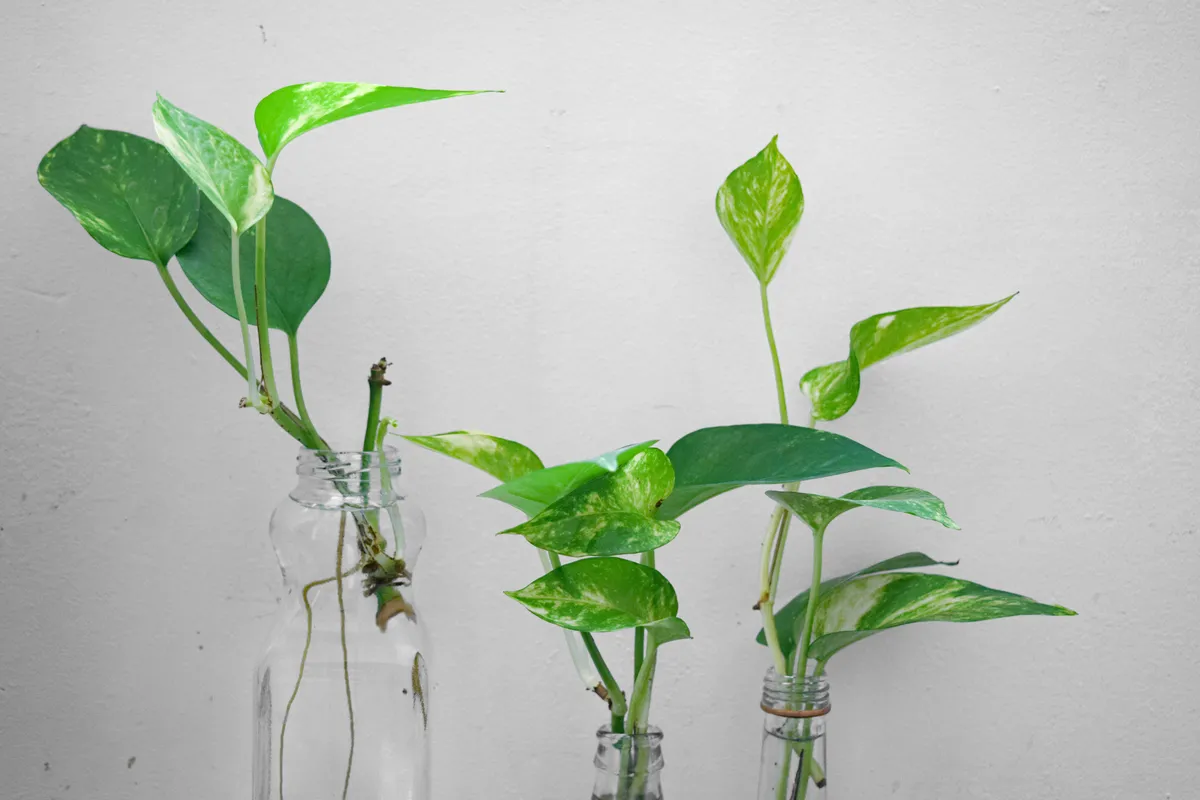
Pothos (Epipremnum aureum) is a forgiving houseplant and a useful first plant to propagate. Its trailing stems form roots readily, including in water, according to the North Carolina State University Extension plant profile. Success still depends on one non-negotiable detail: the cutting must include a section of stem with a node.
Water makes root development easy to observe. Potting mix avoids a later transfer from water to soil. Neither method needs an exact calendar; temperature, light, the condition of the parent plant, and the cutting itself all affect the pace.
Before cutting: identify the node
A node is the joint where a leaf attaches to the vine. On pothos, it may look slightly swollen and often has a small brown aerial-root nub beside the leaf stem. The smooth length between two nodes is the internode.
Nodes matter because they contain growing tissue that can produce roots and shoots. The University of Georgia’s cutting-propagation guide explains that shoot cuttings need growing points and describes nodes as the points where leaves attach. A detached pothos leaf with only its leaf stalk may remain green for a while, but without a piece of the main vine and a node, it cannot become a complete new vine.
For an easy-to-handle cutting, select a healthy stem section with:
- at least one intact node, and preferably two;
- one to three healthy leaves above the node that will be rooted;
- firm green tissue, not a yellow, blackened, or mushy stem; and
- no visible scale, mealybugs, webbing, or other pest signs.
Do not take material from a plant that appears diseased. Propagation can reproduce a plant, but it does not cure infected tissue.
Supplies
- Clean, sharp scissors or hand pruners
- Soap and water for cleaning the container
- A small glass or jar for water rooting, or a small pot with a drainage hole
- Fresh houseplant potting mix for the potting-mix method
- A label with the plant name and starting date
Wash the cutting tool before use and between plants. A clean cut crushes less tissue, and clean equipment reduces the chance of carrying pests or pathogens from another plant.
Make the cutting
- Trace the chosen vine and confirm the location of each node.
- Cut through the internode just below the lowest node you want to keep.
- Remove any leaf whose blade or leaf stalk would sit below water or beneath potting mix. Buried or submerged leaves are more likely to decay.
- Keep the cutting out of hot sun while preparing its container.
One longer vine can be divided into several cuttings, but inspect every section before setting it aside. Each piece needs a node; a section of bare internode is not enough.
Method 1: root pothos in water
- Fill a clean jar with enough room-temperature water to cover at least one node.
- Put the node and cut end in the water while keeping all leaves above the waterline.
- Place the jar in bright, indirect light. Avoid a window where strong direct sun can heat the jar or scorch the leaf.
- Check the jar every few days. Top it up as water evaporates and replace cloudy or foul-smelling water immediately. Cleaning the jar when changing the water helps prevent a film from building up.
- Watch the node rather than relying on a promised number of days. New roots begin as pale projections and then lengthen and branch.
Move the cutting to potting mix after it has developed several healthy roots long enough to spread through a small pot. There is no research-backed magic length that fits every home. The practical goal is a root system that can be arranged without forcing or sharply bending it.
To transfer it, use a small pot with a drainage hole and pre-moistened potting mix. Make a hole wide enough for the roots, lower them in gently, fill around them, and water until excess drains. Keep the mix evenly moist without saturating it during the initial adjustment, then begin checking moisture according to the needs of a normal pothos.
Method 2: root directly in potting mix
The University of Georgia recommends placing the lower node of a shoot cutting beneath the surface and removing low leaves that could rot in the medium. For pothos:
- Fill a small pot with fresh, lightly moistened houseplant potting mix. The pot must drain.
- Make a narrow planting hole so inserting the stem does not scrape the node.
- Set at least one node below the surface and keep leaves above it.
- Firm the mix lightly so the cutting stands upright without compressing all the air from the medium.
- Put the pot in bright, indirect light.
- Check moisture with a finger rather than watering on fixed weekdays. During rooting, do not let the small volume dry completely, but do not leave it soggy or sitting in runoff.
A clear cover can slow moisture loss, but it is optional in an ordinary home. If used, keep it out of direct sun and provide some airflow. Remove the cover if condensation remains heavy or the stem begins to soften.
Water or potting mix?
| Choose water when… | Choose potting mix when… |
|---|---|
| You want to see whether roots are forming | You want the cutting to establish in its final medium |
| You can keep the jar clean and topped up | You can monitor a small pot without saturating it |
| You are learning to recognize healthy roots | You would rather avoid a water-to-mix transfer |
Both are forms of stem-cutting propagation. The better method is the one whose moisture you can monitor consistently.
How to tell whether it is working
Good signs include a firm stem, a leaf that remains reasonably turgid, pale new roots, and eventually a new leaf or shoot. A cutting may pause while it allocates energy below the surface, so lack of immediate top growth is not automatically failure.
Investigate if the stem turns translucent, brown, or mushy; the water smells unpleasant; or every leaf rapidly collapses. Remove the cutting, trim back to firm healthy tissue with a clean tool if a usable node remains, clean the container, and restart. Discard a cutting when rot has reached its only node.
Yellowing has several possible causes, including leaf age, poor light, root damage, or excess moisture. Do not respond automatically by adding more water. Check the stem, node, roots, light, and medium first.
Care after rooting
The University of Wisconsin–Madison Extension describes pothos as durable across a range of indoor conditions, with filtered medium light a good fit. Brighter indirect light generally supports stronger growth and variegation, while harsh direct sun can damage foliage. Let a well-drained medium partially dry between waterings, then water thoroughly and empty collected runoff.
Wait for active new growth before applying fertilizer, and follow the product label rather than estimating a dose. Pruning several established vines after the new cutting begins growing can encourage a fuller plant.
Safety around children and pets
Pothos contains insoluble calcium oxalate crystals. NC State lists it as poisonous to people and a problem for cats and dogs, and the ASPCA lists golden pothos as toxic to cats and dogs. Keep the parent plant, cuttings, water jars, and trimmed pieces out of reach. Do not treat a propagation jar as a child-friendly science activity without close adult supervision.
If a person or animal chews the plant, contact the appropriate medical professional, veterinarian, or poison-control service for situation-specific advice.
Quick checklist
- The cutting includes a visible node on the main vine.
- The parent tissue is firm and pest-free.
- No leaf is submerged or buried.
- The jar is clean, or the pot has a drainage hole and fresh mix.
- The cutting receives bright, indirect light.
- Moisture is checked by observation, not a rigid calendar.
- Rotting material is removed promptly.
- The plant remains out of reach of children and pets.
Sources
- Pothos (Epipremnum aureum) (North Carolina State University Extension). Accessed August 5, 2026.
- Starting Plants From Cuttings for the Home Gardener (University of Georgia Cooperative Extension). Accessed August 5, 2026.
- Dependable & Durable Houseplants (University of Wisconsin–Madison Division of Extension). Accessed August 5, 2026.
- Golden Pothos (ASPCA Animal Poison Control Center). Accessed August 5, 2026.