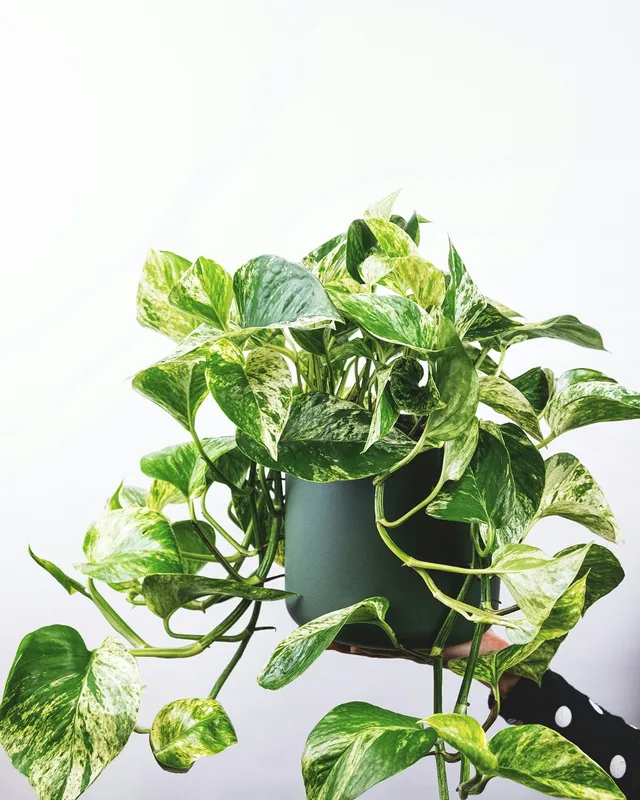
I have worked through yellow leaves on pothos, and I do not treat the color itself as a diagnosis. Normal aging, saturated roots, a dry root ball, abrupt light or temperature changes, fertilizer salts, insects, and disease can produce overlapping symptoms. Reacting to color alone can make the real problem worse: watering a plant with failing roots, for example, adds stress rather than relieving it.
My practical rule is to observe first, change one important condition at a time, and judge the newest growth rather than expecting a yellow leaf to turn green again. The possible causes and corrective boundaries below remain checked against the cited horticultural sources.
First, confirm that the color is abnormal
Golden pothos (Epipremnum aureum) naturally has yellow-green variegation, while cultivars such as ‘Marble Queen,’ ‘Neon,’ ‘Lime,’ and ‘Pearls and Jade’ have cream, chartreuse, or pale areas by design. The University of Wisconsin-Madison Extension pothos profile illustrates these normal cultivar patterns.
Variegation has defined areas that repeat across otherwise firm, healthy leaves. Stress-related yellowing is a loss of normal color: it may spread through a previously green section, affect an entire leaf, or arrive with wilting, spots, soft tissue, pests, or stalled growth.
One older leaf yellowing near the base of a healthy vine may be ordinary senescence. Both Wisconsin Extension and the North Carolina Extension Plant Toolbox note that older pothos leaves eventually yellow and fall. Several leaves changing quickly, yellowing on new growth, or yellowing paired with stem or root damage deserves investigation.
Read the whole pattern
| Pattern | Evidence to check | Most useful first response |
|---|---|---|
| One oldest leaf yellows; new growth is firm | No pests, spots, odor, or widespread decline | Monitor; remove the leaf when it detaches easily |
| Several leaves yellow while mix remains wet | Drainage, standing water, soft roots, sour odor | Stop adding water and inspect the root zone |
| Plant wilts and mix is very dry | Pot weight, mix pulling from pot, whether water runs around a dry root ball | Re-wet the entire root zone slowly, then reassess |
| Plant wilts even though mix is wet | Dark, soft roots or a loose stem base | Treat as possible root loss, not thirst |
| Pale or stretched new growth; variegation fades | Distance from usable window or grow light | Increase light gradually |
| Bleached areas or dry patches face the window | Recent move or strong direct sun | Move out of harsh direct exposure; retain bright filtered light |
| Fine stippling, webbing, cottony masses, brown bumps, or sticky leaves | Leaf undersides, nodes, pot rim, nearby plants | Isolate and identify the pest before treatment |
| Yellowing with brown or black leaf tips | Moisture history and fertilizer use | Correct water management first; consider salt buildup only with supporting history |
The table ranks checks, not diagnoses. A plant can have more than one problem, and leaf appearance alone cannot confirm a particular nutrient deficiency or pathogen.
Check the root zone before watering again
Pothos grows best in an aerated medium that drains, with watering after the surface begins to dry. It is not a plant that benefits from permanently wet mix. Wisconsin Extension identifies overwatering as the usual cause of pothos root rot, and the University of Maryland indoor-plant diagnostic guide describes healthy roots as firm and light-colored and diseased roots as dark and soft.
Do not use a fixed “every seven days” schedule. Drying speed changes with pot size, mix, season, light, temperature, and the size of the root system. Instead:
- Feel below the surface or insert an unfinished wooden skewer into the root zone.
- Lift the pot and compare its weight with its weight just after a thorough watering.
- Confirm that water can leave through drainage holes and that the pot is not standing in runoff.
- If the mix is wet and the plant is declining, slide out the root ball and inspect it rather than adding more water.
Firm roots and an earthy smell argue against advanced rot. Soft, collapsing roots, missing feeder roots, a foul smell, or a soft stem base support a root-rot diagnosis. Root color varies with potting media and species, so color without texture and odor is not enough.
If the root ball is waterlogged
Empty any cachepot or saucer, clear blocked drainage, and let an intact root system regain an appropriate wet-dry cycle. If roots are rotting, use clean pruners to remove tissue that is plainly soft and dead, then repot the viable plant in a clean container with fresh, well-drained houseplant mix. Maryland Extension recommends removing rotten portions and replanting the healthy remainder; a severely damaged plant may be better discarded.
Do not fertilize a plant with active root loss. Fertilizer cannot replace roots and may add soluble salts while the plant is least able to use them.
If the root ball is very dry
Apply room-temperature water slowly across the surface until the full root ball is moist and excess drains. If dried mix repels water, repeat in small passes or soak the pot briefly from below, then let it drain completely. Resume checking by moisture rather than jumping to a rigid calendar.
Wilting should not be the only cue. A waterlogged plant can wilt because damaged roots cannot supply the leaves, which is why the moisture check comes first.
Evaluate light and recent changes
Pothos tolerates lower light but performs best in bright, filtered or indirect light. Wisconsin Extension warns that it does not tolerate much direct sun and should be kept out of drafts; North Carolina Extension notes that low light can reduce variegation.
Ask what changed during the two or three weeks before symptoms appeared:
- Was the plant moved to a brighter window without acclimation?
- Did a seasonal sun angle begin reaching the leaves directly?
- Was it moved farther from a window, behind a curtain, or beneath an overhang?
- Is it next to a heating vent, air conditioner, exterior door, or cold glass?
Move a light-starved plant toward brighter filtered light in stages. Move a scorched plant out of direct afternoon sun but do not put it in a dark corner. Existing bleached or necrotic tissue will not repair; success is measured by stable, normally colored new leaves.
Inspect for pests with magnification
Wisconsin Extension lists mealybugs and scale as the most common pothos pests and spider mites as an occasional problem. The University of Minnesota indoor-pest guide recommends examining upper and lower leaf surfaces, nodes, pot rims, and crevices, using a 10-power hand lens when possible.
Look for evidence rather than spraying preventively:
- white cottony masses in leaf axils or on roots suggest mealybugs;
- tan or bark-colored attached bumps may be scale;
- fine webbing and stippled foliage support spider-mite activity;
- sticky honeydew on leaves or the shelf often accompanies aphids, mealybugs, or some scales.
Isolate a suspect plant from the rest of the collection. For a minor infestation, physical removal, a thorough rinse, or a houseplant-labeled insecticidal soap may be appropriate. Follow the product label and test a small area first. Do not combine pesticides, oils, soaps, alcohol, and household cleaners in an improvised mixture; leaf injury can look like the original problem. If a low-value plant has a heavy infestation, discarding it can be safer for the collection than repeated treatment.
Consider fertilizer only after water, roots, light, and pests
Yellowing is often described online as a specific nutrient deficiency based on vein color. That shortcut is unreliable without the plant’s fertilizer, water, pH, root, and growth history. Damaged roots can produce nutrient-like symptoms even when nutrients are present.
Wisconsin Extension recommends modest feeding during active growth and no fertilizer during the winter rest period; it also notes that excess fertilizer salts can blacken leaf margins or tips and accompany yellowing. If the plant has been fertilized heavily, has crust on the media or pot, and has healthy roots and free drainage, flush the mix thoroughly with water and pause feeding. If it has been in exhausted mix for a long time, is actively growing, and every other condition checks out, use a complete houseplant fertilizer at its labeled rate. More is not faster.
Decide whether to prune, propagate, or seek a diagnosis
Remove a fully yellow leaf with clean scissors if it no longer contributes to the plant. Do not strip every imperfect leaf during recovery; green tissue still supports growth.
If root or stem rot has advanced but some vines remain firm, take cuttings from symptom-free tissue above the damage as a backup. Pothos cuttings root readily, but sanitize the tool between diseased and healthy sections. Discard cuttings with soft nodes or spreading lesions.
Seek help from a local Extension office or plant diagnostic clinic when yellowing continues despite corrected care, when spots spread in a consistent pattern, or when a valuable plant has progressive stem or root damage. Photos of the whole plant, both leaf surfaces, roots, container, and growing location are more diagnostic than a close-up of one yellow leaf.
Keep pothos away from children and pets
Pothos contains insoluble calcium oxalates. The ASPCA Animal Poison Control Center classifies golden pothos as toxic to cats and dogs and lists oral irritation, drooling, vomiting, and difficulty swallowing among possible signs. Keep the plant and discarded cuttings away from pets and young children, and wash hands after handling sap. If a pet chews the plant or develops symptoms, contact a veterinarian or animal poison-control service promptly; do not use a gardening article as treatment guidance.
The central rule is simple: diagnose conditions, not colors. A measured root-zone check and a close pest inspection usually tell you more than the yellow leaf itself.
Sources
- Pothos, Epipremnum aureum (University of Wisconsin-Madison Extension). Accessed August 5, 2026.
- Diagnose Indoor Plant Problems (University of Maryland Extension). Accessed August 5, 2026.
- Pothos - Epipremnum aureum (North Carolina Extension Gardener Plant Toolbox). Accessed August 5, 2026.
- Managing insects on indoor plants (University of Minnesota Extension). Accessed August 5, 2026.
- Toxic and Non-toxic Plants: Golden Pothos (ASPCA Animal Poison Control Center). Accessed August 5, 2026.