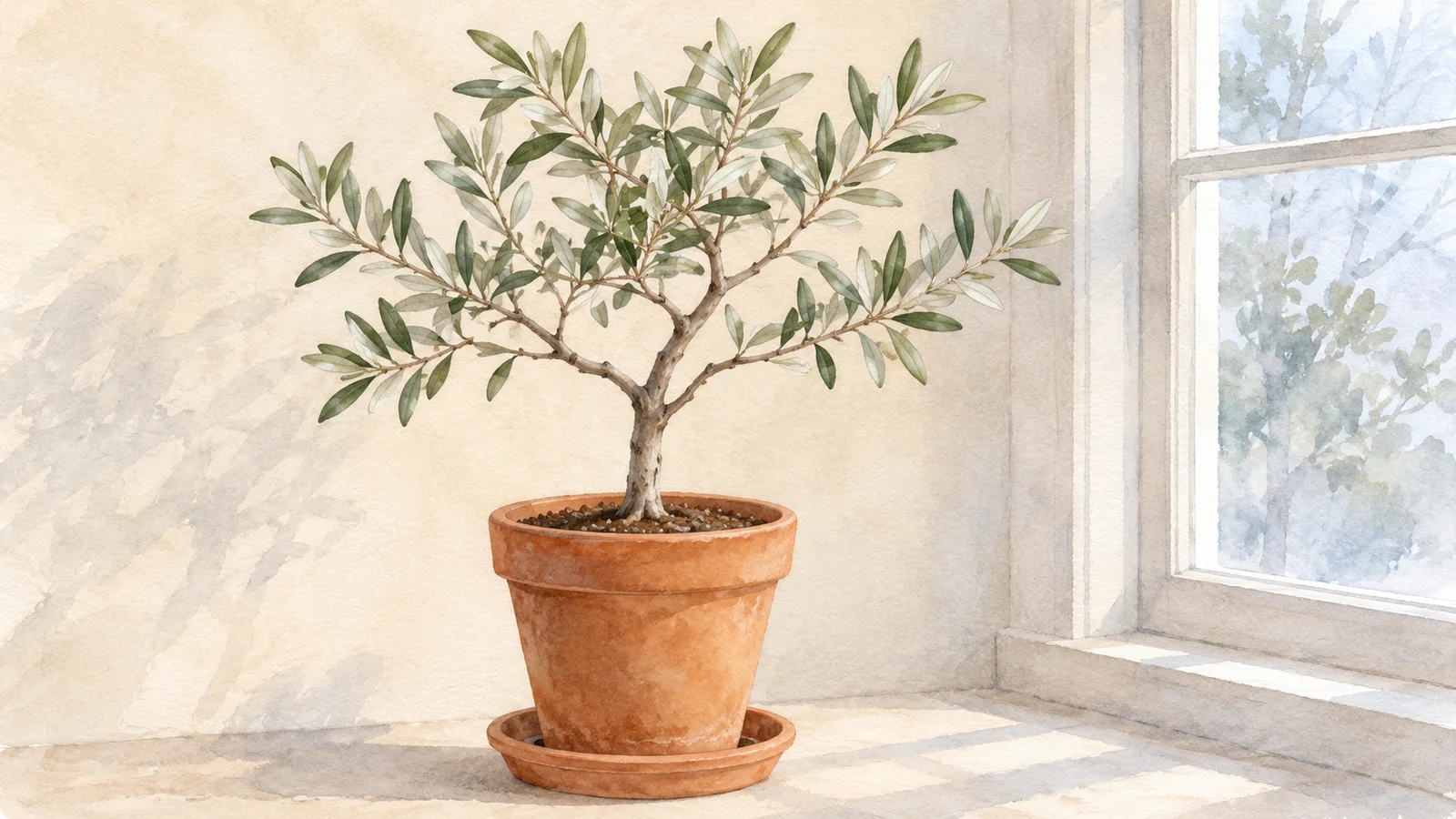
An olive tree can bring its silver-green leaves indoors for winter, but it needs more than a vacant corner. Find the light first, then decide where the pot will stand. A dim room that feels comfortable to you may be a poor winter home for an evergreen accustomed to outdoor sun.
This guide is for Olea europaea, the true olive. Check the nursery label before following its care routine. Sweet olive, usually an Osmanthus, is a different plant despite the shared common name.
Choose shelter before the cold arrives
In a mild climate, your tree may spend winter outside in a sheltered position. In a cold region, plan a protected winter home before freezing weather arrives. The RHS olive guide recommends moving containers undercover during severe cold and keeping them away from cold winds. A bright, cool, frost-free space is a useful starting point when your outdoor conditions exceed the plant’s tolerance.
Do not treat a hardiness number for a tree in the ground as permission to leave its small pot exposed. Kansas State’s overwintering guidance explains that container roots lack the surrounding earth’s insulation. A frost-resistant container protects the container from cracking; it does not make its contents immune to cold.
Check the proposed shelter at night as well as in afternoon sunshine. An unheated porch may be bright yet still freeze. Leave enough room to reach the soil, inspect the leaves and move the tree without snapping branches. If the only frost-free space is dark, solve the lighting problem before moving day rather than planning to leave the olive there until spring.
Put the leaves where the sunlight falls
University of Illinois Extension recommends at least six hours of sunlight for an indoor olive, with a south-facing window and a position away from heat vents and drafts. Watch the actual window: a neighboring building, porch roof or deep overhang can block the sun even when the compass direction looks promising.
Position the crown in the light, not just the pot. A tree standing below a high window may receive much less light than the sill. Keep foliage clear of cold glass and leave access for opening curtains. If daylight is inadequate, use the grow-light guide to plan supplemental light across the canopy; a lamp on the opposite side of the room is not the same setup.
An olive remains evergreen through winter. NC State’s plant profile describes its narrow leaves, green above and silvery underneath, and its full-sun requirements. Do not give it the dark storage treatment used for a dormant bulb. Keeping the foliage through the cold months is the immediate aim.
Check moisture before reaching for the can
The outdoor summer watering schedule will usually be too generous indoors. Kansas State notes that lower light and the absence of drying wind reduce winter water demand. That means checking before watering, not abandoning the pot for a fixed number of weeks.
Feel the upper inch of mix, as Illinois Extension advises for indoor olives, and notice the pot’s weight. If the surface is still damp and the pot feels heavy, wait and check again. When water is needed, apply it evenly and allow the excess to drain. Empty the saucer or outer decorative pot afterward. NC State’s container handbook stresses removing drainage water rather than allowing roots to sit in it.
The RHS describes the winter goal as barely moist compost. Avoid both a permanently wet root ball and one left to dry completely because olives have a reputation for drought tolerance. NC State’s drought-tolerance description applies to established plants; a confined root system still depends on the water you supply.
For a pot staying outside in a suitable climate, make sure its drainage holes remain open and raise it on pot feet so rainwater can escape. Indoors, protect the floor with a saucer you can readily empty. If drainage has become slow, investigate the container and mix before adding another watering.
Inspect the tree while you inspect the soil
Before bringing the pot inside, look along the stems, beneath leaves and around the container rim. Keep checking after the move. Kansas State emphasizes continued insect inspection indoors, where a small unnoticed infestation can grow.
Scale insects are among the problems listed for olives by NC State. If you find persistent bumps on stems or sticky deposits, use the scale-identification guide before treating. Separate an infested plant from nearby houseplants. Choose any treatment only after identifying the pest, and follow a product label that permits its use on that plant in that location. Routine spraying is not a substitute for inspection.
Hold off on a major reshaping job to make the tree fit its winter corner. The RHS places olive pruning in late spring or early summer. Choose adequate space now and revisit the shape during the growing season. Reduced winter growth also means reduced fertilizer demand; the NC State container handbook advises less feeding in this season.
An indoor olive may never produce a useful crop. Illinois Extension cautions that fruit is unlikely indoors, and NC State notes that some cultivars are fruitless. Keep the cultivar label with the pot so future flowering or fruiting questions start with the right plant. For this winter, judge the location by healthy foliage, usable light and a root ball that drains well.
Sources
- How to grow olives (Royal Horticultural Society). Accessed November 14, 2026.
- Houseplants to grow on your kitchen counter (University of Illinois Extension). Accessed November 14, 2026.
- Olea europaea (NC State Extension Gardener Plant Toolbox). Accessed November 14, 2026.
- 18. Plants Grown in Containers (NC State Extension). Accessed November 14, 2026.
- Overwintering Plants and Pots (Johnson County K-State Research and Extension). Accessed November 14, 2026.