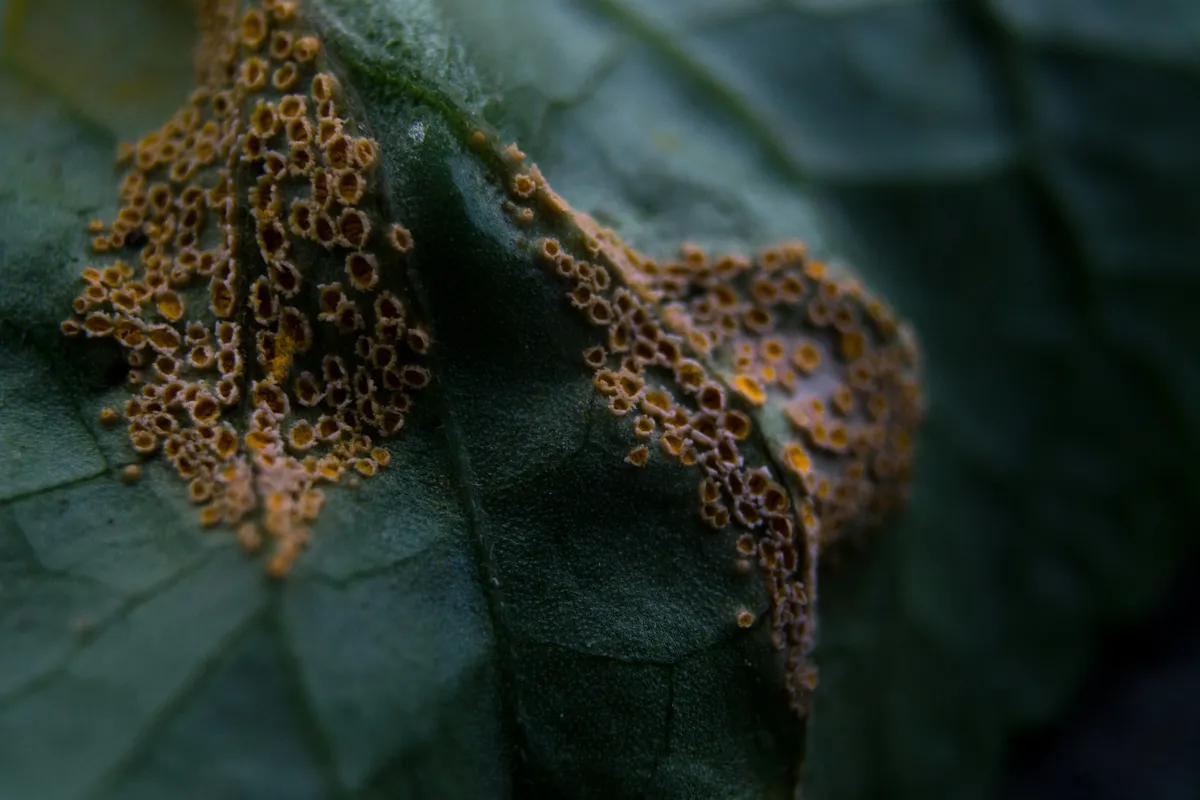
Scale insects can resemble part of the plant: small tan, brown, gray, white, or waxy bumps attached to stems, leaf veins, or leaf undersides. Most adult females move little or not at all. Their mobile young, called crawlers, are much smaller and spread to new feeding sites before settling.
“Scale” is not one interchangeable pest. Soft scales and armored scales differ in structure, honeydew production, and response to insecticides. Treatment chosen without that distinction may fail. Begin by confirming a live insect, determining the scale group when possible, and recording where active stages occur.
Rule out look-alikes
Examine suspicious bumps with a hand lens. Normal lenticels, leaf scars, corking, glands, fern spores, dried sap, edema, and old wounds can all be mistaken for scale. Compare the same structure on healthy parts of the plant and on another plant of the same species if available.
Use a fine probe to lift one suspect cover without gouging the stem. A live scale may reveal moist insect tissue beneath or leave a soft body on the plant. A dry, empty cover may be an old dead scale. Photograph the site before and after lifting it.
The UC Statewide IPM scale guide distinguishes the two major groups:
- Soft scale: generally larger and more rounded; the outer surface is the insect’s body wall and does not lift separately. Soft scales feed on phloem and commonly excrete sticky honeydew, which can support black sooty mold.
- Armored scale: generally smaller and flatter; a plate-like cover can often be lifted while the insect body remains beneath it. Armored scales do not produce honeydew.
| Finding | Supports | Important limit |
|---|---|---|
| Convex live bumps plus sticky honeydew | Soft scale or another honeydew-producing pest | Honeydew alone is not species identification |
| Flat removable cover with insect beneath | Armored scale | Microscopic characters may be needed for species |
| Bumps remain after treatment but are dry underneath | Old covers or dead scale | Appearance alone cannot measure control |
| Tiny mobile yellowish stages near adults | Crawlers | Timing and species still affect treatment choice |
| Yellow leaves or dieback with no confirmed insects | General plant stress | Water, roots, light, disease, and mites can overlap |
Species-level identification matters on valuable plants because harmless and damaging scales can look similar, and pesticide effectiveness varies. Collect a specimen or high-magnification image and ask a local Extension office or plant clinic when the group remains uncertain.
Establish the activity baseline
Map the infested leaves, stems, petioles, crown, and pot rim. Count live scales on several marked sections rather than guessing at the whole-plant population. Wipe honeydew from one durable reference leaf so new sticky deposits can be recognized. Photograph the newest growth; old yellowing and scars will not reverse.
Look for crawlers with a lens around adult females and on nearby young tissue. Because crawlers are small and mobile, inspect neighboring plants and any leaves that touched the infested plant. University of Minnesota Extension emphasizes that crawler timing and accurate scale identification determine effective management.
Move the plant to an isolation area where foliage cannot contact the collection. Bag prunings and fallen leaves before transport. Wash hands and clean tools after use. Do not allow runoff or a contaminated cleaning cloth to move between plants.
Choose management according to scale type and abundance
Light, localized infestation
Hand removal is often the most precise first action on an accessible houseplant. Rub or lift live scales gently with a swab, soft brush, or non-sharp tool that will not damage bark or leaf tissue. Colorado State University notes that even a small disturbance can break a settled scale’s feeding connection, but killed scales may stay attached and still look alive.
Prune a heavily encrusted leaf or small branch when the plant can tolerate the loss. Seal the material in a bag. Wash exposed crawlers from sturdy foliage with a firm, non-damaging water stream, concentrating on leaf undersides and stems while keeping the root ball from becoming waterlogged.
Clean honeydew with plain water on foliage that tolerates wiping. Sooty mold grows on the sugary deposit rather than feeding directly on the plant; removing it improves visibility, but the source of new honeydew must still be managed.
Widespread but salvageable infestation
First reduce the population mechanically and remove the most colonized tissue. Then reassess whether the plant has enough accessible surface area for thorough treatment. Dense crowns, overlapping sheaths, rough bark, and a large canopy can make contact coverage impractical indoors.
Horticultural oils and commercial insecticidal soaps are possible contact controls only when their labels authorize the indoor site, host plant, and scale pest. Oils are particularly important for many armored scales; soaps and oils can be more effective against exposed crawlers than protected adults. The Colorado State University houseplant-pest review identifies horticultural oils as the most effective treatment class for armored scales and warns that systemic insecticides provide poor armored-scale control.
Patch-test as the label directs. Contact products need coverage of the insect and infested plant surfaces, but excessive wetting, prohibited temperatures, strong light, drought stress, or a sensitive species can cause plant injury. Do not substitute dish detergent or a homemade oil mixture for a registered formulation.
Systemic treatment is not interchangeable
Some systemic active ingredients control certain soft scales; the same ingredient may perform poorly against armored scale or another species. Indoor ornamental use, outdoor landscape use, and edible-crop use are legally distinct. Do not apply a soil drench or granule because a general article calls it a “systemic.” The exact product label must list the site and plant, and the identified scale must be susceptible.
If the plant flowers or later moves outdoors, pollinator restrictions also matter. For a fruiting citrus, herb, or other edible plant, an ornamental-only label does not permit use on food. Ask Extension or a licensed pesticide professional when the scale type or legal use is unclear.
Repeat inspections, not a memorized schedule
Scale populations can contain overlapping life stages, especially indoors. A short-lived contact product may not affect protected adults or later-emerging crawlers. That means follow-up is usually necessary, but its timing and maximum number of applications must come from the selected label.
Before any permitted repeat application, inspect the marked sections and record:
- live tissue beneath a sample of covers;
- crawler activity;
- new honeydew on the cleaned reference leaf;
- fresh scales on previously clean growth;
- trend in leaf yellowing, drop, or shoot dieback.
| Trend | Decision |
|---|---|
| Covers remain but samples are dry and no crawlers appear | Continue observation; do not treat old shells |
| Live adults decline but crawlers are active | Use mechanical removal or the next label-permitted crawler treatment |
| Fresh honeydew continues on a soft-scale plant | Search protected stems and leaf undersides for live stages |
| New growth remains clean across repeated checks | Maintain isolation before returning the plant to the collection |
| Counts stay flat after correct contact coverage | Reconfirm soft versus armored scale and obtain expert advice |
| Dieback progresses despite falling scale counts | Investigate roots, disease, and environmental stress as separate problems |
End isolation only after repeated examinations of old colonies, new growth, and neighboring plants show no live scale, crawlers, or fresh honeydew. There is no universal four- or six-week clearance rule; development varies with species and indoor temperature.
When disposal is the lower-risk choice
Discard a plant in a sealed bag when scale covers most stems or growing points, the canopy cannot be inspected or treated safely, the plant has little viable tissue, isolation is failing, or the plant is readily replaceable and threatens a valuable collection. Do not compost heavily infested material beside host plants.
Seek professional or Extension help when a valuable woody specimen is involved, armored versus soft scale cannot be determined, an edible plant limits legal controls, a large plant requires spraying beyond safe household reach, or correctly used labeled tactics do not reduce live counts. A plant clinic can also separate ongoing scale injury from root disease, nutrient problems, or other decline.
Pesticide directions are not optional. The EPA’s label overview explains that a label legally defines where, how, how much, and how often a product may be applied. Follow all listed ventilation, protective-equipment, re-entry, storage, and disposal requirements. Keep the product in its original container. The EPA’s guidance for protecting pets instructs users to keep children and animals away as directed and not to spray or store pesticides near pet food or water. Keep the label available for first aid and emergency contacts if a spill or exposure occurs.
Sources
- Scales (University of California Statewide Integrated Pest Management Program). Accessed August 5, 2026.
- Brown Soft Scale: A Common Insect Pest of Indoor Plants (Colorado State University Extension). Accessed August 5, 2026.
- Scale insects on Minnesota trees and shrubs (University of Minnesota Extension). Accessed August 5, 2026.
- Managing Houseplant Pests (Colorado State University Extension). Accessed August 5, 2026.
- Introduction to Pesticide Labels (United States Environmental Protection Agency). Accessed August 5, 2026.
- Read the Label First: Protect Your Pets (United States Environmental Protection Agency). Accessed August 5, 2026.