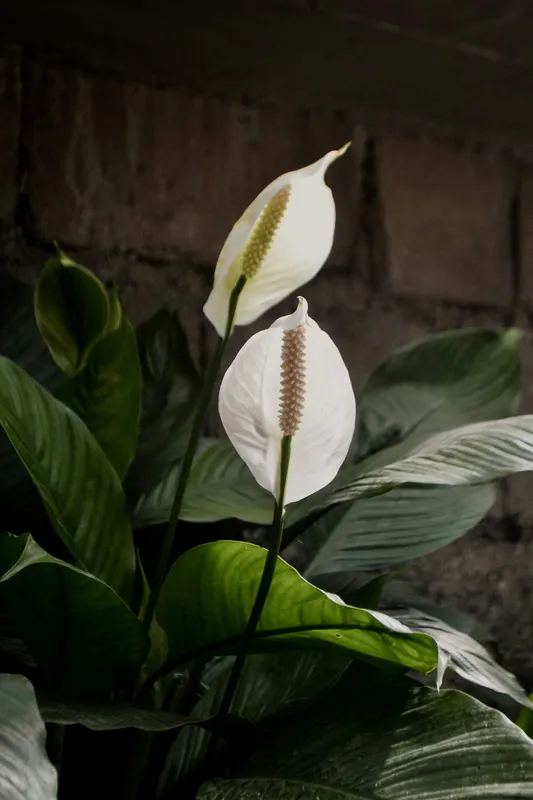
Drooping is a loss of leaf firmness, not a diagnosis. A peace lily (Spathiphyllum species or hybrid) may wilt because its mix is too dry, but similar-looking collapse can follow saturated roots, cold exposure, heat, a damaged root system, transplant disturbance, or pests. Watering every drooping plant immediately can therefore solve the right problem or intensify the wrong one.
Recovery depends on what caused the droop. A mildly dry plant with healthy roots may regain firmness after watering, while tissue injured by rot or cold may never recover. Diagnose conditions first, make one justified correction, and watch the direction of change.
Run a five-minute triage
Check the pot before changing anything:
- Feel the mix at the surface and several inches down, adjusted for pot depth.
- Lift a manageable pot to assess whether it is unusually light or heavy.
- Look inside the saucer or cachepot for hidden runoff.
- Smell near the drainage hole and inspect the crown where leaf stalks enter the mix.
- Note whether all leaves collapsed together or only one section is affected.
- Review changes in the previous week: watering, repotting, relocation, a cold night, direct sun, fertilizer, or pest treatment.
Clemson Cooperative Extension recommends keeping peace-lily mix moist but not soggy, allowing it to dry slightly between waterings, and never leaving the pot in saucer water. The correct response depends on which side of that range the root zone has reached.
| Evidence | More likely explanation | First response |
|---|---|---|
| Mix is dry through much of the root zone; pot is light; leaves are limp but not mushy | Water deficit | Rehydrate the full root ball and drain it |
| Mix is wet; pot is heavy; older leaves yellow; crown or roots soften | Oxygen-starved or decaying roots | Do not add water; inspect drainage and roots |
| Mix is moderately moist; droop began after repotting or division | Root disturbance | Stabilize conditions and avoid repeated interventions |
| Droop follows a cold draft or contact with winter glass | Chilling injury | Move to stable warmth; remove tissue only after damage is clear |
| Leaves sag during hot direct sun and show pale or scorched areas | Heat or light stress, sometimes combined with dryness | Move out of direct sun and reassess moisture |
| One section collapses while the rest remains firm | Local crown/root injury or physical damage | Inspect that division closely rather than watering the whole pot blindly |
| Leaves are distorted or stippled and insects are present | Pest feeding | Identify the pest before selecting a labeled control |
If the mix is too dry
Water slowly across the surface until the entire root ball is moist and excess exits the drainage holes. Let the pot drain fully, then empty the saucer or outer container. Do not leave it soaking indefinitely and do not add fertilizer to a wilted plant.
Very dry peat-based mix can shrink away from the pot wall and resist wetting. If water immediately runs down the gap, apply it in several slow passes with pauses between them. For a draining nursery pot, brief bottom watering can help rewet the medium; remove it once the surface begins to moisten and let all excess drain. Confirm afterward that the center is moist rather than assuming runoff proves the root ball was watered.
Do not use wilting as the routine watering signal. Repeated severe drying can produce yellow margins and leaf loss. Instead, learn the pot’s weight and test the mix before complete collapse. North Carolina Extension advises moist, well-drained conditions with some drying between waterings rather than constant saturation or prolonged drought.
If the plant stays limp after the root ball is evenly moist, stop adding water. Severely dry roots can be injured, and a plant with preexisting root loss may be unable to take up water even though the mix is now wet. Recheck the crown and roots rather than repeatedly soaking it.
If the mix is wet
Do not water again simply because the leaves droop. Remove the inner pot from standing water, confirm the drainage hole is open, and let excess drain. Keep the plant in its normal bright, indirect light and stable warmth; direct sun or a strong heater is not a safe drying method.
If the pot remains saturated, smells sour, or has soft tissue at the crown, inspect the root system:
- Slide out the root ball while supporting the base.
- Look for firm roots as well as roots that are dark, soft, hollow, or separating when lightly handled.
- Remove only clearly failed roots with a clean cutting tool.
- Use fresh, clean, well-drained potting mix.
- Select a pot with drainage that fits the remaining roots; do not move a reduced root system into an oversized pot.
- Keep the crown at its previous depth and discard contaminated old mix.
“Root rot” is a condition with multiple possible organisms and environmental causes, not something that can be confirmed from a yellow leaf alone. If most roots or the crown are affected, consult a local Cooperative Extension office or diagnostic clinic. An unlabeled fungicide, peroxide drench, or spice-based home remedy should not replace diagnosis and drainage correction.
Check light, temperature, and humidity
Peace lilies tolerate shade but generally grow best in bright, indirect light. Clemson Extension warns that direct sun can scorch foliage. A very dark location also slows growth and water use, leaving mix wet longer and reducing flowering. Move toward stronger indirect light gradually rather than making an abrupt jump into a sunny window.
Cold is a separate cause of collapse. North Carolina Extension identifies cold and drafty conditions as growth-limiting and notes that extended exposure below 40°F can damage leaves, stems, and roots. Keep the plant away from exterior-door drafts, air-conditioning outlets, and cold window glass. Chilled tissue may become dark or water-soaked; watering cannot reverse that injury.
Low humidity more often contributes to brown tips and edges than to a sudden whole-plant collapse. North Carolina Extension lists direct sun, underwatering, and low humidity among causes of brown tips. Do not diagnose dry air from one brown tip: fertilizer salts, irregular water, physical damage, and root problems can look similar. A room humidifier may raise ambient humidity, but repeated leaf misting provides only brief wetness and does not correct a dry root ball.
Consider roots, repotting, and pot size
A crowded peace lily may dry unusually fast because roots occupy most of the pot. Confirm by examining the root ball. Roots through one drainage hole are only one clue; dense circling roots and little remaining mix provide stronger evidence.
When a size increase is justified, use a pot only modestly larger with working drainage. An oversized container can keep unoccupied mix wet too long. Repotting itself disturbs roots, so a temporary droop afterward does not automatically require more water or fertilizer. Keep light, warmth, and moisture steady while the roots resume function.
A recent division has fewer roots supporting each crown. It may need more careful moisture monitoring, but constant saturation still deprives the root zone of air. Stake only if necessary, and remove the support once the division is anchored.
Inspect for pests and localized damage
North Carolina Extension identifies mealybugs as a common indoor pest of peace lilies. Check leaf undersides, the joints between stalks, and the crown for white cottony material. Also look for scale, fine webbing and stippling from mites, or silvery scarring associated with thrips. Compare suspect material with Extension pest images before treating.
Isolate an infested plant from the collection. A strong water rinse and manual removal may reduce some pests, but any pesticide must be labeled for the pest and indoor ornamental use. Test soaps or oils on a small area when the label directs, because stressed foliage can be sensitive. Severe crown collapse without visible insects warrants a root and disease assessment instead.
Use the pattern to prevent another droop
Record what the plant tells you over two or three watering cycles:
- Date watered and whether the root ball was dry, moist, or wet
- Pot weight before and after watering
- Light or temperature changes
- Time until the mix begins to dry
- Which leaves recovered and which continued to decline
Adjust the checking interval, not a fixed watering appointment. Larger plants, brighter light, warmth, and active growth can increase water use. Lower light, cool rooms, oversized pots, and nonporous containers can slow it. Always empty runoff.
Remove a fully yellow or collapsed leaf with a clean tool, but do not cut healthy foliage in an attempt to “balance” roots without a specific reason. Old scorch, tears, and yellow sections will not become green again; improvement appears as stable existing tissue and healthy new leaves.
Child and pet toxicity
Peace lily is not a true Lilium lily, but it is not edible or pet-safe. Its flowers, leaves, and stems contain insoluble calcium oxalate crystals. The National Capital Poison Center explains that chewing can cause immediate mouth and throat irritation, lip swelling, drooling, nausea, and vomiting. Keep the plant and trimmings out of children’s reach, wash hands and tools after pruning, and prevent sap from contacting eyes.
The ASPCA Animal Poison Control Center lists peace lily as toxic to dogs and cats, with oral burning, drooling, vomiting, and difficulty swallowing among possible signs. If a child is exposed, use webPOISONCONTROL or call Poison Control in the United States at 1-800-222-1222 for case-specific advice. If a pet chews the plant, contact a veterinarian or animal poison-control service. Difficulty breathing or swallowing, severe swelling, or repeated vomiting needs urgent professional care; do not induce vomiting unless instructed.
Droop-response checklist
- Test moisture at depth and check pot weight.
- Remove hidden standing water and confirm drainage.
- Match the response to dry, moist, or saturated conditions.
- Review recent cold, sun, repotting, fertilizer, and pesticide exposure.
- Inspect the crown, roots, and leaf undersides when symptoms do not fit simple thirst.
- Make one correction and monitor rather than stacking treatments.
- Seek diagnostic help for extensive root loss, crown collapse, or continuing decline.
The key distinction is simple but important: dry-root wilt calls for thorough watering, while wet-root wilt calls for investigation. The plant’s recovery time depends on the health of its roots and the cause of the droop.
Sources
- Peace Lily (Clemson Cooperative Extension Home & Garden Information Center). Accessed August 5, 2026.
- Peace Lily (Spathiphyllum) (North Carolina Extension Gardener Plant Toolbox). Accessed August 5, 2026.
- Peace Lily (ASPCA Animal Poison Control Center). Accessed August 5, 2026.
- Are Peace Lilies Poisonous? (National Capital Poison Center). Accessed August 5, 2026.