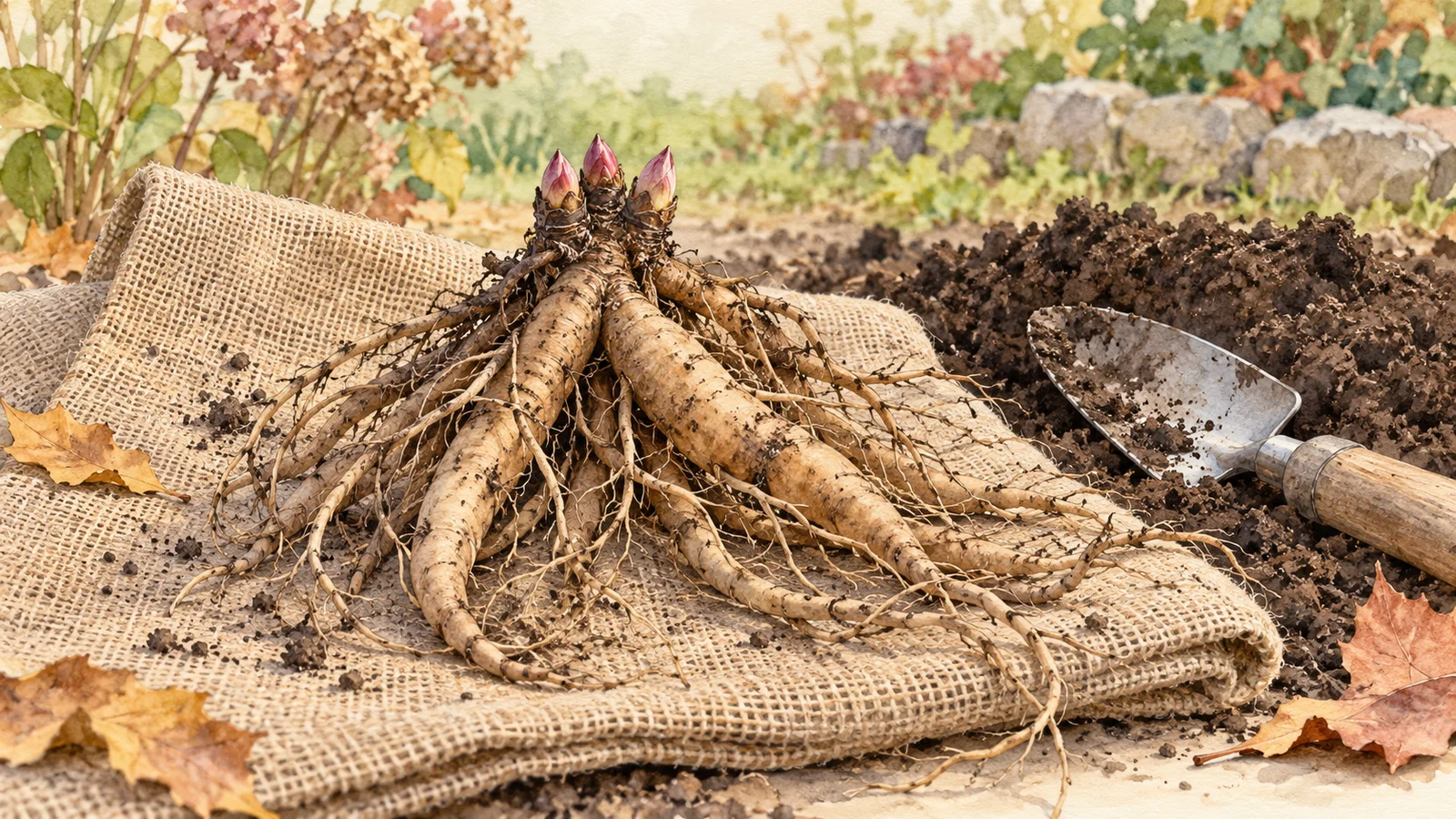
Find the eyes before you dig
A bare-root peony can look like a bundle of thick, awkward roots with very little promise of a flower. Look closely at the crown where those roots join. The small pointed buds, often pink or reddish, are the eyes. Their position below the finished soil surface matters much more than the depth of the longest root.
This planting method is for herbaceous garden peonies, the kinds whose stems die back in winter. Check the nursery label before beginning. Woody tree peonies and intersectional, or Itoh, peonies have their own planting guidance; do not transfer a graft-depth instruction from a tree peony to a herbaceous root. Keep the cultivar label with the plant so you can check its mature size and local suitability later.
Handle the division by supporting the roots and crown, rather than using a bud as a handle. Unpack it where you can see the whole root system. If the crown is soft or badly damaged, ask the supplier about the condition before burying it. A planting hole will not make an uncertain purchase easier to inspect.
Choose a place that can stay its home
Peonies are long-lived border plants, so consider the space they will occupy after the first small season. Iowa State’s growing guide recommends full sun, with at least six hours of direct light, and well-drained soil. A spot beneath a growing tree may gradually become too shaded and crowded by roots even if it looks open now.
Look at the proposed bed after rain. Avoid a low patch where water remains around the roots. The RHS guide allows a range of soil types, including clay, provided the soil does not stay waterlogged. The label’s mature spread should determine spacing; roughly three feet between ordinary garden peonies is a useful starting point, with more room for a wider cultivar.
Mark that space before planting. Leave access for watering, removing dead stems and putting in a support if the mature flowers need one. A tiny division beside a path can be deceptive: the future foliage should not force people to brush through it every time they pass.
Choose a cultivar suited to your region. A photograph of a peony flowering in a cooler garden does not establish that it will perform the same way in a warm-winter location. Clemson’s South Carolina guide is a useful regional starting point for Southern gardeners. Local extension advice is more useful than trying to solve a climate mismatch by planting the roots deeper.
Match the planting window to your climate
Fall is a common season for planting dormant divisions, but the date changes with location. Iowa State identifies September as its preferred time to divide and plant; RHS guidance for the United Kingdom describes late autumn for bare-root divisions. Treat those as regional examples, not two deadlines that every garden must follow.
Check the supplier’s arrival instructions and your local extension’s planting window before ordering. Have the bed ready when the roots arrive. If weather delays planting, follow the supplier’s temporary-storage directions rather than leaving unpacked roots exposed in a warm room or keeping them submerged in a bucket for days.
An established peony does not need routine division simply because you are planting a new one nearby. Illinois Extension describes dividing plants to make new plantings and warns about shade and excessive planting depth when flowering declines. Leave a healthy, well-placed clump alone unless there is a reason to move or propagate it.
Measure from the buds to the finished soil
Dig a hole wide enough to arrange the roots without cramming them into a tight bunch. Set the division with the eyes facing upward. Adjust the soil beneath it until the buds sit at the intended depth, then backfill around the roots. Do not calculate planting depth from the bottom of the hole: roots may extend much farther down than the crown.
For herbaceous peonies, Penn State recommends only one to two inches of soil above the upper buds. RHS guidance is shallower still, limiting the covering to about one inch. Follow suitable local and nursery guidance within that shallow range; neither source supports burying the eyes under several extra inches “for protection.” Deep planting can reduce flowering.
A straight stick laid across the hole at the surrounding ground level makes a useful reference. Check the gap between it and the top eyes before completing the backfill. Gently settle the soil around the roots and water it in. Recheck the level if the division sinks as the soil settles, while it is still straightforward to correct.
Keep that finished soil level in mind when later adding compost or mulch. Repeatedly topping up the center of the clump can gradually hide a crown that began at the correct depth. Mark the planting nearby without driving the marker through the roots.
Care for roots before expecting a border full of flowers
Water during dry spells through establishment, checking the soil rather than assuming a cool autumn means no water is needed. RHS emphasizes watering during the first year, especially in dry weather. Moist soil supports establishment; a continually saturated planting hole calls for attention to drainage, not another watering.
In colder regions, temporary winter mulch may help a new planting through freeze-thaw conditions. Illinois describes this protection for new divisions. Ask locally about timing and material, and draw the covering back from the emerging crown in spring. Do not confuse a removable winter cover with extra planting soil over the buds.
Plan for a gradual display. Iowa State notes that a new peony may not flower in its first spring and may take several years to reach fuller production. Keep a record of growth and flowering instead of digging it up after one quiet season. Photograph the planting position now, while the soil level is easy to see; next spring, that photograph and the cultivar label will be more useful than guessing where the crown ended up.
Sources
- Growing Peonies in Iowa (Iowa State University Extension and Outreach). Accessed October 6, 2026.
- How to grow herbaceous and intersectional peonies (Royal Horticultural Society). Accessed October 6, 2026.
- Dividing Peonies (University of Illinois Extension). Accessed October 6, 2026.
- The Beloved Peony (Penn State Extension). Accessed October 6, 2026.
- How to Grow Peonies in South Carolina (Clemson Cooperative Extension). Accessed October 6, 2026.