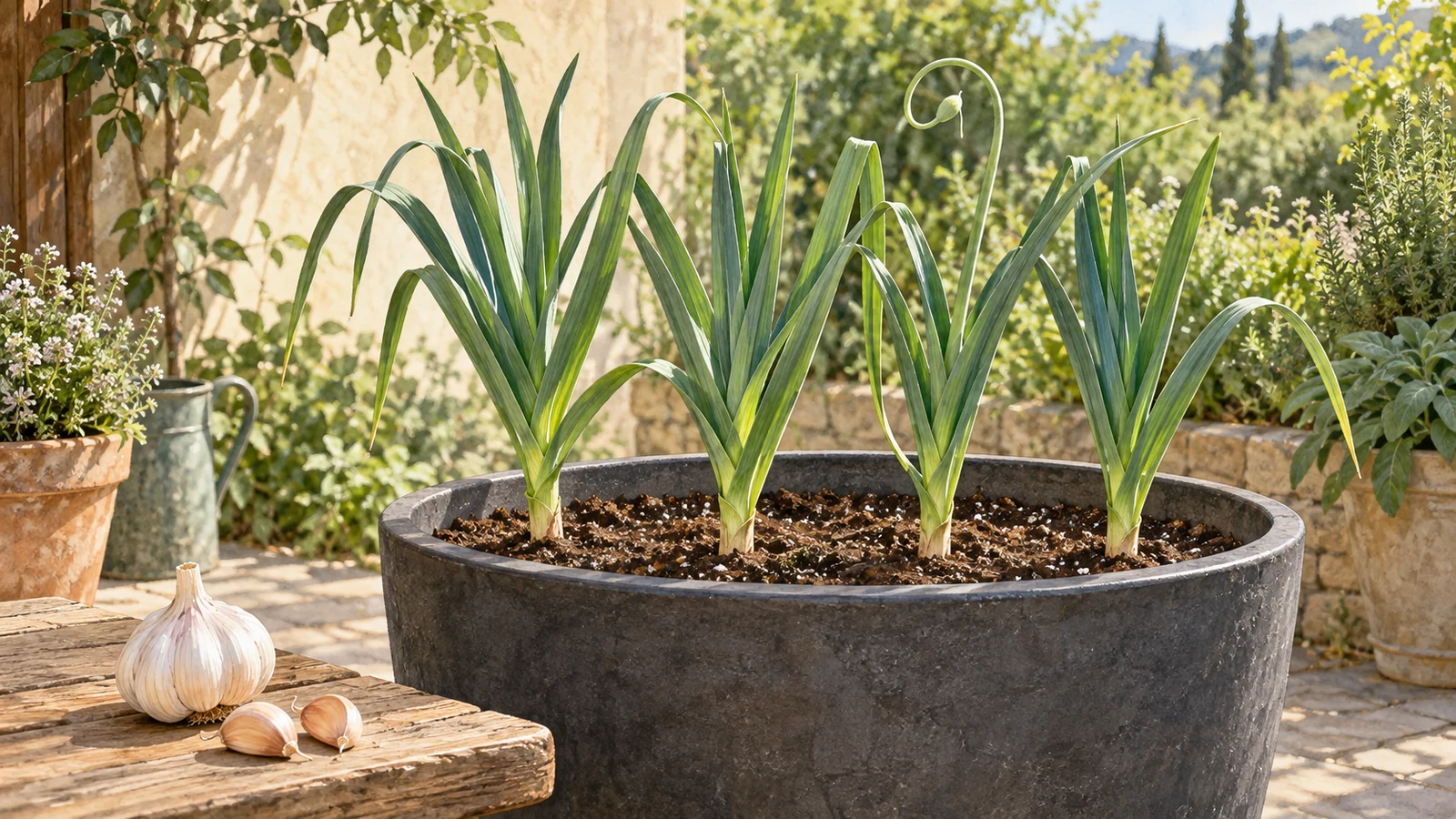
In autumn, the pot can look as though nothing is happening. A few cloves are tucked into the mix, their papery skins still on, and most of the work is out of sight. By spring there should be leaves. By summer, each successful plant may have a bulb worth lifting.
That long occupation is the first thing to plan for. Garlic is a good small-space crop when a container can stay in a sunny growing place across seasons. It is less convenient when that same pot is already promised to early spring lettuce or a tomato transplant.
Before fall planting, count spaces rather than cloves
True bulb garlic is Allium sativum. It is different from garlic chives, which are grown for repeated leaf harvests. A windowsill clove producing a few greens is also a different project from raising a mature, divided bulb outdoors.
The Royal Horticultural Society recommends a container at least 10 inches deep and roughly 6 inches between cloves. Width matters as much as depth. Mark the proposed planting spots across the actual soil surface before buying a large quantity of planting stock. Leave room near the edges instead of filling every gap with another clove.
Use a durable pot with drainage holes and a suitable container medium. Keep it stable and within the weight limit of its patio or balcony. A deep planter can be heavy when wet, so choose its position before filling it. Garlic needs substantial direct light: Maryland Extension specifies at least six hours, with more preferred.
One clove is one potential plant, not a promise of a supermarket-sized bulb. A useful first crop is small enough to water, protect and inspect without competing for every available corner.
Choose planting garlic for your winter
Buy named planting stock from a reputable source. A grocery bulb may sprout, but its suitability for your climate and disease history are uncertain. Maryland Extension warns that food-market garlic can carry disease without showing symptoms.
Hardneck garlic generally offers a central flower stalk, or scape, as well as the bulb. Softneck types commonly have more cloves and flexible tops. Choose among varieties that perform well locally. Minnesota Extension specifically cautions cold-climate growers against assuming commercial garlic from a milder region will do well there.
Ask the supplier about local planting time and cold requirements. Fall planting lets suitable garlic root before winter and develop through spring. But a Minnesota recommendation tied to the first killing frost is not a universal date for Maryland, a mild coastal garden or a hot-winter region.
For mild climates, get a locally suitable variety and any required chilling instructions before purchasing. Do not improvise a refrigerator treatment and assume it replaces the right cultivar and planting season.
Plant with the root end down
Separate the bulb shortly before planting, preserving the skins around sound cloves. Discard damaged or suspect pieces. Set each clove with its flatter basal end downward and pointed end upward.
Planting depth is regional. Maryland advises covering cloves with 1–2 inches of soil; follow locally appropriate guidance for your conditions and planting stock. Water after planting to settle the medium, then check moisture rather than watering because another week has passed.
Add a label with the cultivar and planting date where it will survive the weather. It gives you something concrete to compare at harvest, particularly if two varieties share a larger planter. Keep the cloves separated even when the empty surface makes the planting look sparse.
Winter is a container problem as well as a garlic problem
Garlic’s need for cold does not mean an exposed pot tolerates every freeze. Maryland’s container-growing guidance explains that above-ground root zones experience larger temperature swings than garden soil.
In a severe-winter climate, settle the protection plan before planting. Ask local Extension whether your container can remain outside, needs insulation or a protected cold location, or is unlikely to overwinter reliably on that balcony. Moving it into a warm living room is not the same as providing a cold growing season.
Keep drainage open and check the medium during thawed, dry periods. Rain may miss a pot under an overhang. A mulch can help moderate conditions, but it cannot compensate for a waterlogged container or make a small exposed pot behave like a garden bed.
Resist pulling up a clove to see whether it has roots. A label, a stable location and occasional moisture checks are more useful than repeated disturbance during the quiet part of the year.
Spring is when the leaves earn the bulb
As growth resumes, check water more often. Wet the medium thoroughly when needed and allow surplus water to leave; do not interpret every pale leaf as an instruction to add water or fertilizer.
Minnesota’s garlic planting advice explains why applying all the nitrogen in fall can waste it before the main growth period. For a pot, account for the nutrients already in the mix and follow an edible-container fertilizer’s directions. Commercial field rates are not doses for a planter. Avoid heavy late feeding as bulb development approaches.
Remove small weeds by hand without digging among the cloves. If a hardneck plant produces a curling scape, it can be cut for kitchen use while retaining the leaves that support the bulb. Do not repeatedly harvest the main foliage as though this were a pot of chives.
Let the leaves start the harvest conversation
As the bulbs fill out and harvest approaches, ease off watering. Maryland Extension recommends less frequent watering at this stage to reduce disease problems; a maturing crop should not stay constantly wet.
Watch for lower leaves browning while several upper leaves remain green. Minnesota Extension advises beginning harvest around this stage, rather than waiting for the whole plant to collapse. Check a bulb: the cloves should have filled out while their wrappers still hold together.
Loosen the medium and lift carefully instead of yanking on the stem. Handle the bulbs gently. Set aside damaged ones for prompt use if sound; do not store diseased or rotting bulbs with the healthy harvest.
Cure the healthy plants with tops attached in a dry, airy place sheltered from direct sun and rain. Let the wrappers and necks dry before trimming. The exact interval depends on conditions, so a fixed date alone does not establish that a bulb is ready for storage. Keep cured garlic in a dry, ventilated place and inspect it periodically.
Finally, compare the bulbs with that autumn label. If they are small, consider the variety, spacing, winter conditions, light and planting date before deciding to feed more heavily next time. The empty pot marks the end of a long project; the notes make the next one easier to plan.
Sources
- How to Grow Garlic (Royal Horticultural Society). Accessed September 12, 2026.
- Growing Garlic in Home Gardens (University of Minnesota Extension). Accessed September 12, 2026.
- Growing Garlic in a Home Garden (University of Maryland Extension). Accessed September 12, 2026.
- Growing Vegetables in Containers and Salad Tables (University of Maryland Extension). Accessed September 12, 2026.
- Tips for Garlic Planting Season (University of Minnesota Extension). Accessed September 12, 2026.