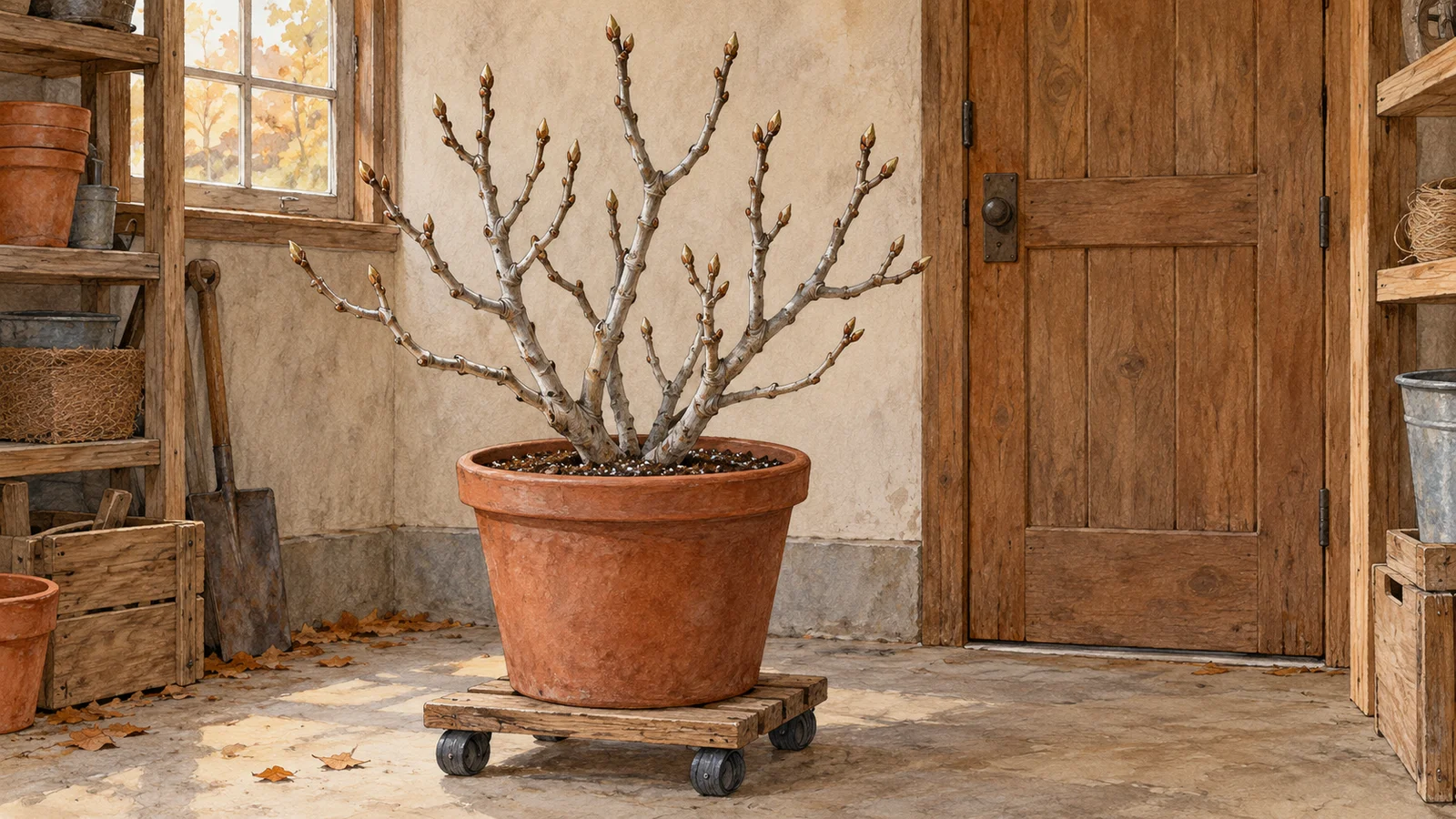
The pot that spent summer beside the patio may need a very different winter address. An edible fig can lose its leaves and rest in cool shelter; bringing it into a warm living room can start growth before you have a suitable place for that growth to live.
This is a winter plan for common fig, Ficus carica, grown in a movable container where outdoor winters are too cold. It is not a care routine for a tropical fiddle-leaf fig. Keep the nursery label with the pot so the species and cultivar remain identifiable after the leaves have fallen.
Choose the winter space before moving day
A cold-hardy cultivar name does not make an exposed root ball winter-proof. Maryland Extension notes that roots above ground are more vulnerable to cold damage. A tree that survives beside a sheltered wall in the ground may fare differently in a pot on an open deck.
Look for an unheated but insulated garage, cool basement or similar sheltered space. Virginia Cooperative Extension recommends a dark, unheated, insulated room for dormant container figs. The useful feature is a cool, protected environment, not the word “garage”: an uninsulated outbuilding can still become dangerously cold.
Raintree Nursery’s potted-fig guidance gives 35–45°F (about 2–7°C) as a useful storage range. Put a minimum–maximum thermometer near the pot and check what actually happens through cold nights and mild afternoons. A warm furnace room and a freezing shed are not interchangeable winter homes. If neither available space stays suitable, arrange another protected location before severe weather arrives.
Leave access to the soil surface and drainage holes. Do not stack boxes around the tree so tightly that checking moisture becomes a chore, or park it where opening the door will strike the branches. Clear the route and check the pot’s weight before lifting it; use help or a suitable plant dolly for a heavy container.
Move as the leaves change, before severe cold
Yellowing and leaf fall in autumn are normal parts of this deciduous fig’s cycle. New Hampshire Extension recommends moving container figs when the leaves begin to turn or before the first killing frost. Follow local conditions rather than waiting for a date printed on a calendar.
You do not need to leave a movable pot outside through a hard freeze to prove that winter has begun. Once the tree has shed its leaves, clear fallen foliage and any remaining unripe fruit. Move the container itself; do not tug the tree along by a branch or trunk.
Before lifting a pot that stood on soil all summer, look underneath. Maryland Extension warns that roots can escape through drainage holes and anchor a container to the ground. Do not assume a pot is free to move simply because it has handles. Plan future summer placement on a firm surface or stable supports that keep those roots from growing into the bed.
Leave major reshaping for a deliberate pruning session instead of cutting every branch that makes storage inconvenient. When handling broken or cut stems, wear gloves and avoid contact with the milky sap. NC State’s common-fig profile identifies sap-related skin irritation. Keep children and pets away from cuttings and cleanup debris.
Keep the roots moist enough to survive the rest
A leafless fig uses much less water than a tree carrying a summer canopy. It still has living roots. Start by feeling the mix rather than pouring the amount you used in August.
Illinois Extension advises infrequent watering when the upper two to three inches feel dry, enough to keep the roots hydrated. If that layer is still moist, wait. When water is needed, moisten the root zone without leaving the pot standing in runoff. A closed decorative outer container needs checking too; drainage from the inner pot is useless if the water remains trapped around it.
There is no single winter watering interval. New Hampshire describes possible one- or two-week intervals, while Virginia’s guide describes monthly watering. Pot size, mix and storage temperature explain why a calendar alone cannot decide. Set reminders to check, then record whether you actually watered. If the mix stays wet from one visit to the next, inspect the drainage and reduce watering rather than adding another scheduled dose.
Watch for buds opening before spring is ready
Check the branches while checking the mix. Swelling buds and unfolding leaves change the situation: a growing plant should not remain forgotten in a dark storage corner. Raintree recommends moving an early-starting fig into a bright position while keeping it cool; excessive warmth with little light encourages stretched growth.
In spring, use mild days for short outdoor visits and return the tree to shelter when frost threatens. Increase its outdoor time and sun exposure gradually over a few weeks, as New Hampshire recommends. Watch the forecast as well as your area’s usual last-frost date. Fresh leaves grown under cover need that transition before the tree returns to its sunny summer position.
Keep the thermometer and your watering notes for next winter. They tell you whether this particular storage spot stayed cool and whether the pot dried slowly or surprisingly fast. Use those observations when choosing next winter’s location and check reminders.
Sources
- Is it possible to grow an edible fig in a container? (University of New Hampshire Extension). Accessed October 23, 2026.
- Growing Figs in Maryland (University of Maryland Extension). Accessed October 23, 2026.
- Backyard Figs in Virginia: A Grower’s Guide (Virginia Cooperative Extension). Accessed October 23, 2026.
- Go figure, figs are a great addition to home gardens (University of Illinois Extension). Accessed October 23, 2026.
- November Growing Tips (Raintree Nursery). Accessed October 23, 2026.
- Ficus carica (North Carolina Extension Gardener Plant Toolbox). Accessed October 23, 2026.