A plant on a desk is often advertised as a natural productivity tool, stress treatment, and air purifier in one pot. A randomized office trial published on August 18, 2026, offers a more useful answer: workers with added plants rated their indoor environment a little more favorably and showed changes in some pupil-response measures, but they reported no productivity advantage during the study.
That mixed result is not a failure. It helps separate the plausible benefit of making a workplace feel better from claims the experiment did not establish.
What the researchers tested
The new trial in Environments was conducted in modern offices across five buildings in Porto, Portugal. Researchers assigned offices to an intervention or control group. Twelve intervention offices received plants; eleven control offices did not. The study involved 130 workers, with 75 in the intervention group and 55 in the control group.
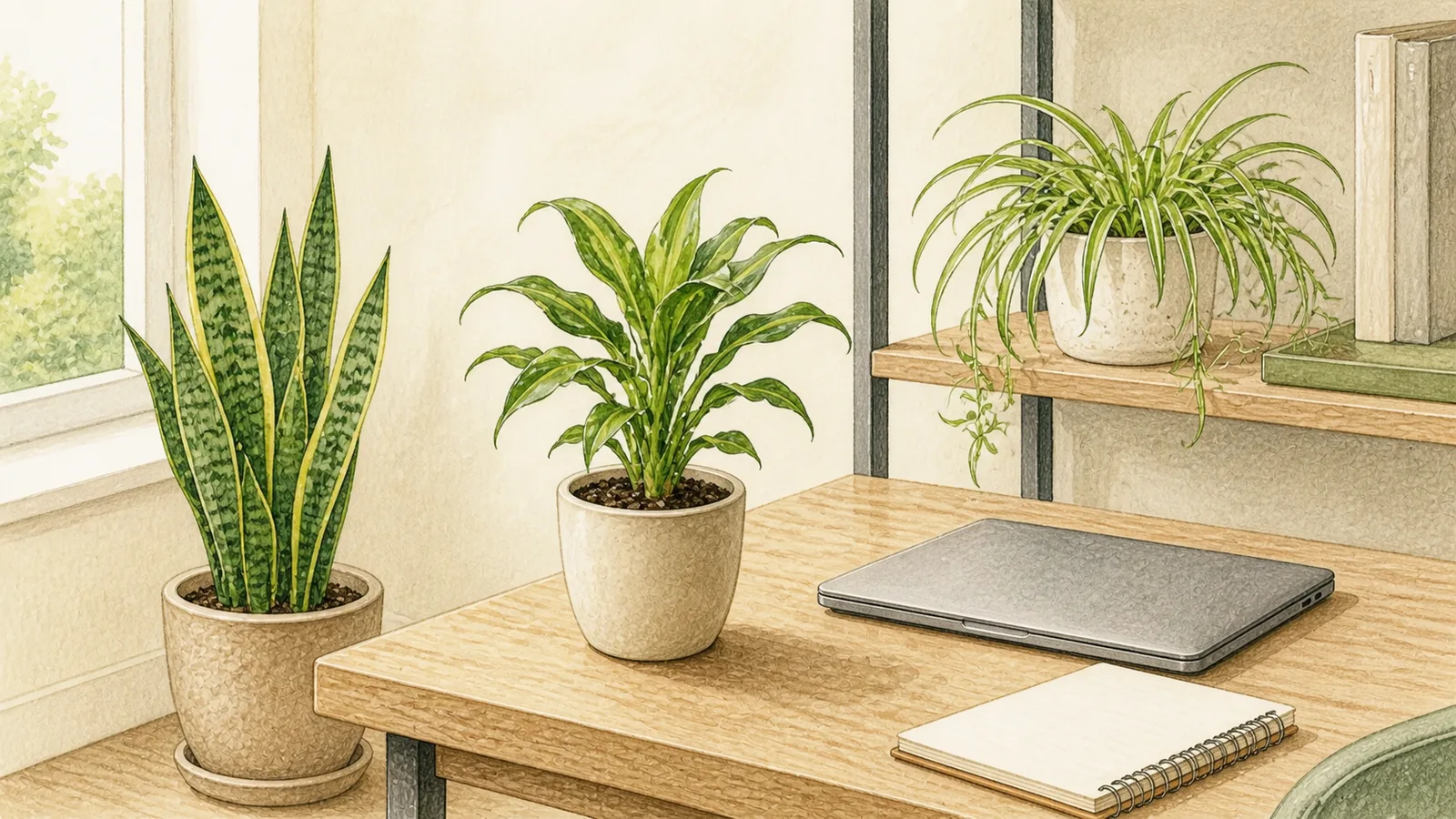
Researchers used three familiar houseplants:
- snake plant, listed in the paper as Sansevieria trifasciata;
- corn plant, Dracaena fragrans;
- spider plant, Chlorophytum comosum.
The pots averaged about 40 centimeters tall and were placed at roughly one plant per nine square meters. Plants sat where workers could see them: on desks, windowsills, or floors. Researchers cared for the plants during the intervention.
Measurements occurred before the plants were introduced and after a 14-day intervention. The team evaluated worker questionnaires, indoor environmental conditions, and pupil responses. Offices continued their normal window-opening practices. Several conditions could vary in the real workplaces, including temperature, light, ventilation, noise, and outdoor influences.
No self-reported productivity advantage
There was no significant difference in self-perceived productivity change between the groups. Seventeen percent of workers in the plant group reported improved productivity, compared with 25 percent in the control group. Average ratings were 3.1 in the plant group and 3.2 in the control group, with a p-value of 0.176. That pattern does not support a claim that adding these plants created a self-reported productivity advantage over two weeks.
The measurement was also narrower than a count of completed work. Participants rated whether their productivity over the previous two weeks had become worse, stayed the same, or improved. The study did not count assignments, measure errors, or test the quality of each employee’s output. It therefore assessed perceived change in productivity, not direct work production.
This finding matters because “boosts productivity” is one of the easiest plant claims to repeat and one of the hardest to define. Productivity can mean task speed, error rate, output, concentration, or a worker’s perception of performance. A short office intervention also competes with deadlines, team dynamics, sleep, workload, temperature, noise, and countless other influences.
The study does not prove plants can never affect work. It shows that this plant mix, density, placement, duration, and group of offices did not produce a measurable self-reported productivity advantage under the study conditions.
Environmental satisfaction improved modestly
Workers in the intervention group gave overall indoor environmental quality an average score of 3.4, compared with 3.1 in the control group. Thirty-nine percent of the plant group reported improvement in overall indoor environmental conditions, versus 15 percent of the control group.
That is a modest but relevant result. A visible plant can change how a room looks and feels even when it does not transform the work performed in that room. The response can still matter to someone choosing between an empty corner and a well-kept plant, but it should not be converted into a promise about output or health.
The authors also examined pollutants and environmental variables. Reductions in carbon dioxide, particulate matter, and volatile organic compounds were not significant predictors of environmental satisfaction or productivity in either group. Ordinary potted plants should not replace source control, adequate ventilation, filtration, or building maintenance. The EPA’s office guidance prioritizes identifying pollutant sources and maintaining ventilation systems rather than relying on decorative plants as treatment equipment.
What changed in reported well-being?
Both groups began with nearly identical scores on the WHO-5, a five-question self-report measure of recent mental well-being. After the intervention, scores fell slightly in both groups: from 67.1 to 63.2 in the plant group and from 67.2 to 62.9 in the control group. Neither change reached a 10-point change on the 0–100 scale, a threshold used in WHO-5 literature to indicate a clinically meaningful difference.
At the same time, 32 percent of participants in the plant group described a positive change in well-being, compared with 20 percent in the control group. A statistical model found an association between reduced volatile organic compounds and improved well-being in the plant offices.
One number in the paper requires particular care. The model explained 20.6 percent of the variance; it did not show that plants improved well-being by 20.6 percent. The association was also near the usual threshold for statistical significance, and the field setting contained uncontrolled differences. This is a reason to investigate further, not a precise benefit a shopper can expect from buying a plant.
What the pupil measurements suggest
Researchers used a portable pupillometer to measure how pupils responded to light. In the intervention group, initial and final pupil diameter decreased and constriction amplitude increased. The authors describe that pattern as consistent with greater parasympathetic activity, which can accompany a more relaxed physiological state.
Pupil response is an objective measurement, but it is not a diagnosis of stress, anxiety, or mental health. Not all pupil measures changed, the control group did not show the same significant changes, and no significant association appeared between changes in environmental perceptions and the pupil measures.
The restrained interpretation is that some physiological signals moved in an interesting direction during the plant intervention. The experiment does not establish that a snake plant treats stress or that a particular number of pots produces a guaranteed nervous-system response.
How this fits with earlier evidence
The broader research record is promising but uneven. A 2022 systematic review and meta-analysis examined 42 studies of objectively measured functions associated with indoor plants, but only 16 supplied data for meta-analyses. The authors found some positive results while emphasizing that each pooled outcome relied on very few studies and that interventions, participants, settings, and measurements varied substantially.
A 2023 systematic review of nature in offices likewise found that workplace nature studies use varied designs and outcomes. A plant on one desk, a room full of greenery, a window view, a simulated image, and a green wall are not equivalent exposures. Results from one should not be silently applied to all the others.
The new Porto trial improves the evidence by testing real offices, assigning offices to intervention and control groups, and combining questionnaires with environmental and physiological measurements. Its realism is also a limitation: researchers could not hold every office variable constant, and the intervention lasted only 14 days. Workers could see whether plants had arrived, so expectations or the novelty of a visible change may have influenced subjective responses. Hybrid work also reduced consistent participation across phases.
A practical office-plant decision
The study supports treating plants as environmental design, not equipment with a promised return on investment. Choose an office plant when it fits the space and the people using it.
Use these checks:
- Start with usable light. Match the plant to measured or observed light rather than choosing only from a study species list. A struggling plant is unlikely to improve anyone’s experience.
- Put it where it is visible but safe. Keep foliage away from walkways, emergency equipment, electronics, and crowded work surfaces.
- Assign care. Define who checks moisture, empties standing water, removes damaged leaves, and reports pests. Shared plants often fail when everyone assumes someone else is watering.
- Avoid water damage. Use a sound container and saucer, protect furniture, and water away from electrical connections.
- Inspect for pests. A plant with fungus gnats, scale, mealybugs, or spider mites can make the workplace less pleasant. Follow a consistent nursery inspection and isolate a new arrival when practical.
- Respect workplace needs. Consider allergies, fragrance sensitivity, accessibility, pets in home offices, and any building rules.
- Evaluate the right outcome. Ask whether the room feels more welcoming and whether the plant is easy to maintain. Do not expect a two-pot desk setup to fix ventilation, workload, or acoustic problems.
What this means for your office
The new trial provides a grounded reason to add plants to an office: people may like the environment more, and some physiological responses deserve further study. It does not show a self-reported productivity advantage, a clinically meaningful well-being improvement, or a dependable air-cleaning effect from ordinary pots.
That leaves a perfectly respectable role for office plants. They are living elements that can make a room feel considered, softer, and more connected to nature. Buy them for that experience, care for them well, and let future research rather than marketing shorthand decide how far the measurable benefits extend.
Sources
- Nature-Based Solutions for Office Workers: A Randomized Controlled Trial on Indoor Plants to Enhance Well-Being and Productivity (Environments). Accessed August 24, 2026.
- The World Health Organization-Five Well-Being Index (WHO-5) (World Health Organization). Accessed August 24, 2026.
- The WHO-5 Well-Being Index: A Systematic Review of the Literature (Psychotherapy and Psychosomatics). Accessed August 24, 2026.
- Effects of Indoor Plants on Human Functions: A Systematic Review with Meta-Analyses (International Journal of Environmental Research and Public Health). Accessed August 24, 2026.
- Nature in the Office: A Systematic Review of Nature Elements and Their Effects on Worker Stress Response (Healthcare). Accessed August 24, 2026.
- An Office Building Occupant’s Guide to Indoor Air Quality (U.S. Environmental Protection Agency). Accessed August 24, 2026.