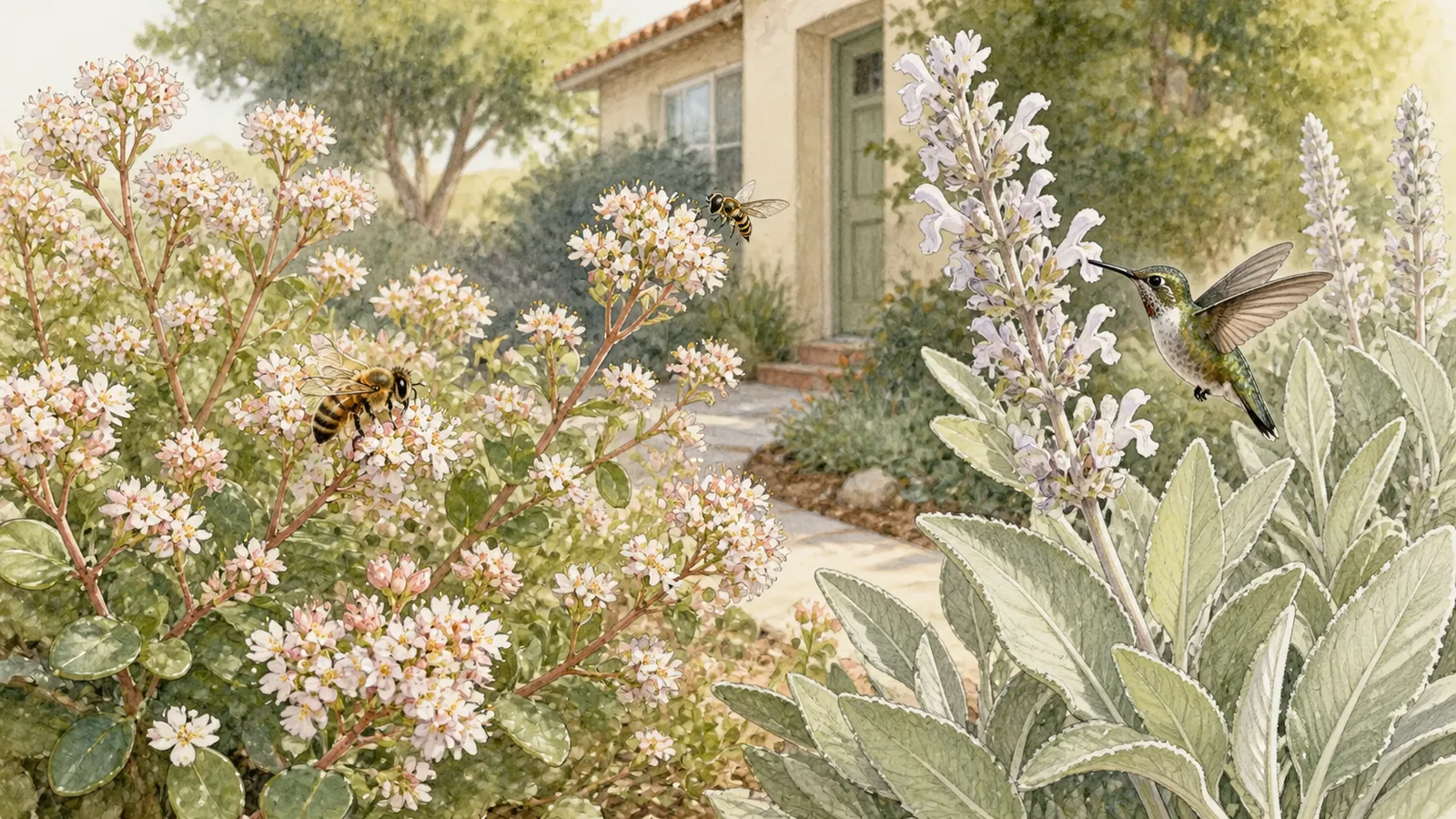
Replacing part of a lawn with native flowers can feel like a small household choice. In an observational study of 31 residential yards across Greater Los Angeles, models that accounted for repeated visits and survey duration found 4.2 times the floral-visitor abundance and 1.5 times the visitor-family richness in native yards compared with conventional yards.
The distinction in that sentence matters. Researchers observed animals visiting flowers. They did not measure how much pollen each visitor transferred, how many seeds formed, or whether every visitor was an effective pollinator. The result is strong evidence that the sampled native yards offered a busier, more diverse floral network, not proof that any one native plant will multiply pollination by four.
What the researchers observed
The open-access study in Urban Ecosystems surveyed yards from April through September 2023. The design included nine pairs of nearby properties, with one native-landscaped yard and one conventional yard in each pair. Researchers also sampled 13 additional native yards in lower-income neighborhoods, for 31 yards total.
Each yard received three visits across spring, summer, and fall. During timed searches, the team recorded insects and birds seen visiting flowers and collected information about plants, flower colors, temperature, air quality, yard size, and neighborhood conditions.
The paper reports several related analyses, and their samples should not be blended:
- Across all 31 yards (22 native and nine conventional), native yards had 4.2 times the recorded floral-visitor abundance averaged across visits and 1.5 times the visitor-family richness; the repeated-measures models adjusted for survey duration.
- In the separate nine-pair analysis, native yards had 2.36 times the abundance (
p = .01). The 1.40-times richness difference was a nonsignificant trend (p = .09). - The pooled networks from those nine matched pairs contained 140 unique plant-species–visitor-family links in native yards versus 48 in conventional yards, a 2.9-fold difference.
- Across the full dataset, native plants received 88 percent of recorded floral visits while accounting for about 80 percent of flowering-resource availability, measured from flowering occurrence across survey events.
Bees in the family Apidae and hoverflies in the family Syrphidae drove much of the difference. Hummingbirds and other flower-visiting groups were also included. California buckwheat (Eriogonum fasciculatum) and white sage (Salvia apiana) were important hubs in the observed interaction networks.
Why the paper says “floral visitors”
It is tempting to shorten the result to “four times more pollinators.” The authors use more precise language because an animal landing on a flower is not the same as confirmed pollen transfer.
A visitor may collect nectar, pollen, or another resource. It may move pollen effectively, carry little pollen, or visit flowers in a way that does not fertilize them. The study used visual observations and did not test pollen loads, fruit set, or seed production.
That does not make the observation unimportant. More visits across more plant-and-animal connections can indicate a richer feeding network and more opportunities for ecological interactions. It simply means the measured outcome was visitation, not a guaranteed crop-yield increase.
What was different about the native yards
The native landscapes did not differ only by the origin of one plant. They contained a substantially different flowering community. The paper reports that native yards had 1.7 times as many flowering plant species and 14.5 times as many native flowering species. Conventional yards had 5.8 times as many nonnative flowering species.
Flowering plant richness was the strongest predictor of floral-visitor abundance and richness. Native plant richness, flower-color diversity, and other variables also helped explain patterns for particular groups.
This points to a useful design lesson: adding one isolated native flower to an otherwise resource-poor yard may help, but the study’s strongest yards offered multiple flowering species and connections. A garden becomes a more dependable food stop when something appropriate is blooming across more than one week of the year.
The result is encouraging, not a universal multiplier
This was an observational study, not a randomized landscaping experiment. Homeowners had already chosen and managed their yards. Native and conventional properties may have differed in ways the researchers could measure and in ways they could not.
The work was also specific to Greater Los Angeles, with its Mediterranean climate, local plant communities, development patterns, and seasonal conditions. Some insects were identified at broad taxonomic levels. Observation time varied with yard size, and the study did not quantify every surrounding pesticide exposure or nearby patch of habitat.
Most importantly, the 4.2-fold figure is an adjusted comparison across the sampled yards, not a forecast for a yard in Maine, Georgia, Arizona, or even another Los Angeles block.
The correct household takeaway is not “plant California buckwheat everywhere.” It is “build a locally appropriate, flower-rich native planting and observe what uses it.”
Start with plants native to the local region
Native status depends on place. White sage belongs in parts of the Southwest, not in every North American garden. A plant that supports Los Angeles wildlife may be poorly adapted, ecologically irrelevant, or invasive somewhere else.
Use a regional source before buying. The USDA regional native-plant resource links plant choices to broad areas of the United States. The Xerces Society’s regional lists provide another starting point. State Extension programs, native plant societies, botanic gardens, and conservation districts can refine the list for local soils and climate.
Then screen each candidate for:
- native range, not merely a “wildflower” label;
- mature height and spread;
- sun, soil, drainage, and moisture needs;
- bloom period;
- whether the plant is host material for caterpillars or other insects;
- whether a straight species or locally sourced form is available;
- conflicts with pets, children, utilities, walkways, or neighborhood rules.
Avoid collecting plants from wild populations. Buy from a nursery or approved plant sale that can identify the species and source.
Build a small flower-visitor patch
A useful first conversion can be modest. Choose a section that can be maintained consistently rather than removing an entire lawn at once.
- Map the site. Record summer sun, drainage after rain, irrigation reach, foot traffic, and the mature space available.
- Choose several flowering species. Aim for different shapes and bloom periods rather than one large block of a single cultivar.
- Plan a sequence of bloom. Include locally suitable flowers for early, middle, and late season so the patch is not useful only during one brief peak.
- Plant in visible groups. Repeating several plants of a species can make flowers easier for visitors to find and gives the design a deliberate structure.
- Leave room for maturity. Crowded young plants can become an airless maintenance problem when they reach full size.
- Add water carefully, if appropriate. A shallow, clean source with landing stones can help wildlife, but standing water that breeds mosquitoes is not a benefit.
- Keep some shelter. Hollow stems, leaf litter, bare soil, shrubs, and other features can matter to different species. Apply local fire-safety and property rules.
A container can also contribute when ground planting is impossible. Use a pot large enough for the chosen species, group several containers if space permits, and expect them to need more frequent water than plants in the ground.
Reduce avoidable hazards
A yard marketed as pollinator-friendly can still expose visitors to pesticides, contaminated water, or poorly chosen plants. Use nonchemical prevention first: match plants to the site, maintain airflow, avoid chronic overwatering, inspect regularly, and tolerate some leaf damage when plant health is not threatened.
When control is necessary, identify the pest before treating. Read and follow the entire pesticide label, including the crop or ornamental use, application method, timing, protective equipment, and pollinator precautions. “Natural” does not automatically mean harmless to insects.
Buyers can also ask nurseries how flowering plants were treated and whether systemic insecticides were used. A label that says “pollinator plant” describes the plant’s potential; it does not document its production history.
Observe the garden as a network
The study’s interaction diagram is a helpful model for home observation. Instead of asking only whether “bees” arrived, record which visitor used which flower and when.
For ten minutes once a week, note:
- date, time, temperature, and cloud cover;
- plant species in bloom;
- visitor type, such as bumble bee, small bee, hoverfly, butterfly, beetle, or hummingbird;
- which flower it visited;
- whether it moved to another flower or plant;
- a photograph when it can be taken without disturbance.
Do not handle or trap an unfamiliar visitor. Community-science platforms and local experts can help with photographs, but an uncertain identification should remain uncertain.
After one season, gaps become visible. Perhaps the patch has many spring flowers and almost nothing in late summer. Perhaps one plant receives nearly every visit. Those observations can guide the next addition more effectively than buying another random “pollinator mix.”
The durable takeaway
The Los Angeles study did not prove that native landscaping produces the same result in every yard. It showed an observational association in the sampled residential landscapes: across all 31 yards and three visits, adjusted abundance and richness were higher in native yards; in the nine matched pairs alone, abundance remained higher while the richness contrast was a nonsignificant trend.
For a household, the useful strategy is regional and gradual. Replace a manageable patch, choose several locally native species suited to the site, spread bloom across the season, reduce hazards, and record what arrives.
One yard cannot restore an entire urban ecosystem. It can become one reliable stop in a larger network. The new data suggest that the plant choices within that stop matter.
Sources
- Native-plant landscaping enhances floral visitation by insects and birds in residential yards (Urban Ecosystems). Accessed August 24, 2026.
- Cal State LA study finds native plants boost urban pollinators (California State University, Los Angeles). Accessed August 24, 2026.
- Native Pollinator Plants by USDA Farm Resource Region (U.S. Department of Agriculture). Accessed August 24, 2026.
- Pollinator-Friendly Native Plant Lists (Xerces Society for Invertebrate Conservation). Accessed August 24, 2026.