A flowering vine can soften a fence, shade a seat, or turn a plain trellis into the center of a garden. It can also overwhelm a weak structure, disappear into a gutter, cross a property line, or become an expensive removal project.
The useful question is not simply, “Which vine looks good?” It is, “Which vine fits this region, attaches to this support, reaches an acceptable mature size, and can be maintained here for years?”
Answering in that order prevents the common mismatch of buying a plant first and improvising its support later.
Start with region and identity
Use the complete botanical name on the plant label, including the cultivar when one is given. Common names such as ivy, honeysuckle, clematis, trumpet vine, and wisteria can refer to plants with very different origins, cold tolerance, growth rates, and local status.
For a perennial vine, the USDA Plant Hardiness Zone Map is a first screen for winter cold. Its zones are based on average annual extreme minimum temperature. They do not describe summer heat, humidity, soil drainage, drought, salt exposure, wind, or every neighborhood microclimate.
Next, check the scientific name with a state or regional Extension source. Compare the plant’s needs with the actual site:
- direct sun and shade through the growing season;
- soil drainage and moisture;
- summer heat and reflected heat from walls;
- wind exposure;
- available root space;
- nearby trees, foundations, utilities, and property lines.
Then check current state agriculture or natural-resources invasive-plant lists. The USDA National Invasive Species Information Center links to federal, state, and regional resources but notes that its resources and lists are not complete or legally binding. Local rules and ecological behavior matter more than a national shopping list.
An aggressive plant is not automatically an invasive species. A locally appropriate vine can still sucker, self-seed, layer along the ground, or outgrow a small yard. That may be manageable on a large site and exhausting beside a narrow walkway. Ask how it spreads as well as whether it is prohibited.
Decide between annual and perennial vines
University of Illinois Extension separates vines into useful life-cycle groups.
Annual vines grow quickly for one season and usually die with frost. They can provide a summer screen without leaving a permanent woody framework. The yearly reset is useful for renters, experimental plantings, and supports that cannot carry years of accumulated growth. The tradeoff is replanting and retraining.
Herbaceous perennial vines return from enduring roots but may die back above ground each year. Their winter footprint can be smaller, though their roots and seasonal growth still need space.
Woody perennial vines retain stems and add structure over time. They can cover large arbors and walls, but their increasing weight, thickness, and reach require a permanent plan. Removing an established woody vine can be more difficult than pruning it.
Do not assume that an annual is always light or a perennial is always slow. A vigorous annual gourd can create a dense canopy and heavy fruit in one summer. Mature size, fruit load, and wind exposure still matter.
Match the climbing method to the support
Vines do not all climb the same way. Illinois Extension and University of Maryland Extension describe four broad attachment patterns.
Twining stems
The stem wraps around a pole, wire, trellis member, or another plant. A twining vine needs vertical or angled elements it can encircle. A solid wall offers nothing to wrap around.
Some species consistently wind clockwise or counterclockwise. Guide young growth in its natural direction instead of repeatedly forcing it the other way. Thick mature stems also need clearance; a narrow wire pressed against a woody stem can become constricting.
Tendrils or grasping leaf stalks
Tendrils and modified leaf stalks grab slender supports. Broad lumber alone may be too wide. Illinois Extension recommends lattice or wire about three-quarters of an inch wide or narrower for tendril climbers.
A wire grid, mesh panel, or thin trellis can work well, provided it is strong enough for the mature canopy and spaced so pruning hands can reach both sides.
Clinging roots or adhesive disks
These vines attach directly to a surface. That can create a smooth green wall, but it also makes the building part of the support system. Adhesive disks grip the surface, while rootlets or stems can exploit loose joints and existing openings. Direct attachment can complicate painting or repairs and leave material behind after removal.
Sound masonry is different from crumbling mortar. Wood, siding, stucco, roof edges, shutters, vents, and gutters present additional moisture and access risks. A plant label that says “self-clinging” does not mean “safe for every wall.”
Scrambling or sprawling stems
Some plants lean, hook, or arch through neighboring growth without true climbing organs. They must be tied, woven, or trained onto a support. Use broad, adjustable ties that do not cut into expanding stems, and inspect them during the growing season.
The support should be selected for the attachment method before planting. Repeatedly tying a strong twiner to decorative string or expecting a tendril vine to grip a wide post creates unnecessary maintenance.
Design for mature weight and wind
The small nursery pot is not the design load. Consider the mature woody framework and the pressure of wind against a leafy screen. If the vine bears heavy fruit or the site receives snow or ice, ask the support designer to account for those additional local loads.
Utah State University Extension notes that an unchecked mature Virginia creeper can weigh hundreds of pounds and exert significant wind pressure. That is a species example, not a universal number, but it shows why a lightweight fan trellis may be inadequate for a long-lived woody vine.
Use these support categories as a planning guide:
- Light seasonal trellis: suitable for a modest annual or light herbaceous vine when firmly anchored.
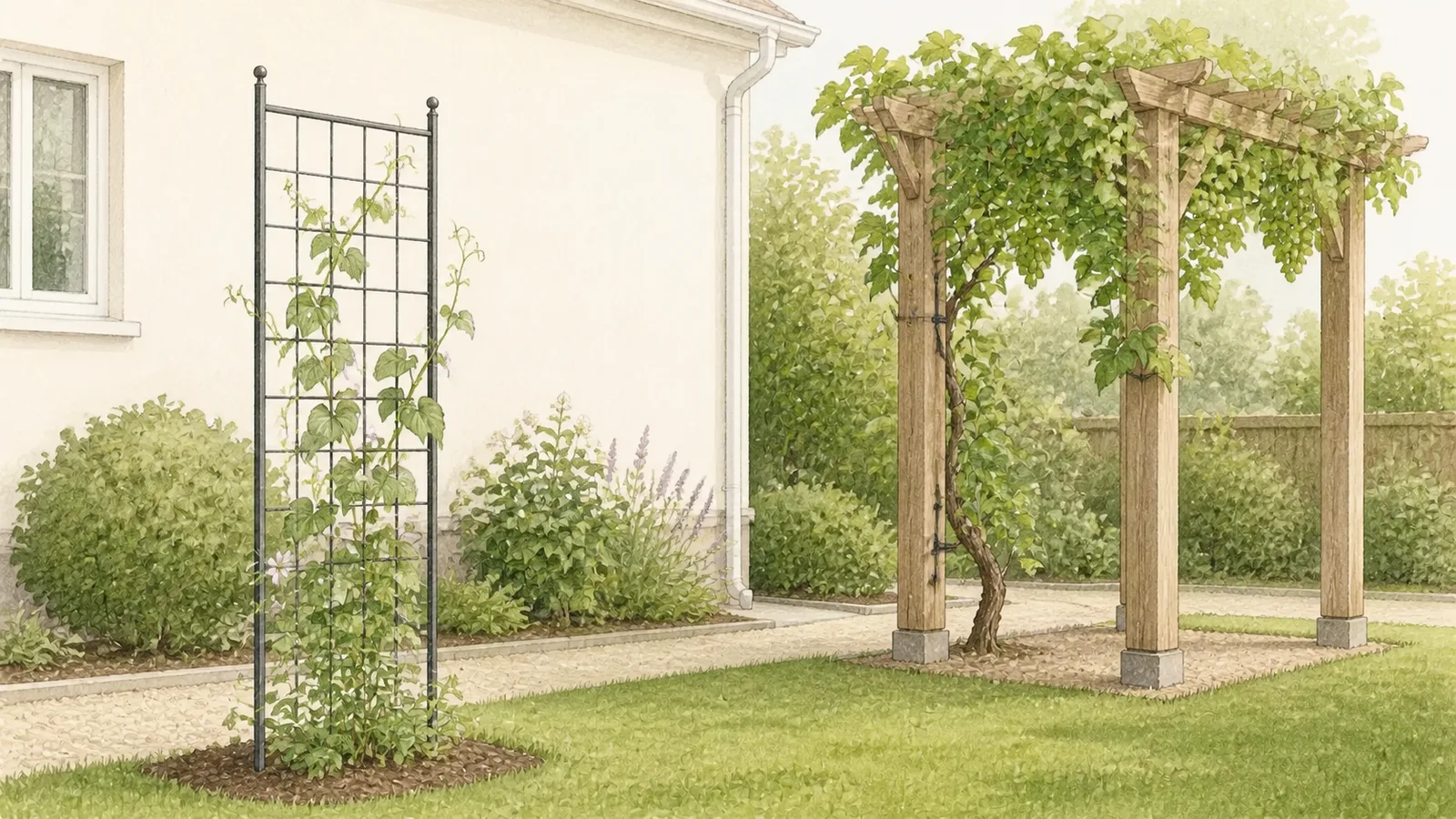
- Freestanding permanent trellis: keeps growth away from siding and allows access to both plant and wall.
- Fence: usable only when the ownership, condition, material, property-line rules, and future maintenance permit it. Confirm ownership and obtain permission where required before attaching anything.
- Arbor or pergola: must carry mature plant load and weather forces while remaining safe below. Use a support designed or professionally evaluated for the anticipated loads when capacity is uncertain.
- Building-mounted cable or lattice: anchors, wall condition, clearance, drainage, and access must be designed together. Decorative fasteners are not structural engineering.
Install and anchor the permanent support before the root area becomes crowded. Leave enough distance from a building to prune, paint, inspect, and maintain airflow. Illinois Extension suggests a separate trellis four to six inches from a building as one approach, but the correct clearance and anchors depend on the wall, support, vine, and local construction.
Keep vines away from critical access
Even a well-supported vine needs boundaries. Do not place it where growth will cover:
- electrical meters, gas meters, shutoff valves, or utility panels;
- dryer, kitchen, bathroom, or attic vents;
- gutters, downspouts, roof edges, flashing, or drainage paths;
- windows, doors, locks, cameras, lights, or address numbers;
- air-conditioning equipment or service clearances;
- damaged masonry, loose siding, or rotting wood;
- septic components, easements, drains, or underground utility routes.
Keep vines well away from overhead lines. Do not install, train, prune, or remove a vine when the plant, support, or tools could contact or approach an energized line. Penn State Extension warns that branches contacting high-voltage lines can cause outages and that people climbing trees into energized lines can be electrocuted; contact the utility for guidance. Before digging post holes, NC State Extension recommends using the local 811 process. Follow the notice and marking rules for the location.
Trees are not neutral trellises. University of Maryland Extension warns that aggressive vines can shade or damage trees and shrubs. Keep vigorous vines off valued trees unless a qualified local source specifically supports the pairing.
Budget the yearly maintenance
A vine is not finished when it reaches the top of the trellis. Its placement remains safe only while growth stays within the planned area.
Build these jobs into the choice:
- Train new shoots. Redirect them before they enter siding, gutters, roof edges, shrubs, or a neighbor’s yard.
- Inspect ties and anchors. Loosen constricting ties and replace degraded cord, wire, screws, or brackets.
- Prune at the correct time. Flower buds may form on old wood or new growth depending on species. Generic winter pruning can remove the next bloom.
- Remove seedlings and suckers. Check beyond the original root area and dispose of propagating material according to local invasive-plant guidance.
- Inspect the structure. Look for leaning posts, rust, rot, cracked anchors, trapped debris, and areas hidden by dense foliage.
- Keep an exit plan. Know how the plant will be reduced or removed without damaging the wall, fence, or neighboring plants.
A large vine that needs several ladder sessions each year is a poor match for a household seeking low maintenance. A smaller cultivar on an accessible freestanding trellis may provide more enjoyment with less risk.
A final checklist before buying
Take a plant home only after confirming:
- the scientific name and cultivar;
- current local legal and invasive status;
- regional cold, heat, light, soil, and moisture suitability;
- annual, herbaceous perennial, or woody perennial life cycle;
- mature height, spread, stem thickness, and fruit load;
- twining, tendril, clinging, or scrambling attachment;
- a compatible, permanent, repairable support;
- safe distance from buildings, trees, utilities, and boundaries;
- realistic pruning, training, and removal needs.
The best outdoor vine is not the fastest or most dramatic plant on the nursery rack. It is the one whose growth habit, mature load, support, and long-term maintenance all fit the exact place where it will grow.
Sources
- Vines (University of Illinois Extension). Accessed August 24, 2026.
- Attachment Methods (University of Illinois Extension). Accessed August 24, 2026.
- Caring for Vines (University of Illinois Extension). Accessed August 24, 2026.
- Vines for Maryland Gardens (University of Maryland Extension). Accessed August 24, 2026.
- How to Use the Maps (USDA Plant Hardiness Zone Map). Accessed August 24, 2026.
- Invasive Species Lists (USDA National Invasive Species Information Center). Accessed August 24, 2026.
- Vines in the Landscape: Virginia Creeper (Utah State University Extension). Accessed August 24, 2026.
- Pruning for Utility Line Clearance (Penn State Extension). Accessed August 24, 2026.
- Extension Gardener Handbook: Landscape Design (NC State Extension). Accessed August 24, 2026.