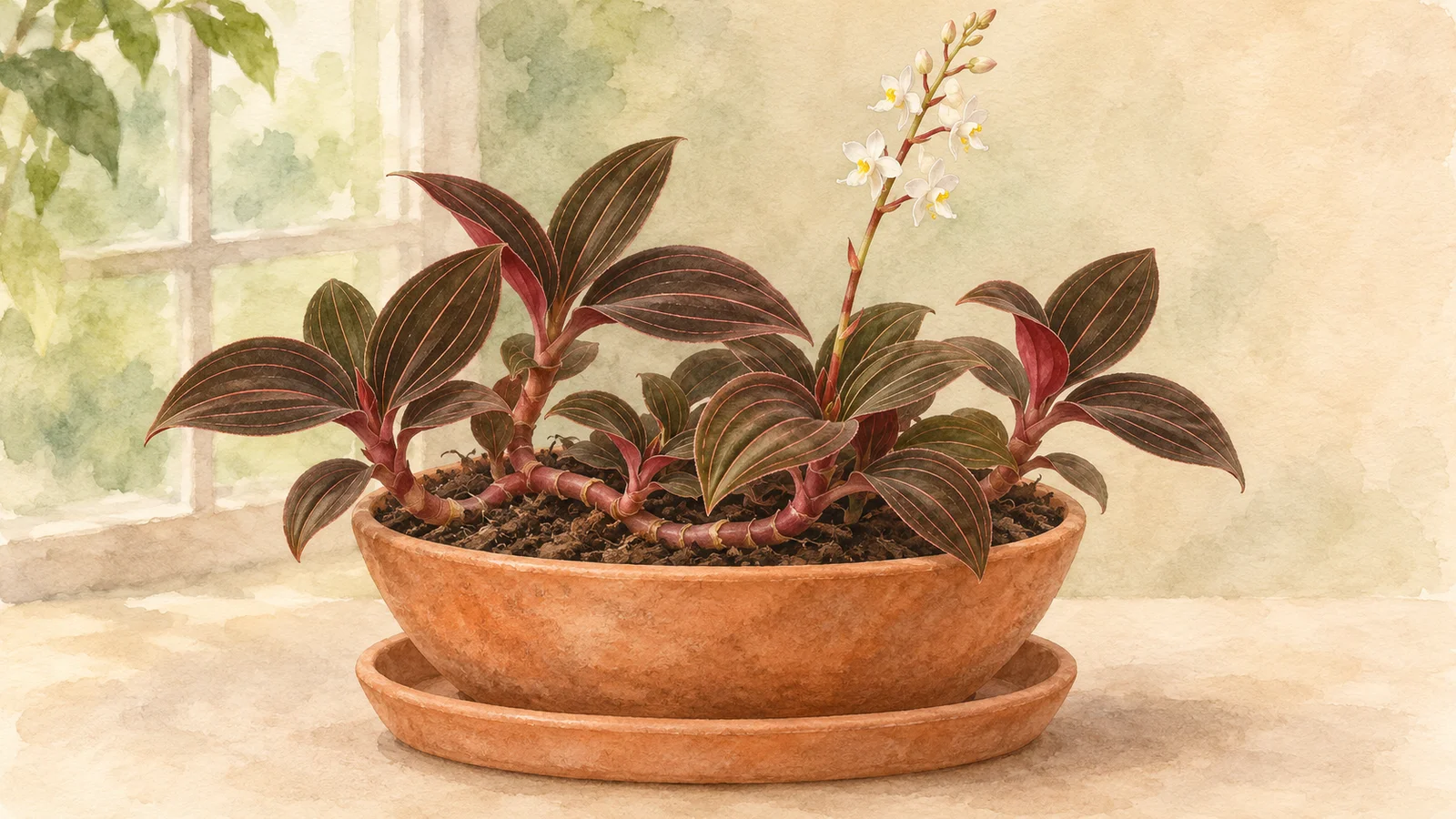
A jewel orchid can earn its place on a windowsill before a single flower opens. On Ludisia discolor, fine pale veins run across dark, velvety leaves, and reddish stems creep outward as the plant fills its pot. The white flowers arrive above that low foliage on slender stalks. Leave enough space overhead to see both parts of the plant.
The useful distinction is below the leaves: this is a terrestrial orchid, rooted in a growing medium on the ground in its natural habitat. A healthy moth orchid in chunky bark is not a watering model for every orchid beside it. Start with the name on the label, then choose the pot and care around Ludisia’s roots.
Check which jewel orchid you have
“Jewel orchid” is a common name used for more than one kind of orchid. Keep the nursery’s botanical label, especially if you buy a small cutting with only a few leaves. Advice for Ludisia discolor should not automatically become a care sheet for every patterned orchid sold nearby.
The Singapore National Parks Board describes Ludisia’s brownish to olive leaves, fine whitish or pink veins and reddish undersides. Its flowers are small and white with yellow centers. You are buying a foliage plant with a flower season, not a compact version of a large-flowered moth orchid. Choose a plant with firm stems and leaves that are securely attached; avoid a specimen collapsing at the soil line.
Choose a broad pot that can drain
A shallow, wide container gives creeping stems somewhere to go. NC State Extension recommends this shape and warns that wet soil can quickly rot the plant. A pot’s width is useful only if water can escape: check the drainage holes and make sure a decorative outer container does not conceal a reservoir underneath.
Use a loose mix suited to terrestrial orchids or a well-draining houseplant mix. The American Orchid Society suggests a medium like one used for African violets. NParks likewise includes African-violet mix among its options. Avoid assuming that a bag labeled simply “orchid bark” is automatically the best fit; check whether it is intended for terrestrial plants or orchids grown with very open roots.
When the plant needs more room, choose a container that accommodates its existing roots and outward growth without adding a large mass of unused wet mix. Handle the fleshy stems carefully. If the plant is healthy and flowering, the American Orchid Society identifies after flowering as a suitable opportunity to transplant it.
Find gentle light and a warm position
Ludisia belongs near useful daylight, away from harsh direct sun. A softly lit window or a position behind a sheer curtain can work better than a hot, exposed pane. The Royal Horticultural Society lists partial shade and a warm, sheltered setting. Its H1A rating describes a plant kept under glass with temperatures above 15°C, about 59°F; it is not a frost-hardy garden orchid.
Check the actual position at night. Move the pot clear of cold glass and away from a heating vent. If the plant needs more light, make the change gradually rather than moving it straight into strong sun. Do not try to compensate for a dark corner with fertilizer. The leaves still need light to support growth.
Keep moisture in the mix, with air around the roots
The goal is a lightly moist root zone that drains freely. Before watering, feel the surface and a little way beneath it. Water as the upper mix starts to lose moisture, before the whole pot becomes a dry, shrunken block. If it is still wet, wait and check again.
Watering wording varies among references: the American Orchid Society emphasizes even moisture, while the RHS advises allowing compost to dry between waterings. The practical common ground is to avoid repeatedly soaking an already wet pot. Use the condition of your own mix and plant, rather than turning either phrase into a fixed weekly schedule.
Apply water across the mix, let it run through the drainage holes, and empty the saucer. University of Missouri Extension explains that pot size, temperature, light and humidity all change how quickly a root ball dries. A Ludisia that used water quickly in summer may take longer in a cooler, dimmer room. High humidity does not remove its need for drainage or air movement.
NC State recommends orchid fertilizer during active growth. Follow the dilution directions on the fertilizer you have rather than adding a stronger dose to speed things up. When growth has slowed, reassess light and moisture before feeding more. Keep a new plant’s routine simple enough that you can tell what changed.
Let the flower stalk finish its job
A tall, slender stem rising above the leaves may be a flower spike, not a sign that the plant needs cutting back. The American Orchid Society describes white flowers opening in sequence during the winter display. Keep the stalk clear of shelves and curtains as it extends; there is no need to remove it merely because the plant is usually sold for its leaves.
After the flowers fade, cut back the spent flower stem with clean tools, as the RHS advises. Preserve healthy leafy stems. Those are the parts used for stem-cutting propagation, which can be undertaken after flowering; a bare spent flower stalk is not the same material.
If the plant instead develops soft stems above persistently wet mix, check the roots and drainage promptly. Use the root-rot triage guide to decide what can be saved. A sound Ludisia needs no dramatic seasonal reset: keep its growing conditions steady and make room as the next leafy stem spreads across the pot.
Sources
- Ludisia discolor (NC State Extension). Accessed November 19, 2026.
- Ludisia discolor (Royal Horticultural Society). Accessed November 19, 2026.
- Jewel Orchids (American Orchid Society). Accessed November 19, 2026.
- Ludisia discolor (Singapore National Parks Board). Accessed November 19, 2026.
- Caring for Houseplants (University of Missouri Extension). Accessed November 19, 2026.