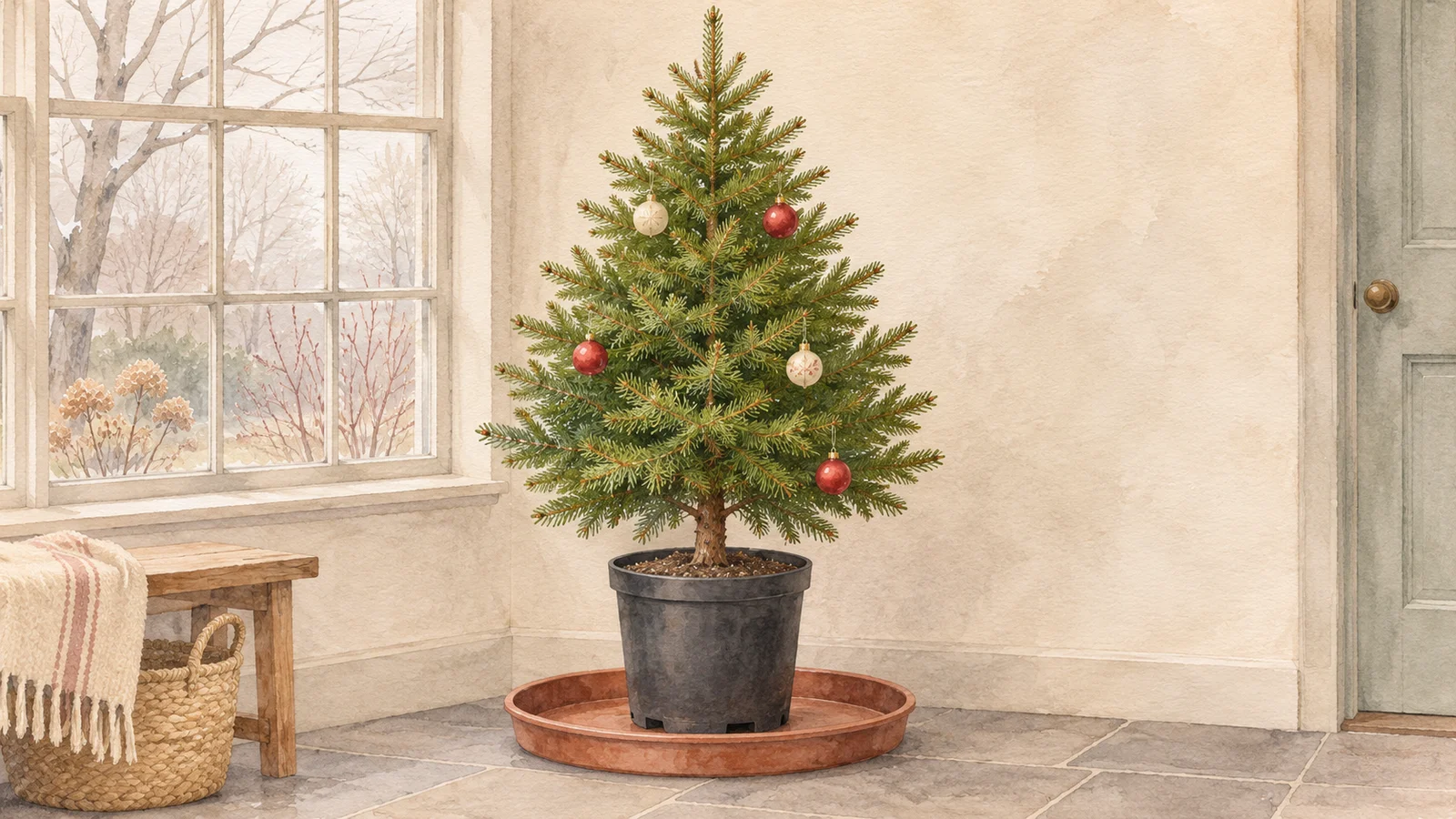
A living Christmas tree arrives with a second destination: the garden. Before choosing the fullest branches or the perfect height for a corner, decide where those roots will go after the ornaments come off. A tree that fits the room for a few days can become much too large for the yard.
This plan is for an outdoor evergreen sold with living roots, either in a container or as a soil ball wrapped in burlap. A cut tree cannot be planted afterward. A tropical Norfolk Island pine follows a different routine as a houseplant; the small decorated trees at a shop are not all interchangeable.
Choose the garden tree before the holiday tree
Keep the botanical name and cultivar label. Ask a local nursery or Extension office whether that exact tree suits your summer heat, winter cold, soil and available space. Hardiness alone does not answer every part of that question. NC State’s guide explains why familiar northern and mountain Christmas-tree species can struggle in warmer parts of North Carolina. Local availability does not prove local suitability.
Look up mature height and spread rather than judging the nursery pot. Check the proposed site for buildings, overhead wires, paths and other trees that the branches could eventually crowd. If there is no suitable permanent site, arrange another destination before buying; an indefinite stay in a small decorative pot is not a planting plan.
Choose healthy foliage without widespread yellowing or brown tips. Smaller container-grown trees are easier to maneuver than large field-dug trees with heavy soil balls. Measure the doorway and arrange help before collection. Protect the root system during transport, and avoid dropping or breaking the ball. The University of Florida stresses that root damage adds stress before the tree even reaches its display spot.
Put the departure date on the calendar
Warm rooms can interrupt an outdoor evergreen’s winter dormancy and reduce its ability to withstand cold when it goes back outside. A rooted tree is therefore a brief holiday visitor, not month-long indoor greenery.
Published recommendations differ: Illinois Extension recommends four to five days indoors, while UNH gives seven to ten days. Plan around the shorter stay when you can, and follow advice for your species and conditions. Ten days is not a survival guarantee or a reason to extend a tree already struggling in a warm room.
Write down both the arrival and removal dates. Leave time on either side for a sheltered transition space, such as an unheated garage or porch. The New York Botanical Garden recommends several days in cool shelter before indoor display and again afterward. Check root moisture during these moves; a tree waiting out of sight still needs attention.
Keep an outdoor-grown dormant tree cool while it waits. If a seller says a small decorative tree was raised in a warm greenhouse, ask about its current cold tolerance before exposing it to freezing weather. A label naming a hardy species does not establish how the individual plant was grown.
Make the pot easy to reach
Choose a cool display position clear of a radiator, heating vent or fireplace. Keep the pot stable and leave access for checking moisture and removing drainage water. Gifts and a tightly fitted tree skirt can make the most important daily task awkward enough to skip.
A waterproof outer tub protects the floor, but it must not become a reservoir around the roots. UNH recommends supporting the root ball above collected water. Check for standing water and remove it after watering. Leave a balled-and-burlapped tree’s wrapping intact during the indoor visit so the soil ball stays together.
Check the growing medium each day. Feel beneath the surface rather than watering because the calendar says to. Water when it is starting to dry, wet the root ball thoroughly, and allow excess water to escape. Keep it moist without leaving it soggy. Florida Extension identifies overwatering as a common problem, while NC State warns that a severe dry-out can be enough to prevent recovery. Both extremes deserve attention.
Use light decorations that the branches can support. If you add lights, UNH recommends LEDs or other low-temperature lights. Check electrical decorations for damage, and switch them off before sleeping or leaving home, following the New York Botanical Garden’s guidance. Keep decorations out of the way of the watering route.
Arrange the next stop before the ground freezes
After removing decorations, return the tree to cool shelter gradually. Do not move a tree from a heated room straight into exposed winter weather and assume that its species name will protect it.
The next step depends on climate. Illinois and the New York Botanical Garden describe preparing a planting place before the soil freezes and planting after the tree has readjusted to cool conditions. If that suits your local conditions, identify the site early and keep excavated soil protected. Follow the tree-planting guide for root-flare depth and a broad planting hole rather than burying the trunk to steady it.
In cold New Hampshire conditions, UNH instead advises cool sheltered storage until spring, with periodic moisture checks, then planting after the soil has thawed and dried. If you lack an unheated structure, its alternative is a protected outdoor position with mulch around the root system. Ask locally which route fits your winter; frozen or saturated soil is not an invitation to force planting.
Keep mulch away from the trunk and continue checking moisture after planting. The tree’s next growing season will require care while roots establish. Choose a permanent place you can reach with water, then let the holiday visit remain the short beginning of that longer job.
Sources
- Selection and Care of Living Christmas Trees (NC State Extension). Accessed November 20, 2026.
- Living Christmas Trees (University of New Hampshire Extension). Accessed November 20, 2026.
- How to care for a living Christmas tree (University of Illinois Extension). Accessed November 20, 2026.
- Care of Holiday Evergreen Trees and Boughs (New York Botanical Garden). Accessed November 20, 2026.
- Living Christmas Trees (University of Florida IFAS Extension). Accessed November 20, 2026.