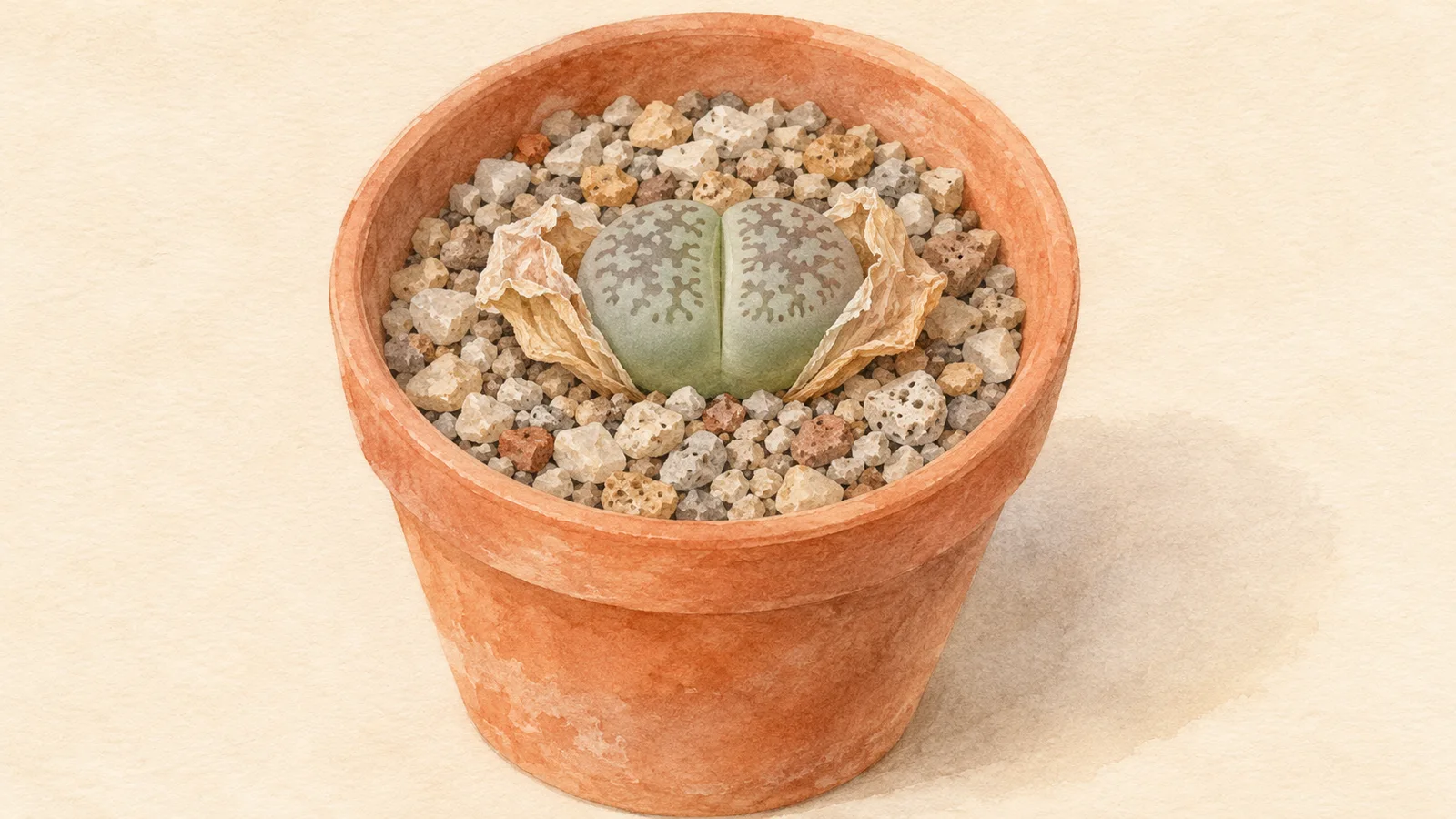
A living stone can look as though it is drying up while a healthy new plant body is forming inside it. The old leaves wrinkle, separate and eventually become a thin, papery covering. Watering to plump those old leaves back up interrupts the very change you want to see.
Before reaching for the watering can, look into the central cleft. A new pair emerging between the old leaves calls for a different response from an actively growing plant with no old pair left to absorb. This guide is for established, potted Lithops, not newly germinated seedlings or every succulent sold as a “living stone.”
Know which leaves are changing
Lithops are small succulents made up of a pair of thick, closely joined leaves. Their flat or rounded tops may carry dots, branching patterns and translucent areas. The RHS genus profile places them in the ice-plant family, Aizoaceae. They are not little cacti, and the cactus shelf’s usual watering routine is not automatically suitable.
During renewal, a fresh pair develops within the old one. As the new leaves expand, they draw water and nutrients from the old leaves, which shrink around them. The University of Edinburgh’s archived botanical guide illustrates that transfer, including plants that produce two new pairs and begin forming a cluster. The old body is supplying the new growth; dry-looking outer leaves alone do not mean the roots need water.
Look at the whole sequence rather than one wrinkle. Is a fresh pair visible? Are the outer leaves becoming progressively thinner while the new pair remains sound? A dated photograph from the same angle makes slow changes easier to recognize. Leave attached old leaves alone instead of peeling them away to make the plant look tidy. Do not cut through the central cleft to “help” the new pair emerge.
Keep renewal dry, even when the pot is dry
Wisconsin Extension advises withholding water during leaf replacement until the old leaves have dried completely. This is an important exception to the familiar instruction to water a succulent when its mix dries. The pot can be dry while the plant is still drawing on water stored in its old leaves.
That does not make the end of leaf replacement an automatic watering date. Identify the plant’s current growth phase as well. Lithops commonly have a summer resting period and a later active period, and species and growing conditions affect the calendar. If a seller supplies care tied to a particular species or growing setup, keep those details with the label. A month printed in a Northern Hemisphere guide should not override what your own plant is doing.
When the old pair is fully dry and the plant is in an active watering phase, water the mix thoroughly and let excess drain; allow it to dry before another watering. During dormancy, withhold routine watering. Do not keep adding small sips simply because the rest of the windowsill is being watered. If you cannot identify the phase, show a specialist the plant, label and recent watering history before changing its care.
Give it bright light without a sudden scorch
A compact Lithops needs a bright position. NC State Extension suggests four to five hours of morning sunlight with some afternoon shade. It also identifies stretching as a sign of insufficient light. A plant leaning upward toward a dim window needs a light assessment, not more water or fertilizer to encourage growth.
Move a plant from a shaded shop display into stronger light gradually. Observe the actual sunlight reaching the pot, including seasonal changes and nearby buildings; a “south-facing room” can still contain a shaded shelf. Avoid pressing the leaves against hot or cold glass. Choose a frost-free indoor position, and check the temperature beside the plant rather than assuming the entire room stays equally warm.
Bright light still matters while the plant rests. The New York Botanical Garden guide recommends supplementary light when a window cannot provide enough and emphasizes ordinary household humidity with good air circulation. Keep Lithops away from plants being misted, and skip the closed terrarium. For a dim winter window, the grow-light guide can help you assess the equipment and placement.
A small plant still needs root room
The low body hides a comparatively long taproot. Use a pot with drainage holes and enough depth for the roots, rather than a shallow decorative dish. Wisconsin Extension suggests containers about three to five inches deep. Keep the leaf tops above the surface rather than burying the whole body under decorative grit.
Choose a fast-draining, gritty mix suitable for Lithops. A layer of attractive stones on top does not change a water-retentive mix beneath it. Lift a nursery pot out of its decorative cover to check for trapped water, and empty any saucer after watering. Keep plants with different watering needs in separate pots, even if they would make an attractive shared arrangement.
Papery is different from mushy
Normal renewal leaves a thin, dry outer sheath. Yellowing, spreading soft areas or a collapsing, mushy body need a closer look; NC State lists these among problems associated with excess water. Do not treat every soft-looking plant as thirsty. Check recent watering, whether the lower mix is wet and whether the drainage holes are open.
Keep a troubled plant apart from the collection while you work out the cause. The root-rot identification guide explains what root damage looks like, but do not repeatedly unpot a sound Lithops just to inspect it. For a new purchase, three useful questions are its identity, its current growth phase and when it was last watered. Write the answers on the pot’s record; they are more useful than a standing weekly reminder to water.
Sources
- Living Stones: Lithops (University of Wisconsin–Madison Division of Extension). Accessed November 6, 2026.
- Living stones (Lithops spp.) (New York Botanical Garden). Accessed November 6, 2026.
- Lithops (North Carolina State University Extension). Accessed November 6, 2026.
- Living Stone Plants (archived Desert Ecology guide) (University of Edinburgh). Accessed November 6, 2026.
- Lithops (Royal Horticultural Society). Accessed November 6, 2026.