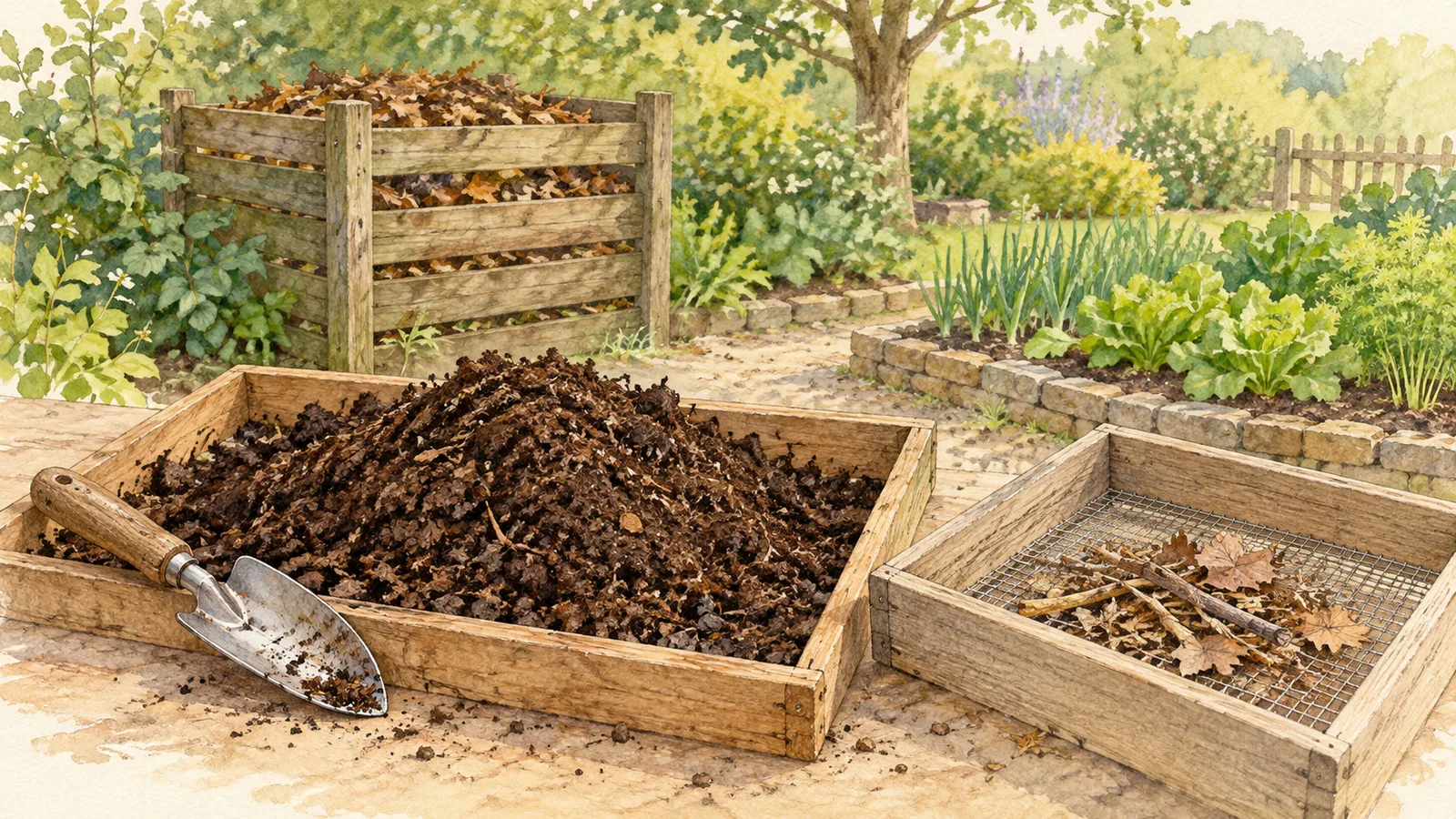
The bottom of a compost bin can look like dark soil while the top still holds last week’s vegetable peelings. That does not mean the whole bin is ready to empty onto a bed. Judge the material you plan to harvest, and keep fresh scraps separate from the batch you want to use.
Finished compost should be mostly unrecognizable as the leaves, stems and kitchen scraps that went in. It should have an earthy smell and a loose, crumbly texture. Those are useful clues, but a cool pile alone is not enough: dry material, cold weather or poor aeration can slow decomposition before the job is done.
Start with the oldest material
If you continually add scraps to the same bin, move the newer material aside and inspect the older compost underneath. Maryland Extension describes this difference between a continuously fed pile’s fresh top and more decomposed bottom. You can harvest an older portion without pretending that the latest additions have finished too.
Take a few samples from the area you intend to use, rather than choosing the nicest-looking handful. Look for a reasonably consistent material. A dark exterior around a mass of intact leaves or wet food scraps is a reason to leave that portion composting. If the batch is still obviously mixed, separate out the older material or give it more time.
For the next harvest, it helps to stop feeding one pile and start another. Mark which batch is resting. Otherwise, each new bucket of scraps makes it harder to judge the material as a whole. Save new fallen leaves for the active pile or for an appropriate mulching use.
Check texture, smell and temperature together
UF/IFAS Sarasota lists several signs of readiness: substantial shrinkage, loss of recognizable original ingredients, a dark crumbly appearance and an earthy odor. A previously hot pile should also have stopped generating substantial heat.
Spread a small sample on a tray or tarp. It should separate into crumbs rather than reveal layers of recognizable scraps. A sour or ammonia-like odor calls for more attention, not a trip to the planting bed. You are looking for these signs together; none is a certificate by itself.
A few coarse remnants can be screened out. Use a garden sieve to separate twigs and other unfinished pieces, then return that organic material to the active pile. Iowa State Extension recommends screening for a more uniform finished product. Screening removes pieces; it does not make the fine material mature if it is still actively decomposing.
A cold pile may have stalled
Before declaring a pile finished because it feels cool, check its moisture and structure. Dry, dusty material may simply lack water. A dense, soggy mass may lack air. Iowa State identifies dry conditions, insufficient turning, small pile size and cold conditions among the reasons decomposition or heating can slow.
Minnesota Extension recommends periodic watering and turning to maintain an active pile. For dry material, add water while turning so moisture reaches the inside. Aim for the feel of a wrung-out sponge, not a dripping mass. If the pile is wet and smells bad, turn it and incorporate dry carbon-rich material to improve the conditions. That corrective addition becomes part of an active batch; it is not finished compost just because it was added to an old pile.
Watch what happens after the correction. If a formerly hot pile heats again after mixing, leave it working. In freezing weather, wait for conditions that allow decomposition to resume before using a lack of heat as a readiness clue. A calendar date cannot tell you whether the ingredients have broken down.
Let the batch cure
Curing is the quieter period after active composting. Stop adding fresh scraps, keep the material moist and allow air to reach it. The EPA’s home-composting guidance recommends at least four weeks of curing once a pile no longer heats after mixing and visible food scraps are gone. That is a finishing stage, not a promise that any four-week-old pile is usable.
The intended use matters too. UF/IFAS distinguishes compost used on the surface as mulch from material destined for containers, which must be thoroughly composted. If you are unsure about a batch, keep it curing and use a suitable prepared potting mix for seedlings. Do not put tender roots into material whose readiness you are still trying to establish.
Oregon State’s compost-analysis guide explains why this matters: immature compost can retain compounds harmful to plant growth. Stability, which concerns the rate of decomposition, and maturity, which concerns suitability for plants, are related checks rather than interchangeable promises.
Decide where the finished compost belongs
Use mature compost as a soil amendment or an appropriate surface dressing. It is not a complete replacement for garden soil. Oregon State Extension advises against filling a raised bed with compost alone and notes that soluble salts in some composts can injure seeds and transplants. A crumbly texture does not tell you its salt level.
Plan the amount around the bed’s condition and soil-test results. Repeated applications can build up nutrients, including phosphorus and potassium; Minnesota Extension recommends more frequent soil testing when using compost and manure. Having a full bin is not, by itself, a reason to spread a thick layer everywhere. Keep surface applications away from stems and tree trunks.
Finally, remember what went into the pile. The EPA recommends keeping pet waste, herbicide-treated plants and diseased plant material out of a backyard compost system. Earthy smell and dark color cannot establish that a questionable ingredient has become harmless. If the input history is uncertain, seek local Extension advice before spreading the batch around food crops. Leave that material separate while you resolve the question; it is much easier to manage a pile than to retrieve compost from an entire bed.
Sources
- How to Make Compost at Home (University of Maryland Extension). Accessed October 29, 2026.
- Composting for Home Gardeners (Iowa State University Extension and Outreach). Accessed October 29, 2026.
- When Is Compost Ready? (University of Florida IFAS Extension Sarasota County). Accessed October 29, 2026.
- Composting At Home (US Environmental Protection Agency). Accessed October 29, 2026.
- Interpreting compost analyses (Oregon State University Extension Service). Accessed October 29, 2026.
- How to use compost in gardens and landscapes (Oregon State University Extension Service). Accessed October 29, 2026.
- Soil testing for lawns and gardens (University of Minnesota Extension). Accessed October 29, 2026.
- Composting in home gardens (University of Minnesota Extension). Accessed October 29, 2026.