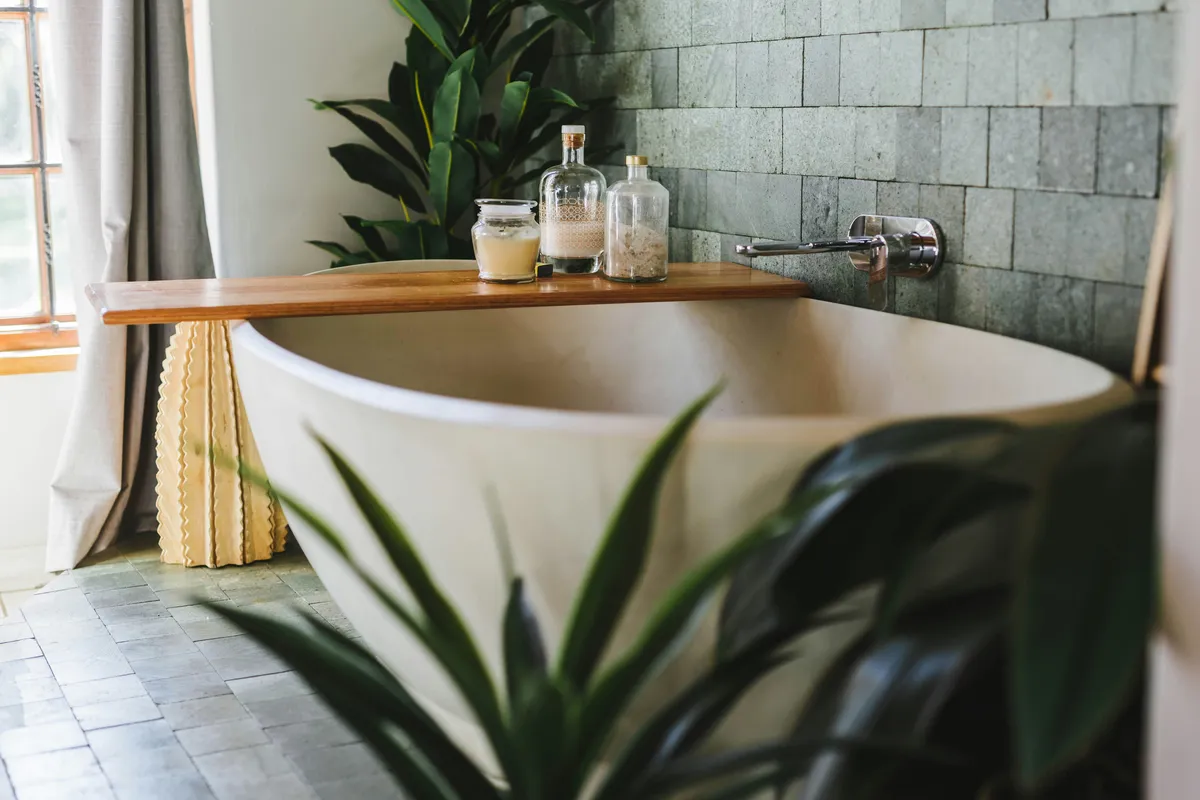
Bathroom humidity cannot compensate for missing light. A steamy room with no window is still dark, and no living houseplant can maintain normal growth without natural or supplemental light. In a windowless bathroom, install a suitable grow light on a timer or choose nonliving decor.
For a bathroom with a window, measure light where the leaves will actually sit. Frosted glass, deep window recesses, nearby buildings, and privacy blinds can reduce light substantially. Then consider shower spray, ventilation, soil drying time, stable placement, and whether children or pets can reach the foliage. Humidity is only one part of the decision.
Quick bathroom plant choices
| Light at the plant | Suitable choice | Moisture and care | Pet note |
|---|---|---|---|
| Low to medium indirect light | Cast iron plant | Let the mix partly dry; low burden | ASPCA lists it as non-toxic to cats and dogs |
| Medium indirect light | Parlor palm | Check regularly; moderate burden | ASPCA lists it as non-toxic to cats and dogs |
| Medium to bright indirect light | Spider plant | Water after partial drying; moderate burden | ASPCA lists it as non-toxic to cats and dogs |
| Medium to bright filtered light | Bird’s nest fern | Keep evenly moist, not saturated; moderate burden | Clemson Extension describes it as non-toxic to pets |
| Bright indirect light | Boston fern | Steadier moisture; higher burden | ASPCA lists it as non-toxic to cats and dogs |
| Medium indirect light | Peace lily | Keep moist, not soggy; moderate burden | Toxic to cats and dogs if eaten |
| Medium indirect light | Golden pothos | Let the mix partly dry; low burden | Toxic to cats and dogs if eaten |
These are starting points, not guarantees. University of Georgia Cooperative Extension explains that window direction, distance, curtains, season, and outdoor obstructions all affect usable indoor light. Move a plant farther from the window and its available light can fall sharply.
Choose by measured light, not the word “bathroom”
University of Minnesota Extension recommends determining the quality and hours of natural light before choosing a plant. It identifies pale foliage, leggy stems, leaf drop, and failure to flower as possible low-light signs. A phone light-meter app can provide a rough comparison between proposed locations, but it is not a calibrated plant-light instrument.
A low-light-tolerant species generally grows more slowly in low light and uses water more slowly. That raises the risk of root problems when the pot is watered on the same schedule as a brighter plant. If a bathroom is lit only when someone enters, the ceiling fixture is not providing a dependable plant photoperiod.
Cast iron plant for lower indirect light
Cast iron plant (Aspidistra elatior) tolerates shade and irregular watering better than many tropical foliage plants. NC State Extension describes it as drought- and deep-shade-tolerant, with leaves that can bleach in direct sun. It suits a floor position or broad counter away from splash, provided some indirect daylight reaches the leaves.
Its deliberate growth makes it a lower-burden choice. Allow some drying before watering, and never leave the nursery pot standing in a full decorative cachepot. The ASPCA lists cast iron plant as non-toxic to cats and dogs, though keeping all plants out of mouths remains sensible.
Parlor palm or spider plant for medium light
Parlor palm (Chamaedorea elegans) gives an upright, feathery shape in medium indirect light. Inspect the mix regularly and water according to moisture rather than shower frequency. The ASPCA lists parlor palm as non-toxic to cats and dogs. Verify the botanical name because “palm” appears in the common names of unrelated plants.
Spider plant (Chlorophytum comosum) fits medium to bright indirect light and works well on a secure shelf where arching leaves have room. The ASPCA spider plant profile also lists it as non-toxic to cats and dogs. It can still be damaged by chewing, and dangling plantlets may attract a cat, so placement matters.
Bird’s nest fern for filtered light and consistent care
Bird’s nest fern (Asplenium nidus) appreciates humidity, but it also needs light and careful moisture management. NC State Extension recommends high humidity, moist porous soil, and bright indirect or filtered light. It is a better match for a bright frosted window than for a dark shelf across the room.
Use a draining potting mix and keep it moist rather than waterlogged. Do not treat shower steam as watering: roots still depend on moisture and air in the potting mix. Clemson Cooperative Extension describes bird’s nest fern as non-toxic to pets and advises keeping the pot out of standing water.
Peace lily only where toxic foliage can be separated
Peace lily (Spathiphyllum) appears in the bathroom illustration because it is commonly considered for warm rooms with indirect light. NC State Extension recommends partial to deep shade, warm conditions, and moist but not soggy soil. It is not a safe default where pets or young children can reach the foliage.
The ASPCA identifies peace lily as toxic to cats and dogs because of insoluble calcium oxalates. Use a safer species when reliable separation is uncertain.
Boston fern when steady moisture is realistic
Boston fern (Nephrolepis exaltata) can suit a bright bathroom with good ventilation and space for spreading fronds. NC State Extension recommends bright indirect light, high humidity, and moist soil that does not dry out. It can shed old leaflets, so it is not the lowest-maintenance option. A hanging basket must be anchored into suitable structure and kept away from shower spray and electrical fixtures.
The ASPCA lists Boston fern as non-toxic to cats and dogs. Check the full botanical label: plants casually sold as “ferns” do not all share the same safety status.
Pothos only where toxic foliage can be separated
Golden pothos (Epipremnum aureum) adapts to ordinary indoor humidity and medium indirect light, so it does not need a bathroom to survive. It can be useful where a trailing plant fits a bright shelf, but low light will slow growth and soil drying. Secure vines before they reach a sink, toilet, doorway, or electrical cord.
ASPCA identifies golden pothos as toxic to cats and dogs. Insoluble calcium oxalates can cause oral irritation, drooling, vomiting, and difficulty swallowing. Do not rely on a high ledge if an animal climbs or a child can move furniture.
Manage moisture and ventilation for the room
Shower humidity rises quickly and then should fall. Keeping a bathroom constantly damp to please plants encourages mold and other biological contaminants. The U.S. Environmental Protection Agency recommends using an exhaust fan vented outdoors or opening a window during showers, and maintaining indoor relative humidity below 60 percent, ideally 30 to 50 percent when possible.
Plants do not replace the exhaust fan. Run ventilation long enough to clear condensation from walls and mirrors, repair leaks, and dry standing water. Separate room humidity from soil moisture: a humid room may slow evaporation, but it does not reliably hydrate roots. Touch or probe the mix before watering and adjust as daylight and temperature change through the year.
Keep pots outside the direct spray zone. Soap, shampoo, cleaners, and very hot water can damage foliage or contaminate the soil. Use drainage holes and a saucer, but empty collected water so roots do not remain submerged. Inspect the pot rim, soil surface, and leaf undersides for mold, fungus gnats, scale, or other pests.
What works in a windowless bathroom
Occasional rotations between a dark bathroom and a bright room are unreliable because the plant still needs an adequate, recurring light supply. Repeated moves also make watering harder to judge. Snake plants, ZZ plants, and pothos may decline slowly enough to appear tolerant of darkness, but low-light tolerance is not the same as living without light.
For a living plant, use only a fixture and installation method that the manufacturer permits for that room. Keep cords and connections away from sinks, tubs, and wet surfaces; use a qualified electrician when the installation is uncertain. A timer can provide a consistent daily light period. Fixture output, distance, coverage, and species all affect whether the light is adequate.
If safe installation is impractical, the right answer is no live plant. A preserved botanical display or washable artificial plant adds green color without setting up a cycle of plant replacement.
Use a bathroom-specific final check
Before buying, confirm all of the following:
- The proposed location receives repeatable natural or supplemental light at leaf level.
- The pot has drainage, a stable base, and clearance from water, cleaners, outlets, and hot fixtures.
- The exhaust fan or window controls condensation independently of the plant.
- The species’ watering burden fits the available care time.
- Its botanical identity and pet-toxicity classification are verified, and children cannot pull down, chew, or spill the plant.
- The mature plant will not block a doorway, snag towels, or fall from a narrow shelf.
Measured light decides whether a bathroom plant can live there. Humidity may help a suitable fern or palm, but safe placement, ventilation, and careful watering determine whether the plant and the room remain healthy.
Sources
- Lighting for indoor plants and starting seeds (University of Minnesota Extension). Accessed August 24, 2026.
- Growing Indoor Plants with Success (University of Georgia Cooperative Extension). Accessed August 24, 2026.
- Biological Contaminants and Indoor Air Quality (U.S. Environmental Protection Agency). Accessed August 24, 2026.
- Asplenium nidus (NC State Extension). Accessed August 24, 2026.
- Aspidistra elatior (NC State Extension). Accessed August 24, 2026.
- Cast Iron Plant (ASPCA Animal Poison Control Center). Accessed August 24, 2026.
- How To Grow and Care for Bird’s Nest Fern (Asplenium Nidus) (Clemson Cooperative Extension). Accessed August 24, 2026.
- Nephrolepis exaltata (NC State Extension). Accessed August 24, 2026.
- Boston Fern (ASPCA Animal Poison Control Center). Accessed August 24, 2026.
- Spider Plant (ASPCA Animal Poison Control Center). Accessed August 24, 2026.
- Parlor Palm (ASPCA Animal Poison Control Center). Accessed August 24, 2026.
- Golden Pothos (ASPCA Animal Poison Control Center). Accessed August 24, 2026.
- Spathiphyllum (NC State Extension). Accessed August 24, 2026.
- Peace Lily (ASPCA Animal Poison Control Center). Accessed August 24, 2026.