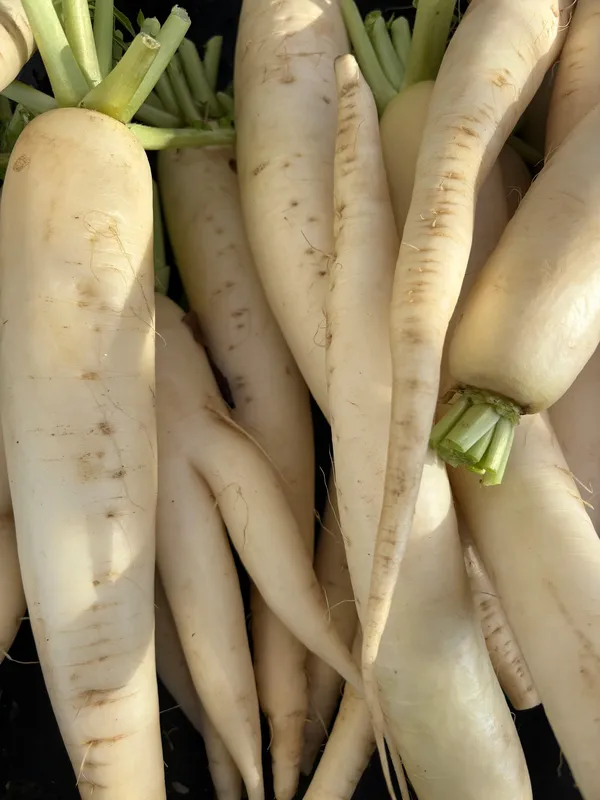
Daikon is a group of radish cultivars selected for large, usually elongated roots. Some produce long white roots; others are shorter, broader, or differently colored. Seed packets may use names such as daikon, Japanese radish, Chinese radish, or winter radish, so the cultivar description is more useful than the common name alone.
The reliable growing plan is simple but not universal: direct-sow in a locally appropriate cool-season window, give the expected root enough loose soil, thin seedlings before they crowd, and keep moisture reasonably even. Heat, compacted ground, crowding, and delayed harvest can reduce root quality.
Choose a cultivar before preparing the site
Read the seed packet for expected root shape, days to maturity, spacing, and seasonal guidance. A long daikon needs a different root zone from a short, blunt cultivar. The packet also helps distinguish an actual daikon selection from another winter or specialty radish sold nearby.
University of Florida IFAS Extension lists several daikon cultivars and reports maturity ranges that vary by cultivar and season. Use those figures as regional trial information, not as a promise for every garden.
For a first crop, favor a cultivar whose expected length fits the available bed or container. Shorter types are easier where soil is shallow or stony. A long-rooted cultivar is reasonable only when the soil can be loosened deeply without hitting rubble, compacted subsoil, or the bottom of a pot.
Find the right planting window
Radishes are cool-season crops. University of Minnesota Extension recommends using spring and late-summer sowings for radishes in its climate and notes that hot weather can produce poor-quality roots. That calendar should not be copied to a warmer or milder region without adjustment.
Use three local signals:
- Check the cultivar packet for its preferred season and time to maturity.
- Consult local Extension planting dates for radishes or cool-season root crops.
- Count backward from the period when sustained heat or hard freezes normally limit growth in the local garden.
In regions with short, hot springs, fall may provide a longer cool period. In mild-winter regions, daikon may be a fall or winter crop. UC Master Gardeners of Santa Clara County treats daikon as a cool-season vegetable and recommends direct sowing in the local fall-to-winter window. That is useful for its California service area, not a nationwide date.
Successive small sowings can spread the harvest, but only while the remaining weather still suits the cultivar. A seedling planted late into warming conditions will not gain quality merely because it was part of a schedule.
Prepare a deep, unobstructed root zone
Choose a site with strong light and soil that drains after watering. Loosen the bed to at least the expected root depth and remove stones, dense clods, old roots, and construction debris. Do not compact the prepared area by stepping on it.
Work in finished compost only where it improves the soil’s structure. Avoid fresh manure or an excessive fertilizer application immediately before planting. A soil test is the best basis for correcting nutrients or pH. Too much nitrogen can favor leaves at the expense of the root crop, while poor fertility can also limit growth.
Utah State University Extension recommends fertile, well-drained soil and advises incorporating organic matter and following soil-test recommendations.
Use a container only when it fits the cultivar
A container must be food-safe, stable, and equipped with open drainage holes. Its usable soil depth should exceed the cultivar’s expected root length, with additional room for drainage and the root tip. A shallow window box is not a suitable home for a long daikon.
Fill the container with fresh commercial container mix rather than garden soil. Leave enough headspace to water without washing mix over the rim. Place the pot where the foliage receives adequate light and where drainage will not damage the surface below.
Container culture increases the need for moisture checks because a limited volume can dry faster than a garden bed. It does not change daikon into a warm-season indoor crop. If the available light and temperature do not support cool-season vegetable growth, wait for a better site or season.
Direct-sow and thin promptly
Daikon is normally direct-sown because the harvest is the enlarged root and early disturbance can deform it. Follow the packet’s sowing depth and final spacing; cultivar size matters.
- Rake the prepared surface level and break up remaining clods.
- Make a shallow furrow at the packet’s stated depth.
- Sow seeds evenly rather than dropping a dense pile.
- Cover with fine soil or mix and water gently enough to avoid washing seeds together.
- Keep the seed zone evenly moist while germination begins.
- Thin seedlings to the final spacing before roots become crowded.
University of Illinois Extension emphasizes direct seeding, prompt thinning, and steady growth for good radish quality. Crowded tops are easy to see, but the more important competition is below the surface. A dense row cannot produce uniformly broad roots.
Cut unwanted seedlings at the soil line if pulling them would disturb the ones being retained. Label the row or pot with cultivar and sowing date so maturity estimates are tied to the correct seed lot.
Keep moisture even, not saturated
Check the root zone rather than watering by a fixed weekday. The soil should remain moist enough for uninterrupted growth but still drain and contain air. Repeated swings from very dry to saturated conditions can contribute to poor texture, cracking, or uneven development.
Apply water slowly across the planted area. After seedlings establish, mulch lightly if local conditions make the surface dry rapidly, but keep heavy material away from tiny stems. In containers, empty runoff and confirm that drainage holes remain clear.
University of California Statewide IPM recommends regular irrigation, good drainage, weed control, and harvest when roots reach usable size. A rigid “one inch every week” rule is less useful than inspecting the actual soil after rain, heat, wind, and irrigation.
Feed the crop by evidence
Begin with a soil test for a garden bed and a fresh, labeled container mix for pots. If a fertilizer is needed, choose one labeled for edible vegetables and follow its rate and timing. Do not add extra phosphorus, nitrogen, or a household amendment based only on weak leaf growth.
Slow growth can also result from cool soil, excessive heat, crowding, weak light, compacted ground, root pests, or water stress. Correct the actual constraint before increasing fertilizer.
Prevent pest damage without recipe sprays
Inspect seedlings often, especially leaf undersides and the soil line. Small holes may come from flea beetles; chewed foliage can have several other causes. Identify the pest before choosing a control.
Fine-mesh row cover can exclude some flying pests when installed immediately after sowing, sealed at the edges, and kept from pressing on the crop. Rotate radishes and other brassica-family crops where space allows, remove crop debris after harvest, and control nearby brassica weeds that can host pests.
If a pesticide becomes necessary, use only a product whose label names the crop and target pest. Follow the rate, protective-equipment directions, reentry restrictions, and preharvest interval. “Natural” ingredients are not automatically appropriate for edible radish leaves or roots. Do not improvise a neem, soap, oil, or bacterial-pesticide recipe from a generic houseplant recommendation.
Diagnose root-quality problems
| Symptom | Likely questions | Next step |
|---|---|---|
| Thin roots with large tops | Was spacing too tight or nitrogen excessive? | Review thinning and soil-test guidance |
| Forked or twisted roots | Did the root meet stones, compaction, fresh organic material, or physical damage? | Prepare a finer, deeper root zone next crop |
| Pithy or woody texture | Was the crop exposed to heat or harvested late? | Use a better seasonal window and check earlier |
| Cracking | Did soil moisture swing sharply? | Improve watering consistency and drainage |
| Small, stressed seedlings | Are light, moisture, temperature, pests, or crusted soil limiting growth? | Correct the observed constraint before fertilizing |
These patterns are not laboratory diagnoses. More than one factor can occur at once. Keep the cultivar packet and a simple sowing record so the next planting can change one variable rather than guessing.
Harvest by cultivar size and eating quality
Start checking near the packet’s maturity range, but inspect the crop rather than harvesting solely by elapsed days. The shoulder of a daikon often becomes visible at the surface. Compare its width with the cultivar description and gently uncover a small amount of soil if needed.
Loosen the surrounding soil before pulling a long root. Place a garden fork beside the root, not through it, then lift from low on the leaf bases without twisting sharply.
Harvest before roots become overmature, pithy, or damaged by unsuitable weather. Remove loose soil outdoors. Handle edible roots and greens with clean hands and tools, then wash them under clean running water before preparation. Do not wash produce with soap or household cleaner.
Keep the next sowing specific
Record the cultivar, sowing date, thinning distance, major weather changes, and harvest date. If roots were short but healthy, choose a shorter cultivar or improve soil depth. If they became hot or pithy, shift the local planting window rather than assuming daikon is unsuitable.
The useful target is not the largest possible root. It is a straight, sound root harvested while its texture still matches the cultivar’s intended use. Cool conditions, adequate space, loose soil, and even moisture make that outcome far more predictable than a fixed national calendar.
Sources
- Growing Radishes in Home Gardens (University of Minnesota Extension). Accessed August 25, 2026.
- Daikon Radish Cultivation Guide for Florida (University of Florida IFAS Extension). Accessed August 25, 2026.
- Daikon (UC Master Gardeners of Santa Clara County). Accessed August 25, 2026.
- Radish (University of Illinois Extension). Accessed August 25, 2026.
- Cultural Tips for Growing Radish (University of California Statewide Integrated Pest Management Program). Accessed August 25, 2026.
- How to Grow Radishes in Your Garden (Utah State University Extension). Accessed August 25, 2026.