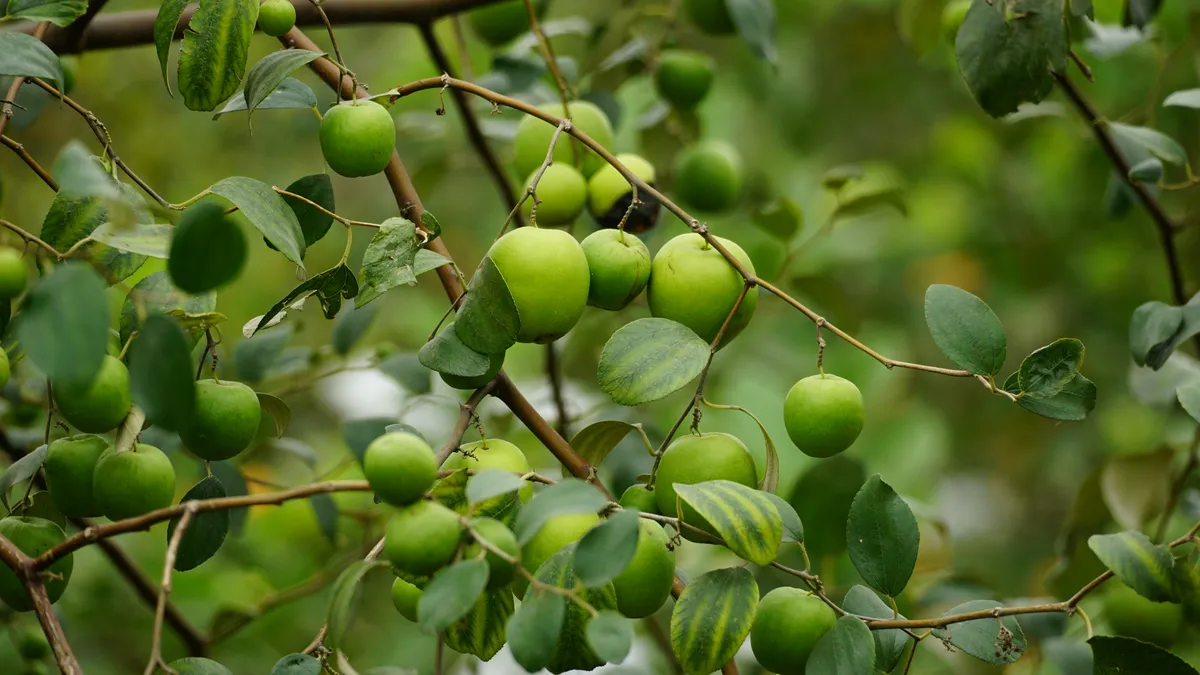
Chinese jujube is a deciduous fruit tree whose success depends on more than winter hardiness. A tree may survive the cold yet fail to ripen a late cultivar before autumn weather ends the season. A cultivar described as self-fertile may set some fruit alone while producing a better crop beside a suitable pollenizer. A drought-tolerant mature tree still needs deliberate watering while its roots establish.
Confirm the species and nursery identity
This guide concerns Chinese jujube, Ziziphus jujuba. It does not apply to Indian, Taiwan, or Thai jujube, Ziziphus mauritiana. New Mexico State University distinguishes the cold-hardy, deciduous Chinese species from the tropical Indian species, and UF/IFAS Extension likewise warns that the two do not share the same growth characteristics. A listing that says only “jujube” is not specific enough for a climate decision.
Buy a named cultivar from a nursery that identifies both the scion and, when possible, the rootstock. Seedlings do not reliably reproduce a cultivar’s fruit. Texas A&M AgriLife Extension notes that seedling fruit is often inferior and that named cultivars such as ‘Li’ and ‘Lang’ should be grafted. NMSU reports that commercial trees are commonly grafted onto sour jujube, Z. spinosa, for seed availability and stress tolerance.
Inspect a nursery tree for a sound trunk, live buds or healthy leaves appropriate to the season, and a visible graft union. Avoid substituting an unidentified root sucker for a named tree: a sucker below the union belongs to the rootstock, not necessarily to the fruiting cultivar above it.
Match climate, heat, and season length
Published zone ranges are only a first screen. UF/IFAS summarizes reports of Chinese jujube growing in USDA zones 5 through 10, with best performance often reported in zones 6 through 9. Established trees can tolerate substantial winter cold, and the species has a relatively low chilling requirement. It also has a high heat requirement for growth after dormancy and tends to leaf out late.
That combination explains why both cold and warm regions can grow jujube, but it does not make every cultivar suitable everywhere. Fruit develops and ripens through summer and early fall. In a short or cool growing season, choose an early or midseason cultivar with evidence from a comparable region. NMSU’s New Mexico guide cautions that late cultivars may not mature in northern New Mexico, while southern sites can support a broader sequence of early through late cultivars.
Warm, humid regions present a different test. UF/IFAS documents successful Florida cultivars but also reports inconsistent fruit set in some plantings, possibly associated with weather during bloom. Texas A&M describes better adaptation to arid parts of Texas than to the Gulf Coast. These regional observations are more useful than a blanket claim that the tree performs identically across a zone.
Before buying, compare summer heat, frost-free season, rainfall near harvest, and local trial results. A county Extension office or regional fruit group may know which cultivars actually finish ripening nearby.
Choose a cultivar for use and ripening time
Cultivar names describe real differences in harvest timing, fruit size, use, tree form, and pollination. NMSU’s 2025 cultivar guide separates recommendations for southern, central, and northern New Mexico rather than treating the state as one environment.
Examples illustrate the decisions:
- ‘Alcalde #1’ ripens early, has large fruit for fresh use, and is described by NMSU as suitable for marginal areas with shorter seasons.
- ‘Honey Jar’ has small, sweet, early fruit and is recommended for home gardens, including shorter-season sites in New Mexico.
- ‘Li’ has large, round, midseason fruit used primarily fresh.
- ‘Lang’ has large, pear-shaped fruit suited to drying, but NMSU notes that rain near maturity can split some fruit.
- ‘Sugarcane’ has small to medium fruit for fresh eating or drying, but its pollination requirements make a second cultivar especially important.
- ‘Sherwood’ is late and is better reserved for a long growing season.
Choose the intended use first, whether crisp fresh fruit, drying, or both, and then eliminate cultivars that ripen too late for the site. Confirm the nursery’s cultivar spelling because aliases are common, and ask whether its regional ripening description comes from a climate comparable to the planting site.
Treat pollination as cultivar-specific
“Self-fertile” is not a complete pollination plan. NMSU reports that ‘Li’, ‘Alcalde #1’, and ‘Shanxi Li’ set fruit in self-fertility tests, but cross-pollination increased fruit set and fruit size. It also explains that some cultivars set alone but improve with cross-pollination, while a few require a pollenizer and insect activity. Its cultivar notes specifically say that ‘Sugarcane’ needs pollenizer cultivars and bee activity for good fruit set.
University of Georgia Cooperative Extension gives the useful general summary that jujube trees can be self-fertile while yielding more with another variety.
For the most reliable plan, plant two different, locally adapted cultivars with overlapping bloom unless authoritative information for the chosen cultivar supports a single-tree planting. Preserve insect access during bloom and avoid applying pesticides to flowers. If space permits only one tree, choose it for documented self-fertility and local performance rather than relying on a generic nursery label.
Select a permanent, well-drained site
Provide full sun and enough room for a tree rather than planning around a temporary sapling. NMSU describes typical trees 15 to 30 feet tall, with cultivar habits ranging from spreading to narrow and upright; Texas A&M reports that favorable conditions can produce still larger trees. Mature size, pruning system, access for harvest, and distance from structures all belong in the site decision.
Drainage is essential even though jujube tolerates varied soil textures and pH. Texas A&M calls for fair to good drainage, and Georgia Extension reports that the tree can tolerate poor soil when it is well drained. Do not install it in a depression that holds water after rain.
Many jujubes have thorny young branches, and grafting rootstocks may also be thorny. Keep the canopy and likely sucker zone away from narrow walks, play areas, utilities, and property boundaries. Place the graft union above the finished soil line and protect the trunk from mower or string-trimmer injury.
Container culture is a compromise, not a default balcony solution. The cited Extension guides describe vigorous, long-lived trees with large root systems and a tendency to sucker; they do not establish a universal small-container protocol. A marketed “compact” cultivar is not automatically suitable for years in a patio pot. Where in-ground planting is impossible, confirm cultivar and rootstock vigor, use a stable container with unobstructed drainage, plan for frequent moisture checks and eventual root management, and obtain local advice for winter root protection.
Water for establishment, then by conditions
Drought tolerance develops with establishment. UF/IFAS emphasizes that adequate water is critical after planting, particularly for bare-root trees, and describes irrigation two or three times per week during establishment while noting that rainfall, soil, and evaporative demand determine the amount. Treat that frequency as a Florida starting point, not a universal schedule.
Check the root zone and water deeply enough to moisten it without keeping it saturated. Increase checks during hot, dry, or windy weather and reduce irrigation after meaningful rain. NMSU notes that irrigation remains important for good fruit set and yield in its semiarid climate even though established trees tolerate drought.
Fertilizer research for jujube is limited. NMSU advises against fertilizing a newly planted tree until it has leafed out. After establishment, use a soil test, growth observations, and local fruit-tree recommendations. Excess fertilizer is not a substitute for sun, compatible pollination, adequate water, or a cultivar that can ripen locally.
Train the tree and control rootstock growth
Jujube bears on short-lived fruiting branchlets produced from specialized shoots and spurs. Its buds do not always respond to heading cuts like apple or peach. NMSU therefore recommends learning the tree’s shoot structure before making major training cuts. Central-leader and open-center systems are both documented by UF/IFAS; the appropriate choice depends on the starting tree, site, and management goal.
Begin with structural work: select a durable framework, remove broken or rubbing wood, maintain light through the canopy, and keep harvest height practical. Avoid severe, unexplained heading cuts. Georgia Extension reports that established jujubes often need little pruning because of their naturally open habit, while NMSU notes benefits from annual training and pruning. The difference supports moderate, goal-driven work rather than a fixed recipe.
Inspect below and around the graft union several times during the growing season. Jujube roots commonly send up suckers. Texas A&M advises removing them at or below ground and avoiding unnecessary root injury, which can stimulate more sprouting. On a grafted tree, allowing rootstock suckers to grow can create a thorny thicket and does not preserve the named fruit cultivar.
Harvest by color, texture, and intended use
Jujube fruit does not ripen uniformly across the tree, so expect more than one picking. NMSU describes a progression from dark green to a creamy yellow-green stage, then mottled brown or red, half-red, and finally fully red-brown. Fresh-eating cultivars can be picked from the creamy stage through full color while still firm, depending on cultivar and preferred flavor. Fruit intended for drying is generally harvested fully red.
Use the cultivar description along with color. ‘Li’ is valued fresh around the half-red to full-red stage, while ‘Lang’ is commonly allowed to develop full color for drying. Do not use softness alone as the ripeness test: fully colored fruit begins to soften and wrinkle after several days, and rain near maturity can crack susceptible cultivars.
Climate changes the harvest decision. NMSU advises harvesting fully red fruit and drying it promptly in humid areas to reduce yeast or mold problems. In dry climates, fruit may begin wrinkling on the tree. Collect damaged or fallen fruit, inspect for cracking or decay, and keep repeated harvests moving as color develops.
Use regional observations for problems
Low pest pressure in one trial region is not a nationwide guarantee. NMSU reports relatively few pest and disease problems in New Mexico but notes rain-related cracking and occasional local issues. UF/IFAS identifies birds and stinkbugs as possible fruit pests in Florida, while Texas A&M flags cotton root rot on affected Texas sites. Diagnose the actual symptom and consult local Extension guidance before choosing a treatment.
A sound purchase decision can be summarized in six checks: confirm Z. jujuba; choose named grafted stock; match ripening season to local heat; verify cultivar-specific pollination; provide full sun and drainage; and reserve room for a mature, sometimes thorny and suckering tree. Those checks cannot guarantee a crop, but they remove several preventable causes of failure before planting.
Sources
- Jujube: Chinese Date in New Mexico (New Mexico State University Cooperative Extension Service). Accessed August 25, 2026.
- Jujube Cultivars in New Mexico (New Mexico State University Cooperative Extension Service). Accessed August 25, 2026.
- Jujube as a Florida Fruit Crop (University of Florida Institute of Food and Agricultural Sciences Extension). Accessed August 25, 2026.
- Jujube (Texas A&M AgriLife Extension). Accessed August 25, 2026.
- Minor Fruits and Nuts in Georgia (University of Georgia Cooperative Extension). Accessed August 25, 2026.