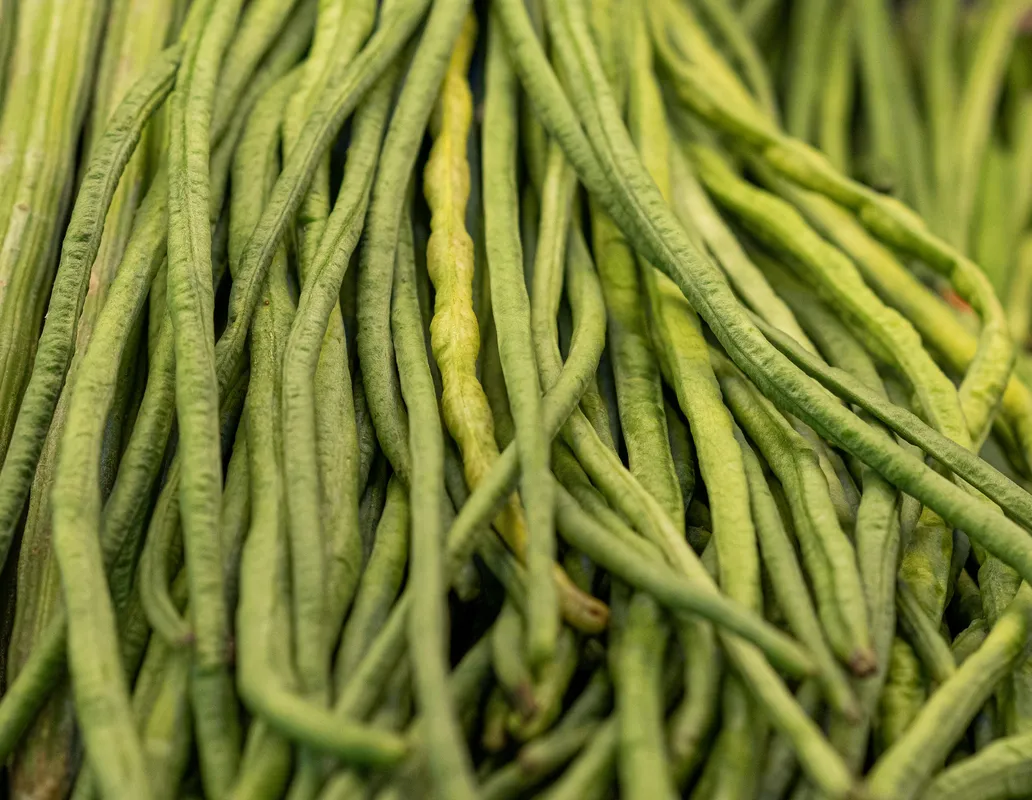
Yardlong beans earn their name from the pods, but their growing habit matters more than their maximum length. These are vigorous, twining vines that want summer heat, vertical support, and regular picking. Give them those conditions and they can keep flowering while ordinary snap beans are struggling with heat.
Also called Chinese long beans, asparagus beans, snake beans, or dau gok, they are Vigna unguiculata subsp. sesquipedalis. They resemble pole snap beans, but they are a form of cowpea rather than a common bean in the genus Phaseolus. The USDA Natural Resources Conservation Service describes vines that may reach 9 to 12 feet and pods that lengthen rapidly after pollination. A six-foot trellis can manage the crop, but the vines may continue above it and fold back over the top.
Check soil warmth before sowing, moisture before watering, and pod development before harvesting. Local conditions will determine the timing.
Start with the right conditions
Choose a location with full sun, well-drained soil, and enough vertical clearance for a substantial trellis. General bean guidance from Utah State University Extension calls for full sun and well-drained soil; shade may support vines, but it usually reduces the energy available for flowering and pod production.
Warmth is the key difference between yardlong beans and many familiar snap beans. UF/IFAS Extension reports good growth in warm climates with average monthly temperatures of about 68°F to 86°F and warns that cold, frost, and waterlogged soil injure the crop. Clemson Cooperative Extension likewise classifies yardlong beans as a warm-season vegetable that tolerates high temperatures but not cold.
Use that information as a decision rule:
- If the soil is still cold or saturated, wait. Seed can rot or emerge poorly in cold, wet ground.
- If frost is still plausible, wait or protect the planting. A warm afternoon does not make a settled warm season.
- If the site stays soggy after rain, improve drainage or use a raised bed or container. Heat tolerance does not equal tolerance of waterlogged roots.
- If your warm season is short, choose an early-maturing cultivar and the warmest sunny microclimate available. Days-to-harvest on a seed packet are estimates, not deadlines.
Pod color, mature length, tenderness, and time to harvest vary by cultivar. Let the seed packet refine the general directions below. Any disease-resistance claim applies only to the diseases specifically named.
Build the trellis before sowing
The support should be in place before roots and vines make later installation awkward. UF/IFAS notes that a six-foot trellis supports the climbing vines and makes harvest easier, even though plants can grow taller. Use a firmly anchored wire panel, strong netting on posts, a fence with added strings, or a pole structure with many narrow climbing lines.
Plan for wind. A light cage pushed into potting mix can tip under a mature vine. Anchor a container trellis where permitted, use a weighted freestanding frame, or choose a broad, heavy planter. Keep vines away from utilities, neighboring property, and places that cannot be reached safely.
Guide young shoots toward the support without tight ties. Once they begin twining, inspect the top every few days and redirect wandering stems. Do not rely on a short balcony rail alone: pods hanging outside a railing may be unreachable and can fall beyond the growing space.
Sow after the soil warms
Direct sowing is simple and avoids holding fast-growing transplants in small cells. Clemson recommends planting yardlong bean seed 1/2 to 1 inch deep and about 3 inches apart after the soil has warmed thoroughly. Follow the cultivar packet if it differs, then thin crowded seedlings rather than leaving a dense wall of vines.
Use these steps:
- Loosen the bed and remove perennial weeds.
- Use a soil test to guide lime and fertilizer. UF/IFAS gives a preferred soil pH of 5.5 to 6.5, but local laboratory recommendations should take priority.
- Sow into soil that is moist and crumbly rather than muddy, placing the seed beside the trellis.
- Water gently to settle the seed without crusting the surface.
- Keep the seed zone evenly moist while germination is underway, then thin for airflow and access.
Make containers large and stable
Yardlong beans can grow in containers, but “fits in a pot” does not mean “thrives in a small pot.” University of Maryland Extension cautions that undersized containers restrict roots, dry faster, and undergo sharper temperature swings. Its two-gallon minimum is for bush beans, not for 9- to 12-foot yardlong vines.
The Maryland guide’s two-gallon minimum applies to bush beans and should not be treated as a yardlong-bean recommendation. Choose a broad, stable container with enough volume to buffer moisture and temperature changes at the site. More root volume becomes especially useful where conditions are hot, windy, exposed, or difficult to water consistently. Crowding several vigorous vines into a small grow bag creates a thirsty, top-heavy planting with tangled foliage.
Use container mix rather than garden soil, keep drainage holes open, and leave headspace for watering. Check moisture below the surface daily during hot or windy periods, but water only when needed. Maryland Extension recommends watering until excess drains out instead of giving shallow sips on a fixed schedule.
Water and feed for pods, not just leaves
Established yardlong beans tolerate heat and some drought, but that does not mean dry soil produces good snap pods. Clemson warns that low soil moisture makes the pods shorter and more fibrous. Water when the upper root zone begins to dry, wetting the soil deeply, and use mulch to slow evaporation. During flowering and pod development, avoid large swings between bone-dry and saturated soil.
Aim water at the soil instead of repeatedly wetting the canopy. If prolonged rain keeps the bed wet, pause irrigation and restore drainage. In a container, empty standing water from an outer cachepot or saucer.
Yardlong beans form nitrogen-fixing nodules when compatible bacteria are present, but that ability is not a reason to skip soil testing or all fertility. It is a reason to avoid indiscriminate high-nitrogen feeding. Excess nitrogen can favor leafy growth over pods. Use the soil-test recommendation in the ground; in containers, follow a fertilizer labeled for edible container vegetables and do not exceed the label. UF/IFAS notes that a crop-specific fertilizer recommendation is not yet available in its guidance, so precise homemade formulas are not well supported.
Read flowering problems by condition
When vines grow but do not yield, diagnose the environment before adding fertilizer.
- Few flowers: Recheck light, maturity expectations, and excessive nitrogen.
- Flowers drop during stressful weather: Keep moisture steady and allow conditions to change. Heat-tolerant does not mean every flower sets during every heat event.
- Short, fibrous pods: Harvest younger and correct dry soil; low moisture is a documented cause.
- Yellowing with wet soil: Check drainage and root health before feeding.
- White patches or recurring leaf disease: Improve spacing and airflow, avoid routine leaf wetting, remove badly affected residue, and obtain a local diagnosis.
Poor pod set is not proof that pollinators are absent. UF/IFAS reports bee-mediated pollination, so avoid spraying blooming vines or open flowers. If a pesticide becomes necessary, select one whose label includes the crop and identified pest, follow pollinator precautions, and observe the preharvest interval.
Use IPM instead of calendar spraying
Inspect vines at least weekly, and more often once hot weather accelerates growth. Look under leaves, along tender tips, and on developing pods. Aphids, beetles, caterpillars, mites, whiteflies, and several diseases can affect beans, but the likely problem varies by region. The UC Statewide IPM bean guide is a useful visual index; a local Extension office is better for confirming what occurs in your area.
Start with low-risk actions:
- remove weeds that hide pests and compete for water;
- prune only enough tangled or diseased growth to improve access and airflow;
- hand-pick larger pests when practical;
- use a firm water spray for a small aphid colony without soaking the canopy late in the day;
- preserve predators by avoiding broad, preventive treatments;
- remove spent vines and diseased debris at the end of the crop.
Some leaf feeding is tolerable. Treating an unidentified hole can kill beneficial insects without solving the cause. If damage is increasing, photograph the pest and both sides of affected leaves, then seek a diagnosis. “Natural” and “organic” products can still injure plants, pollinators, or people; the label remains the controlling instruction.
Harvest while pods are smooth
Pod length alone is a poor harvest test because cultivars differ. Pick when the pods have reached useful length but remain slim, smooth, flexible, and free of swollen seed outlines. USDA NRCS advises harvesting before seeds mature and expand; UF/IFAS reports that commercial harvest may begin roughly 40 to 70 days after sowing, depending on location, with daily picking once production starts. Your seed packet and the pod’s texture are better guides than a universal number.
Check vines daily or every other day in peak production. Hold the stem and cut or pinch the pod stalk so the flowering shoot is not torn. Keep picking tender pods to prevent hidden mature pods from consuming the plant’s resources. Pods that become bulged and firm are better treated as shelling or dry beans only if the cultivar’s seed is intended for that use and is fully cooked.
Use clean hands and a clean harvest container. Discard rotten pods and cut away damaged areas. Before preparing the beans, rinse them thoroughly under running water; do not use soap, detergent, or produce wash. Those practices follow current FDA fresh-produce guidance, which also notes that washing reduces but does not eliminate bacteria and that thorough cooking reduces risk. Refrigerate the harvest promptly and use it while the pods are still crisp.
For seed saving, allow a few healthy pods to mature and dry fully on disease-free plants. Keep them separate from the eating harvest, shell when dry, label with cultivar and year, and store cool and dry. Cross-pollination and seedborne disease can make saved seed differ from expectations, so purchase fresh seed when varietal purity or disease status matters.
The practical formula
Wait for genuinely warm soil, provide full sun and drainage, install a strong trellis, and keep moisture steady. In containers, give one vigorous vine real root volume and a support that cannot tip. Scout before treating, harvest by pod texture rather than record-setting length, and handle the crop as fresh produce.
Yardlong beans are heat-loving, not neglect-loving. Their best pods come from the same combination that makes most productive gardens work: suitable conditions, regular observation, and timely harvest.
Sources
- Long Bean: An Asian Vegetable Emerging in Florida (University of Florida Institute of Food and Agricultural Sciences Extension). Accessed August 25, 2026.
- Plant Guide: Yardlong Bean (USDA Natural Resources Conservation Service). Accessed August 25, 2026.
- Chinese Vegetables (Clemson Cooperative Extension). Accessed August 25, 2026.
- Growing Vegetables in Containers and Salad Tables (University of Maryland Extension). Accessed August 25, 2026.
- How to Grow Beans in Your Garden (Utah State University Extension). Accessed August 25, 2026.
- Beans: Home and Landscape (University of California Statewide Integrated Pest Management Program). Accessed August 25, 2026.
- Selecting and Serving Produce Safely (U.S. Food and Drug Administration). Accessed August 25, 2026.