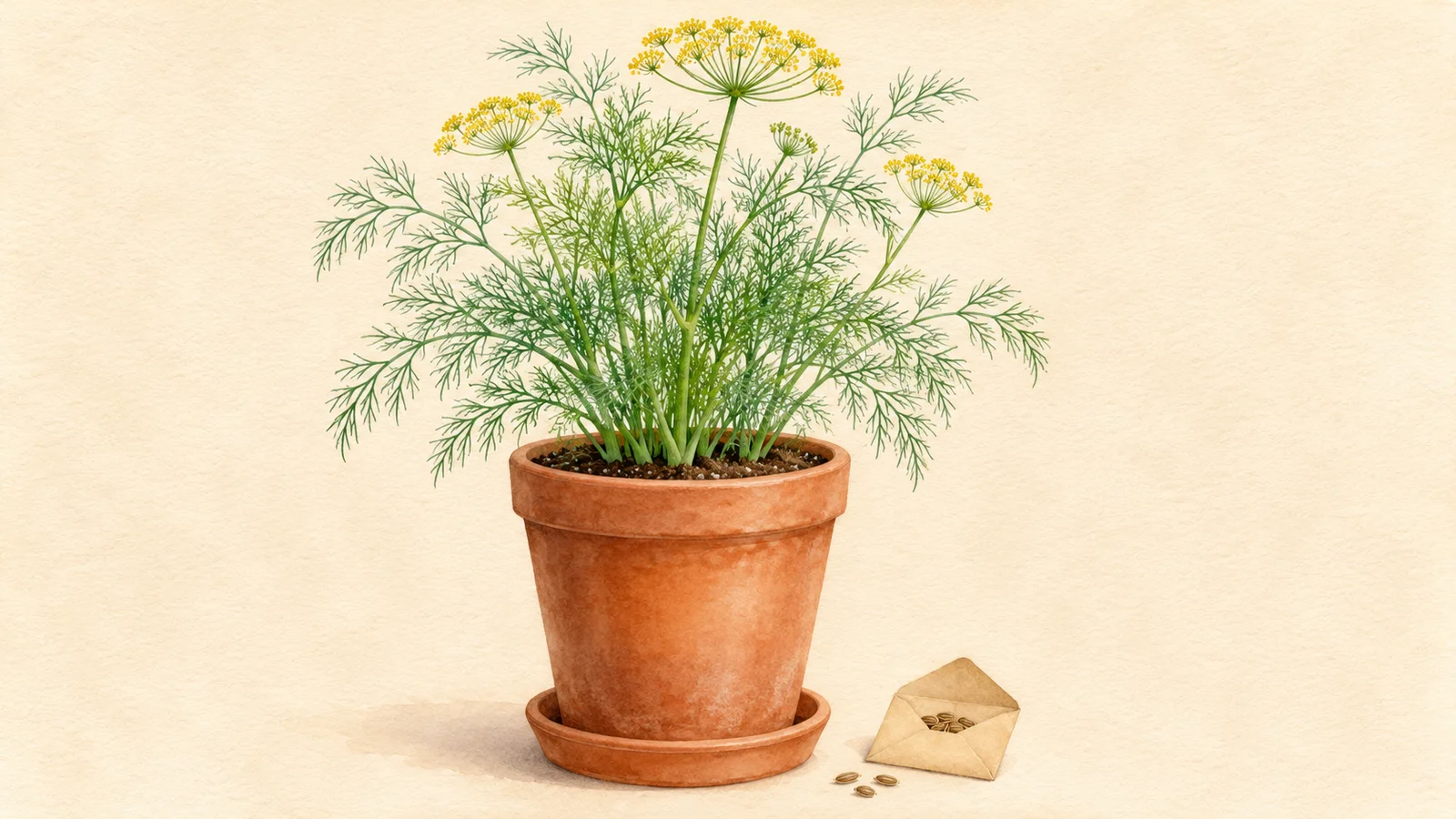
A pot of dill changes character as it grows. First come soft, finely divided leaves for snipping; later, stems stretch upward and open into yellow flower umbrellas. Both stages are useful. The disappointment comes from expecting the same plant to stay a low, leafy herb all season.
Dill (Anethum graveolens) is an annual. Plan for a succession of young plants if leaves are your priority, and let a separate plant flower if you want blooms or seed. A sunny balcony, patio or garden edge can provide the space without a full herb bed.
Choose a plant that fits the pot
For a container, look at the cultivar as well as the word “dill.” Illinois Extension lists compact choices such as ‘Fernleaf’ and ‘Ella’; tall ‘Mammoth’ makes a different-sized plant. Slow to bolt means slower to flower, not a plant that will never flower.
Choose seed sold for growing and keep the packet. Its variety, sowing directions and date will be useful when you compare later batches. If you buy a young plant instead, choose one that is still leafy and compact rather than already carrying flower stems. Delaware Extension’s dill guide distinguishes dense, leafy ‘Fern Leaf’ from early-flowering ‘Bouquet’, a useful reminder that not every variety has the same purpose.
Make room for roots and sunlight
Use a pot at least 12 inches wide and 12 inches deep, the container size recommended by the RHS. Check that it has drainage holes. Fill it with fresh container potting mix; a shallow decorative bowl is a poor match for dill’s taproot. Our pot-selection guide can help if you are comparing containers.
Outdoors, aim for six to eight hours of direct sun and shelter from strong wind, following Minnesota Extension. Tall, hollow stems can topple. Put the container somewhere stable before filling it, with enough room above for the variety’s mature height.
Indoor growing is possible, but light is often the limiting factor. A bright-looking room is not necessarily a sunny growing position. If winter light is weak, use suitable grow lights or wait for the outdoor season instead of expecting a generous windowsill harvest.
Sow where the dill will stay
Dill dislikes root disturbance, so direct sowing into its final pot avoids a transplant. For an uncomplicated outdoor start, wait until your local spring frost danger has passed. Follow the seed packet’s depth; Minnesota Extension gives a quarter inch as a general sowing depth. Scatter sparingly rather than emptying the packet into one pot.
Moisten the mix gently and keep the seed layer from drying out while it germinates. Label the sowing date. Garden Organic’s growing card gives a germination range of seven to 21 days, so an empty-looking pot after one week is not automatically a failure.
Thin the seedlings as they develop. Give them the spacing on the packet; Minnesota’s general guide is 10–12 inches between plants. One plant is a manageable starting point in a 12-inch pot. The whole packet does not need to survive in that container. If you already have a nursery plant, transfer its root ball gently rather than teasing the roots apart.
Water the mix, then let it drain
Check moisture below the surface before reaching for the watering can. Once the plants are established, water thoroughly when the mix is beginning to dry, allowing excess water to escape. Empty a collecting saucer. Maryland Extension recommends checking containers daily while learning how quickly they dry, especially in summer, rather than watering automatically every day.
Keep water aimed at the potting mix. A fine rose on the watering can helps avoid flattening seedlings. A windy day can dry a container faster than a still one, so yesterday’s condition is only a clue. Dill should not alternate between a bone-dry root ball and a standing puddle.
Check whether the potting mix already contains fertilizer before adding more. If feeding is needed, use a product labeled for edible container plants and follow its rate and interval. Extra fertilizer cannot replace light or correct a pot that stays saturated.
Harvest leaves while starting the next batch
Snip a few leafy sprigs once the plant has enough foliage to spare. Keep most of the plant intact and use the leaves promptly. The RHS advises leaving at least a third of the plant; with a small seedling, take much less than that maximum harvest.
For a longer supply, sow another small batch about every two weeks during the suitable growing season. Illinois Extension recommends this because leaf production declines after flowering. Use a second labeled pot so you can see which plants are coming along and which are nearing the end of their leafy stage.
Removing emerging flower stems can extend leaf production, but it does not make dill perennial. Hot, dry conditions can hurry flowering. Garden Organic emphasizes watering through dry spells; keeping a replacement sowing underway gives you another option when the older plant bolts.
Let some flowers finish
If you want seed, leave selected flower heads on the plant. Collect them as the seeds become tan to brown, before they scatter. Hang the cut heads in a dry, airy place with a paper bag around them to catch falling seed. Store only thoroughly dry seed in a closed container; Minnesota Extension cautions that moisture after storage means further drying is needed.
A yellowing plant with mature seed heads may simply be finishing its annual cycle. Yellowing young plants need a closer look at moisture, drainage and light. Delaware Extension also lists aphids and mildews among dill’s possible problems. Inspect affected growth before choosing a treatment; a symptom is not an insect identification. When the old plant is finished, the next labeled pot can take its place.
Sources
- Growing dill in home gardens (University of Minnesota Extension). Accessed November 26, 2026.
- How to Grow Dill (Royal Horticultural Society). Accessed November 26, 2026.
- Dill (University of Illinois Extension). Accessed November 26, 2026.
- Dill (University of Delaware Cooperative Extension). Accessed November 26, 2026.
- Growing Vegetables in Containers and Salad Tables (University of Maryland Extension). Accessed November 26, 2026.
- Dill growing guide (Garden Organic). Accessed November 26, 2026.