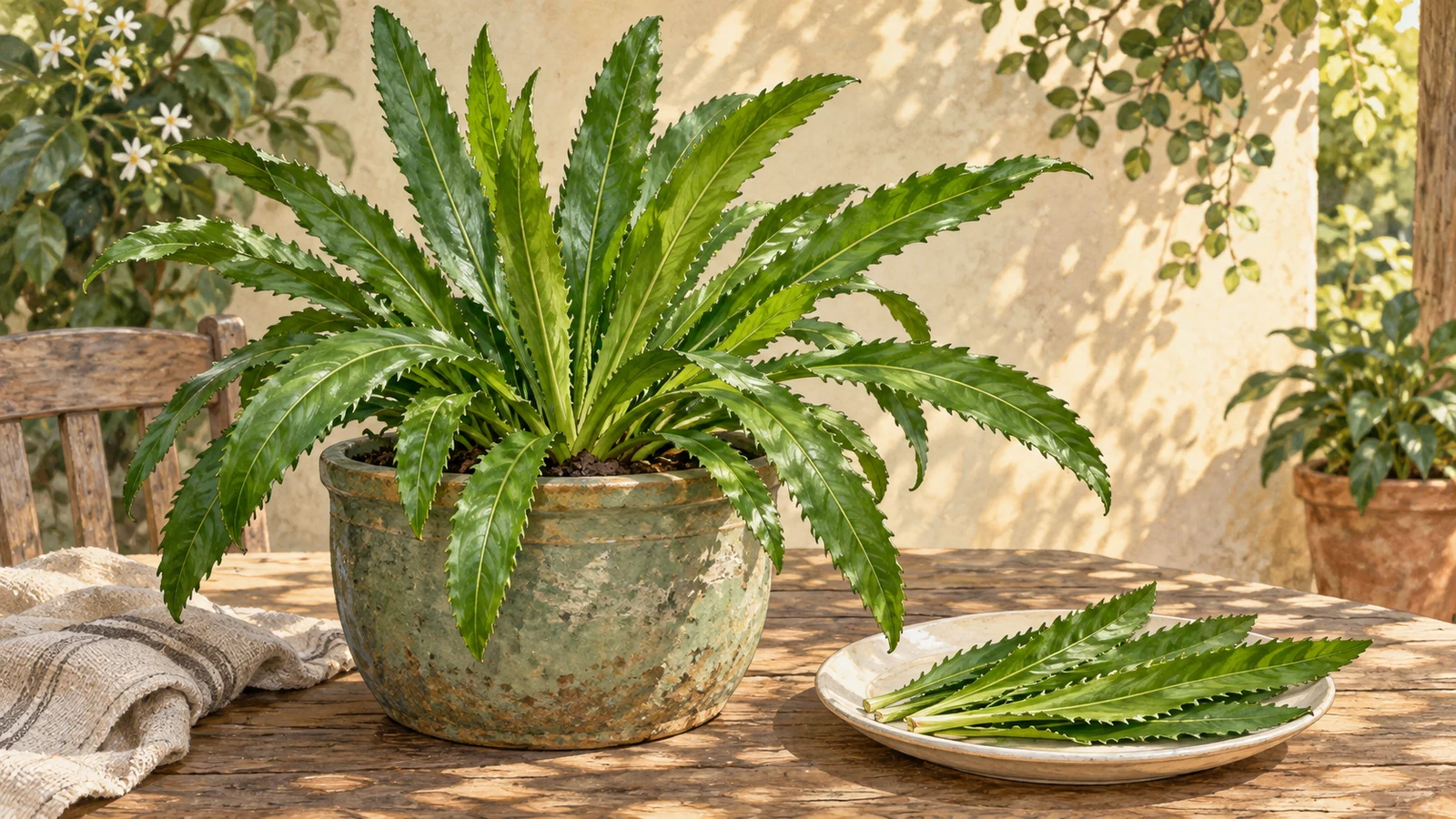
A culantro leaf looks ready for a task that a feathery sprig of cilantro could never manage. It is long, substantial and edged with little teeth. The plant stays low, opening new leaves from its center rather than building a branching canopy above the pot.
For a cook who uses only a few leaves at a time, that shape suggests a pleasant sort of herb garden: one accessible container, a small harvest, and room for the center to keep growing. The challenge is to give this warm-climate herb enough light without assuming it wants the hottest patch of the patio.
First, find the right rosette
Culantro is Eryngium foetidum. Kew’s Plants of the World Online accepts that name and places the species in the wet tropics, with a native range from Mexico through tropical America. It is also grown and eaten in parts of Asia.
A label may say sawtooth coriander, recao or culantro. None of those names makes it the same plant as cilantro, Coriandrum sativum. Nor is it rau răm, Persicaria odorata, which is also sold under the confusing name Vietnamese coriander. The botanical name on a seed packet or nursery label is the useful tie-breaker.
The Singapore National Parks Board profile describes long, toothed leaves arranged in a basal rosette. In plain language, the leaves radiate from a low central growing point. Buy a labeled culinary plant rather than collecting something with a similar outline from a path or garden bed. A smell or an illustration is not enough to establish that an unknown plant is food.
If what you want is the familiar delicate cilantro leaf, use the separate cilantro growing guide. Culantro offers a related flavor, not an identical plant or texture.
Give shade a job, not a guarantee
UF/IFAS recommends shade for culantro and notes that it helps delay flowering. NParks lists both sun and semi-shade, also describing delayed flowering under partial shade. For a container grown mainly for leaves, a bright position with shelter from harsh afternoon sun is a sensible starting choice.
Watch where the light actually falls. A patio shaded by a tree still receives daylight from the open sky. A shelf several feet inside a dark room does not offer the same conditions merely because both places lack direct sun.
Place the pot where you can see its center and reach the outer leaves. Check the pot each day for new growth, leaf damage, moisture and changes in its exposure; add water only when the medium needs it. Seasonal shadows move. A spot that was protected in early summer may receive a strip of strong late-afternoon sun later on.
Build around the plant, not around a watering date
Choose a container with room for the rosette to spread and with open drainage holes. Fill it with fresh, lightweight container mix. Maryland Extension’s herb guidance recommends well-draining pots and soilless medium; heavy soil dug from a garden is not necessary for this project.
Aim for steady moisture without a permanently waterlogged pot. Touch the medium below the surface before adding water. When it needs watering, wet the root zone and let the surplus drain. Empty a catch tray rather than leaving the pot soaking. A plant in shade may use water differently from the sunny tomatoes beside it, so sharing a patio does not mean sharing a watering schedule.
Fertilizer needs depend partly on what is already in the mix. Follow the container-use directions on an edible-crop fertilizer and account for any nutrients supplied with the potting medium. Maryland Extension’s container advice cautions that excess fertilizer can accumulate as salts and damage roots.
A small start is enough
A healthy transplant makes the starting plant easy to inspect. Look for an intact center and firm leaves rather than a collapsed, sour-smelling root ball. Keep the crown at its previous planting level and settle the medium around the roots without packing it hard.
Seed is another route. UF/IFAS gives roughly three weeks for germination, so an apparently quiet seed pot is not necessarily a failed one. Follow the packet’s sowing-depth and temperature directions, keep its surface from drying out, and label the pot. Avoid repeatedly digging through it to check for roots.
Thin seedlings according to the seed supplier’s spacing rather than leaving every sprout in a crowded clump. If several plants arrive together, find their individual centers before deciding whether they need separate containers. The space you leave now is where the broadening rosettes will sit later.
Take a leaf, leave the center
Harvest a few mature outer leaves while allowing the younger central leaves to develop. UF/IFAS notes that culantro keeps poorly after harvest and that the tougher leaves are useful finely chopped. Picking what the meal needs is more practical than stripping a pot to fill a storage box.
Use clean scissors or a clean knife and avoid injuring the crown. Check the undersides as you harvest. Flower stalks and their surrounding leaves can be sharp; handle them carefully. NParks notes that leaves become tougher after flowering. Removing a developing flower stalk may help keep the plant convenient to harvest, but do not expect one aging rosette to supply tender leaves indefinitely.
Rinse harvested leaves under plain running water and dry them with a clean towel. The FDA’s produce guidance recommends clean hands and utensils, not soap or household cleaners on the food. Keep the harvest away from dirty potting equipment while preparing it.
Decide what happens when warmth leaves
Kew describes culantro as a tropical biennial; NParks notes that it can behave as a perennial in Southeast Asia. Neither description promises that a pot will survive a freezing winter or keep producing at summer speed indoors.
Before frost, choose between finishing the outdoor crop and moving a healthy plant into a suitable indoor growing space. Inspect it first, keep it away from other houseplants while checking for pests, and provide enough light. Maryland Extension warns that indoor herbs can need supplemental lighting during winter and should be kept away from drafts and heat vents.
If there is no warm, well-lit place available, harvesting the remaining usable leaves and starting again next season is a reasonable finish. A small seasonal herb pot does not have to become a year-round obligation.
Sources
- Culantro (University of Florida IFAS Gardening Solutions). Accessed September 12, 2026.
- Eryngium foetidum (Singapore National Parks Board). Accessed September 12, 2026.
- Eryngium foetidum L. (Royal Botanic Gardens, Kew). Accessed September 12, 2026.
- Growing Herbs in Containers and Indoors (University of Maryland Extension). Accessed September 12, 2026.
- Growing Vegetables in Containers and Salad Tables (University of Maryland Extension). Accessed September 12, 2026.
- 7 Tips for Cleaning Fruits, Vegetables (U.S. Food and Drug Administration). Accessed September 12, 2026.