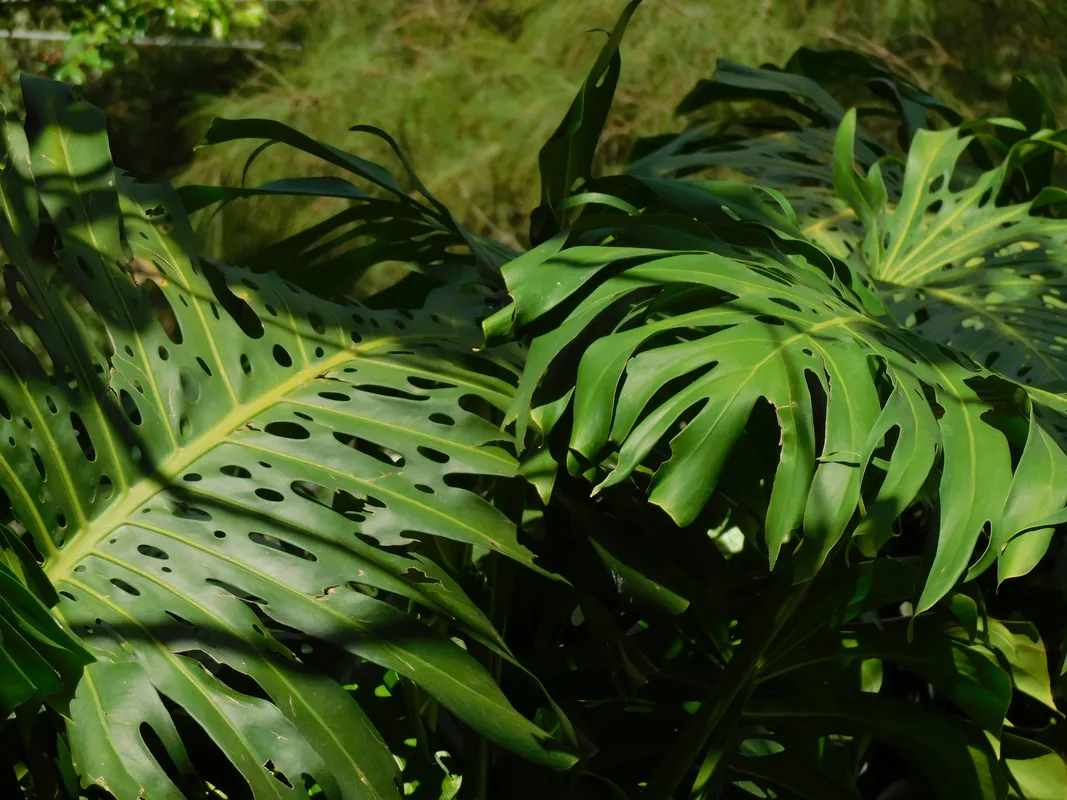
Solid leaves on a young Monstera deliciosa are normal. Fenestrations, the internal holes and cuts that reach a leaf margin, are features of progressively more mature foliage, not a repair response that appears later on an existing leaf. A leaf that has unfurled without holes will remain that way.
When several successive leaves remain small and entire, the useful question is not “How can this leaf be made to split?” It is “What is limiting the next stage of growth?” Plant identity and developmental stage come first, followed by light, climbing support, root-zone health, temperature, and nutrition.
First confirm the plant
“Swiss cheese plant” and “split-leaf philodendron” are inconsistent trade names. Monstera deliciosa is in the arum family, Araceae, but it is not a philodendron. University of Wisconsin Extension describes juvenile M. deliciosa leaves as small and uncut, with deep clefts and oblong perforations developing as foliage matures.
Several commonly confused plants follow different patterns:
| Plant | Typical mature leaf pattern | Why identification matters |
|---|---|---|
| Monstera deliciosa | Larger leaves can develop both internal holes and deep marginal cuts | Juvenile leaves are normally entire |
| Monstera adansonii | Smaller leaves with prominent oval internal holes | It does not become a giant-leaved M. deliciosa |
| Thaumatophyllum bipinnatifidum | Deeply divided or lobed margins without M. deliciosa-style internal holes | It is often mislabeled “split-leaf philodendron” |
University of Minnesota Extension explains the distinction between mature M. deliciosa, which has holes and cuts, and T. bipinnatifidum, which has deep cuts but not the internal “Swiss cheese” holes. Check the botanical label, stem and leaf pattern, or ask an Extension horticulturist to confirm an uncertain plant before changing care.
Read the sequence, not one leaf
One solid leaf is not evidence of failure. A recently rooted cutting, divided plant, damaged growth point, or vine adapting to new conditions may temporarily produce simpler foliage. Compare at least the last three fully hardened leaves on the same vine.
| New-leaf trend | Likely interpretation | Priority check |
|---|---|---|
| Each leaf is larger and beginning to cut or perforate | Normal progression | Keep conditions stable |
| Leaves are healthy and larger but still entire | Plant may still be juvenile | Continue appropriate light and support |
| New leaves become progressively smaller with longer bare stem between them | Light or root-zone limitation | Measure placement and inspect care history |
| New leaf is pale, scorched, or distorted | Environmental injury or pests | Diagnose damage before pursuing fenestration |
| One vine matures while another in the pot stays juvenile | Different stems have different growth stage or access to light/support | Evaluate each vine separately |
| Growth has stopped entirely | Broader care problem | Check roots, moisture, temperature, pests, and season |
Variegated cultivars and individual seedlings can grow at different rates. There is no reliable indoor age or number of months at which every plant must produce its first hole. A promised countdown ignores genetics and growing conditions.
Light is a major control
Inadequate light is one of the strongest reasons an established plant keeps producing small, simple leaves. Wisconsin Extension states that Monstera grown with inadequate light will not develop leaf perforations. Penn State Extension recommends a bright location without direct sun and notes that lower light can produce leggy growth.
Assess light across the day rather than using a room label such as “bright.” A plant several feet from a window, behind an overhang, or shaded by outdoor trees may receive far less light than expected. Signs that strengthen the low-light diagnosis include increasingly long internodes, a vine leaning toward the window, smaller new blades, slow drying mix, and little new growth.
Move the plant closer to a suitable window gradually. Protect it from abrupt intense sun, which can bleach or scorch foliage. A grow light can supplement poor natural light, but select and position it according to the manufacturer’s plant-light instructions; an ordinary room lamp does not necessarily provide useful intensity. Existing leaves will not gain fenestrations after the move. Judge the response only in future growth.
Give the vine a climbing framework
M. deliciosa is a climbing vine that uses aerial roots to attach to trunks and branches. Missouri Botanical Garden recommends a pole or trellis indoors and notes that unsupported plants tend to grow horizontally. Wisconsin Extension likewise recommends a strong bark or moss-covered support.
Climbing support helps the plant maintain an upright growth pattern associated with mature foliage, but it is not a stand-alone guarantee of holes. A dark, waterlogged plant tied to a pole still lacks the resources for strong growth.
To establish support:
- Choose a rigid pole, plank, or trellis tall enough for the current vine.
- Anchor it securely, ideally during a necessary repot when roots can be seen.
- Face the back of the vine toward the support. This is the side that produces aerial roots.
- Attach the main stem with broad, soft ties, leaving room for expansion.
- Never bind the petioles, unfurling leaves, or growing tip.
- Inspect ties and pot stability as the plant gains weight.
Guide flexible aerial roots to the support without forcing sharp bends. A lower root can be directed into the potting mix if it reaches naturally. Do not keep the root zone saturated to make a moss pole wet, and do not let the plant attach to walls or furniture that could be damaged.
Keep roots functional
Fenestration is secondary when roots are stressed. Monstera needs a well-drained container mix that holds some moisture without remaining saturated. Wisconsin Extension advises thorough watering followed by slight drying, and Penn State warns that overwatering can cause root rot.
Use actual moisture instead of a fixed weekly schedule:
- Test below the surface and compare pot weight.
- Water the full root ball when the upper layer has dried appropriately.
- Let excess water leave through a working drainage hole.
- Empty saucers and cachepots.
- Adjust the checking interval as light, temperature, pot size, and growth change.
Yellowing, soft stems, persistently wet mix, or an abnormal odor point toward excessive moisture or root decline. Crispy margins, a very light pot, and mix pulled from the sides support drought, but damaged roots can also leave foliage wilted while soil is wet. Inspect the roots before assuming.
A severely root-bound plant may dry rapidly and stall, but one root at a drainage hole is not enough evidence. Repot when a dense root mass has displaced most mix or the container can no longer be watered effectively. Increase pot size modestly. An oversized pot can retain excess water and does not force larger leaves.
Temperature, humidity, and nutrition are supporting factors
Stable warmth supports tropical growth; cold drafts slow or injure it. Wisconsin Extension reports that M. deliciosa stops growing below 50°F and is killed by frost. Keep it away from cold glass, exterior doors, and air-conditioning outlets.
Moderate to high humidity can reduce dry edges and help new leaves unfurl, but a humidifier cannot compensate for weak light or failed roots. Do not diagnose low humidity from solid leaves alone. Pebble trays and occasional misting are unlikely to transform room-wide humidity; monitor the room with a hygrometer if dryness is a concern.
Feed only a healthy, actively growing plant. Use a complete houseplant fertilizer at the label rate, accounting for any nutrients already in the potting mix. Deficiency is more plausible when new growth is pale or progressively small despite appropriate light and roots. Overfertilizing can injure roots and will not “buy” fenestrations. If salt crust appears, review fertilizer and water practices before adding more.
Rule out pests and physical damage
Inspect new growth and leaf undersides for the indoor pests listed by Wisconsin and Penn State Extension: thrips, mites, scale, mealybugs, and aphids. Pest feeding can scar or distort an unfurling leaf. Isolate the plant, identify the pest, and use only a control labeled for that pest and indoor ornamental plants.
Mechanical tears are not fenestrations. Cuts made with scissors will not signal the plant to form natural holes, and pruning healthy leaves reduces photosynthetic area. Protect unfurling leaves from being handled or manually opened; damage at that stage remains after the blade hardens.
Changes that do not force splits
- Cutting holes into an existing leaf
- Removing all juvenile leaves
- Moving the plant abruptly into intense direct sun
- Applying extra fertilizer to a stressed plant
- Repotting into a dramatically oversized container
- Keeping mix constantly wet
- Misting leaves as the sole response
- Buying a pole without attaching and orienting the vine correctly
Each action either fails to address development or adds a new stress. Improvement should be judged by the size, spacing, color, and natural fenestration of later leaves.
A practical next-growth plan
- Confirm the plant’s botanical identity.
- Photograph and measure the newest three hardened leaves.
- Map direct and indirect light at several times of day.
- Move gradually to brighter indirect light if current placement is inadequate.
- Install stable climbing support and secure only the main stem.
- Verify drainage and water from root-zone evidence.
- Inspect for pests, cold exposure, and root decline.
- Fertilize only if the plant is healthy and actively growing.
- Reassess after several new leaves, not after several days.
If future leaves remain progressively smaller despite verified light, sound roots, stable warmth, and support, ask a local Cooperative Extension office or horticulturist to review photographs and care records.
Child and pet safety
Monstera leaves, stems, and roots contain irritating calcium oxalate crystals. Keep the plant and cuttings away from children, wear gloves if sap irritates the skin, protect eyes during pruning, and wash tools and hands afterward. For a human exposure, contact Poison Control in the United States at 1-800-222-1222 or the appropriate regional service; difficulty breathing or swallowing needs urgent medical care.
The ASPCA Animal Poison Control Center lists M. deliciosa as toxic to dogs and cats. Chewing can cause oral burning, drooling, vomiting, and difficulty swallowing. Contact a veterinarian or animal poison-control service after ingestion and do not induce vomiting unless directed.
Fenestration is the result of plant identity, developmental stage, and sustained growing conditions. Create the conditions for healthy mature growth; do not try to manufacture holes in foliage that has already formed.
Sources
- Monstera as a Houseplant (Penn State Extension). Accessed August 5, 2026.
- Swiss-Cheese Plant, Monstera deliciosa (University of Wisconsin–Madison Division of Extension). Accessed August 5, 2026.
- Monstera deliciosa (Missouri Botanical Garden Plant Finder). Accessed August 5, 2026.
- Propagating Monstera deliciosa (University of Minnesota Extension). Accessed August 5, 2026.
- Swiss Cheese Plant (ASPCA Animal Poison Control Center). Accessed August 5, 2026.