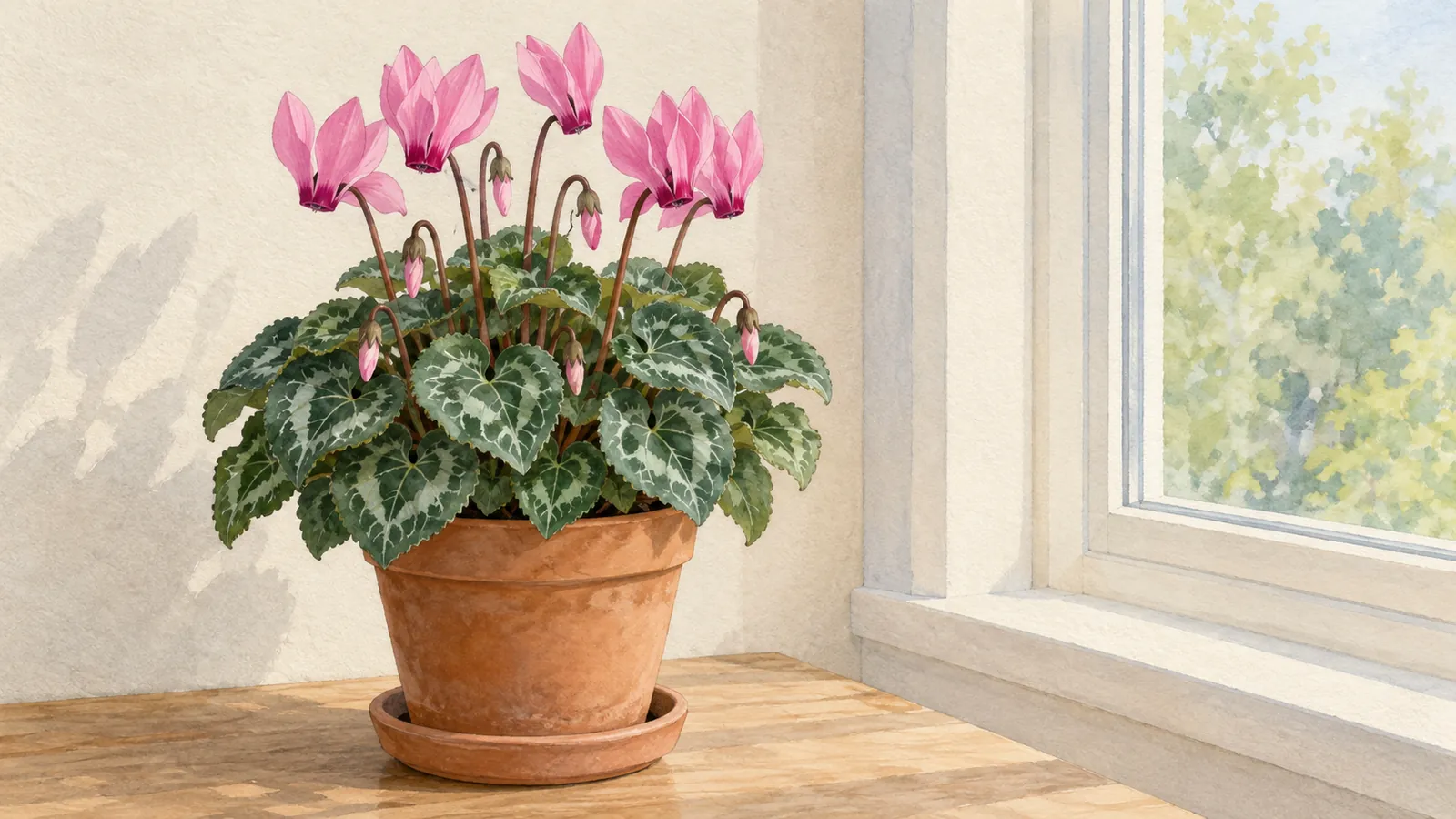
The warmest windowsill in the house is rarely the best place for a flowering cyclamen. Its swept-back petals may look tropical, but florist’s cyclamen keeps its flowers longer in a cool, bright room. Choose that place before deciding whether there is room for another pot on the shelf.
Look for Cyclamen persicum or florist’s cyclamen on the label. These tender plants are different from hardy garden cyclamen sold for outdoor beds. NC State’s species profile identifies florist’s cyclamen as frost-tender, with growth and flowering in the cooler part of the year and a summer rest. A cold-tolerant reputation for the genus is not permission to leave this pot outside through a freeze.
Choose a plant with flowers still to come
An open flower catches the eye, but the buds below it tell you more about the display ahead. Iowa State recommends a healthy, dark-green plant just beginning to flower, with unopened buds beneath the leaves. Lift or part the foliage gently enough to see the center without snapping a flower stem.
Check how the plant is actually potted. A decorative sleeve can hide a nursery pot, and a handsome outer container can hide water underneath it. You need to be able to remove the inner pot, inspect its drainage holes and let excess water escape. Put the label somewhere you can find it later, especially if it names a cultivar with its own care directions.
Before bringing it home, consider who can reach it. ASPCA lists cyclamen as toxic to cats and dogs; eating large amounts of the tuber can cause severe poisoning. Keep the whole plant and discarded material inaccessible to pets and children. If a pet may have eaten it, contact a veterinarian or animal poison service promptly rather than waiting for symptoms. A different plant is the better purchase when you cannot provide a suitable place out of reach.
Cool does not mean dark or freezing
Give the plant bright, filtered light. An east-facing window is a useful starting point, but check the actual room: buildings, curtains and the season can change how much light reaches the leaves. Keep it clear of a heater’s dry airflow and away from a door that repeatedly admits freezing air.
The temperature recommendations are cool-room targets, not a demand for one exact thermostat setting. Wisconsin Extension gives ideal days of 60–65°F and nights around 50°F, while noting that modern hybrids tolerate a wider range. Iowa State recommends 50–60°F. Avoid a hot display spot, but do not chase a low reading by pressing foliage against cold glass.
The RHS growing guidance likewise emphasizes filtered light, moderate humidity and avoiding hot, dry air. A room thermometer near the pot can help you compare possible locations. Choose one where you can also reach the soil surface and lift the plant for watering.
Water the mix without flooding the center
During active growth, check the surface of the potting mix daily. If it still feels moist, wait. When the surface is dry to the touch, water thoroughly; do not turn the daily check into a daily watering appointment. The aim is moist root conditions with drainage, rather than a constantly saturated pot.
NC State recommends watering along the edge of the pot or from below, keeping water away from the crown where the stems emerge. Bottom watering can be convenient with a dense leaf canopy. Stand the pot in a shallow container of water long enough for the mix to take it up, then lift it out and drain it. Wisconsin describes a roughly 15-minute soak; absorption and the condition of your mix still need checking.
Empty the saucer or outer pot after drainage. Leaving the plant standing in its soak water defeats the purpose. If you water from above instead, direct the stream toward the mix at the rim and keep the tuber and central growth dry.
Read yellow leaves in context
A yellow leaf does not identify one problem. Wisconsin lists excessive wetness, dryness, hot dry conditions and insufficient light among possible causes. Check the mix and the plant’s position before adding either more water or fertilizer. Limp foliage in dry mix presents a different situation from a collapsing plant whose pot remains wet.
Remove spent flowers and dead leaves as part of regular care, without damaging the emerging buds. Feed only during active growth, using a suitable flowering-houseplant fertilizer according to its label; the RHS recommends a low-nitrogen feed. Fertilizer cannot compensate for a hot room or restore air to saturated roots.
When flowering gives way to rest
After the flowering season, a gradual yellowing and loss of leaves can signal dormancy. Do not assume the same explanation for a newly bought plant that abruptly collapses while its buds are still developing. Consider the season, recent conditions and how quickly the change happened.
As foliage naturally dies back, reduce watering and stop feeding. Keep a resting, leafless tuber from sitting in wet mix. When new growth returns, restore watering gradually and move it into bright, filtered light. If repotting is needed at the end of the rest, use a draining mix and leave the top of the tuber above the surface rather than burying it.
Reflowering takes suitable conditions and is not guaranteed in a warm home. Iowa State describes keeping a cyclamen for another season as possible but difficult. Decide whether you have a place for the resting pot; if you do, label it so its leafless period is not mistaken for a neglected pot that needs a thorough soak.
Sources
- Cyclamen (University of Wisconsin–Madison Extension). Accessed September 27, 2026.
- All About Cyclamen (Iowa State University Extension and Outreach). Accessed September 27, 2026.
- Cyclamen persicum (North Carolina Extension Gardener Plant Toolbox). Accessed September 27, 2026.
- Cyclamen persicum (Royal Horticultural Society). Accessed September 27, 2026.
- Cyclamen (ASPCA Poison Control). Accessed September 27, 2026.