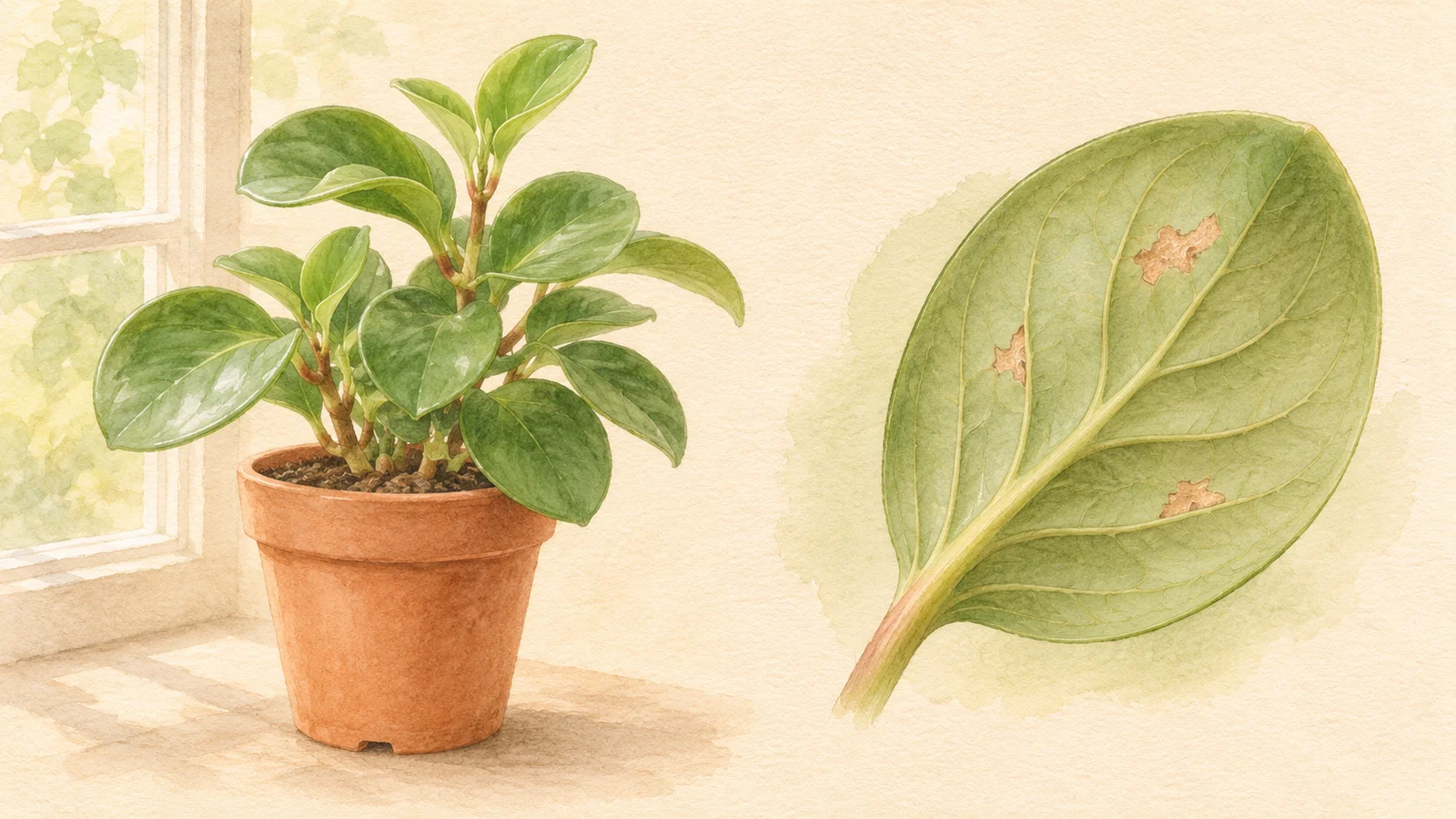
Turn over a leaf and you may find damage you missed from above: tiny blisters, rough tan patches or a crust that looks almost like something stuck to the surface. Edema, also spelled oedema, is one possible explanation. It is a problem within the leaf tissue, so scrubbing the marks away is not the answer.
Before changing care, look at the whole plant and the conditions around its pot. Corky spots alone do not prove edema. Pests and other leaf problems can look similar, and a plant can have more than one problem at once.
Follow the change from blister to scar
Wisconsin Extension describes edema as a physiological disorder: small, translucent, fluid-filled blisters can form, often on the undersides of older leaves. As the damaged tissue dries, the spots become tan or brown and corky. Several can merge into a larger rough area. Depending on the plant, stems or other tissues may also be affected.
You might first notice the dry scars rather than the watery stage. Look underneath several leaves, including a few that appear healthy from above, and compare older foliage with the newest growth. Take a clear photograph of the same leaf so you can tell whether you are seeing an old mark again or a genuinely new spot.
Edema is often mainly cosmetic, but severe damage and leaf loss are possible. It should not become a catch-all explanation for a plant that is rapidly collapsing. Maryland Extension’s indoor-plant guide emphasizes that its wartlike or crusty bumps are easily mistaken for insect or disease damage. Appearance starts the investigation; it does not finish it.
Rule out a living pest before reaching for a spray
Use good light and a hand lens to inspect leaf undersides, veins, petioles and nearby stems. Look for actual insects or mites, rather than treating every brown bump as one. The scale-insect guide explains how to examine a suspicious bump without scraping up an entire leaf.
UConn Extension describes how mite and thrips injury can resemble edema on ivy geraniums. Its guidance uses magnification to look for the pests themselves. The comparison is a reason to inspect closely, not a rule that every houseplant shows the same pattern of damage.
Avoid applying oil, soap or fungicide just to see whether the spots disappear. These products do not repair corky tissue, and Wisconsin notes that some oily sprays can themselves contribute to edema. If you find a pest, identify it and choose an appropriate response. If the evidence is unclear, photograph the leaf surface, its underside and the whole plant before asking a local extension service or plant clinic for help.
Check the pot’s moisture and the room together
The usual explanation is a mismatch between water entering through roots and water leaving through leaves. When uptake exceeds loss, cells can be damaged. Cloudy weather, high humidity and persistently wet growing medium can favor that mismatch, according to UC IPM’s edema guidance.
At home, start with observations you can act on. Is water trapped inside the decorative outer pot? Has a plant moved from a bright summer position to a dim shelf while receiving the same watering schedule? Are its leaves crowded into a still, humid corner? These are useful questions even when the final diagnosis remains uncertain.
Check the growing medium before adding water. Let it reach the appropriate drying point for that species, then water and allow drainage; do not impose a cactus-style dry spell on every plant with a blister. The RHS guidance cautions against both waterlogging and drying plants out. Empty collected water and make sure the pot can drain freely.
If the mix stays wet for an unusually long time, investigate the container, drainage and root condition instead of repeatedly adding smaller splashes. A foul smell, soft roots or substantial wilting calls for a wider assessment; the root-rot guide covers that separate problem. Repotting is a response to a demonstrated pot or root issue, not an automatic treatment for a few old leaf scars.
Improve the growing conditions without shocking the plant
Give the plant suitable light and some space around its foliage. Moving a low-light plant directly into harsh sun can create a second kind of damage, so make any light change gradually and stay within that plant’s needs. Improve ventilation around crowded pots without putting a cold-sensitive plant in a winter draft.
Review watering whenever seasonal light changes. A calendar can remind you to check a plant, but it cannot tell you whether today’s root ball is ready for water. The winter-watering guide helps make that check part of ordinary care.
There is no universal room setting that prevents every blister. UConn distinguishes some forms of edema from related growth disorders called intumescences, and reports that responses differ among plants and cultivars. Do not add calcium, extra fertilizer or a special lamp simply because a photograph online looks similar. An uncertain diagnosis is a good reason to seek help before buying a treatment.
Judge recovery by fresh growth
Existing corky tissue will not become smooth green leaf again. UC IPM explicitly notes that injured tissue cannot be restored. Keep your reference photo and watch whether fresh leaves develop normally as care improves, rather than checking the same scar each morning for disappearance.
Leave otherwise useful leaves in place. The RHS advises against picking off edema-affected foliage, because removing leaf area can worsen the water imbalance. If a leaf is dying or another problem is present, assess that separately; a few rough patches alone are not a reason to strip the plant.
If new damage continues, record the plant’s name, recent watering, any sprays, light changes and photographs over time for a plant clinic. That history is more useful than a close-up with no context. The goal is a plant making healthy new leaves, even while older leaves keep a record of an earlier rough spell.
Sources
- Edema (University of Wisconsin-Madison Extension). Accessed November 24, 2026.
- Oedema (Royal Horticultural Society). Accessed November 24, 2026.
- Edema on Indoor Plants (University of Maryland Extension). Accessed November 24, 2026.
- Non-Infectious Plant Disorders - Oedema and Intumescences (University of Connecticut Extension). Accessed November 24, 2026.
- Edema (University of California Statewide IPM Program). Accessed November 24, 2026.