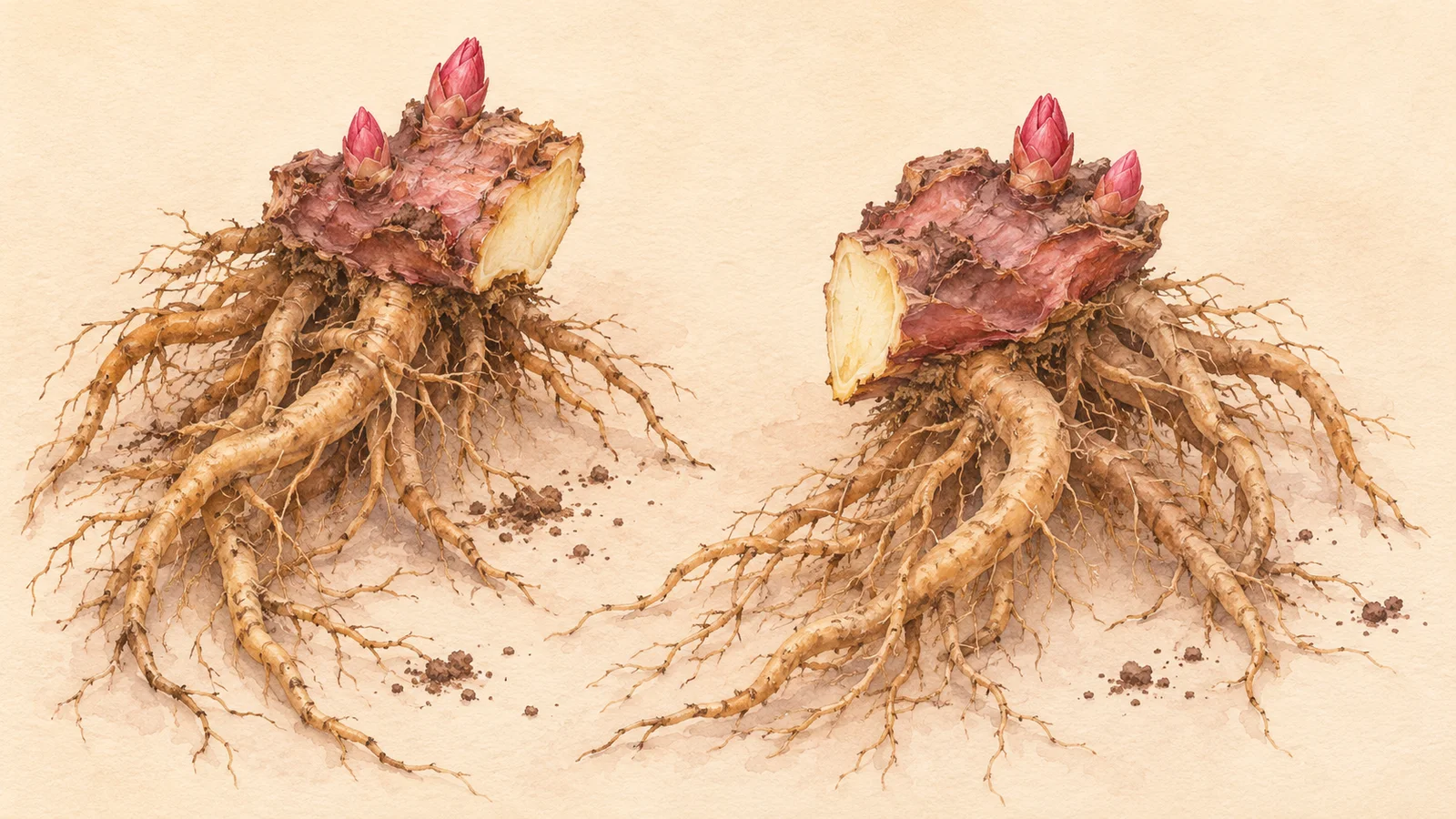
A rhubarb patch can outgrow its corner of the garden. Dividing the crown gives an established clump more room and produces plants to move or share. The piece that matters is below ground: a section of the crown carrying living buds and roots, not a handful of cut stalks.
Plan the job around dormancy and workable soil. A date on the calendar is less useful than knowing whether your plant has stopped growing and whether the ground can be dug without breaking frozen clods or smearing wet soil.
Decide whether this clump is worth dividing
An older plant producing many thin stalks may benefit from division. University of Maine Extension recommends splitting established crowns around every four or five years, or when small stalks become numerous. Before digging, consider whether shade, dry soil or repeated heavy harvesting could be contributing to weak growth. Moving pieces back into the same difficult conditions will not resolve those problems.
Start with a healthy, known culinary rhubarb plant. Do not propagate a crown with soft, decaying tissue or an unexplained history of decline. Keep the cultivar name if you have it; a shared division should arrive with its identity, not just the promise that it makes good pie.
“Rhubarb” is also used for ornamental plants. Wisconsin Extension’s profile distinguishes edible garden rhubarb from other plants carrying the name. Do not identify an unknown plant for eating from its red stalks alone. The leaf blades of culinary rhubarb are poisonous and must not be eaten; the edible part is the leaf stalk.
Choose spring if winter is already arriving
Early spring, before leaves develop, is a dependable division window in cold-winter gardens. Maine Extension favors it because the plant then has a growing season to rebuild its roots and reserves. Wait until the soil can be worked, but aim to finish before the crown has put out a large canopy.
Fall division is also possible, but its timing is regional. The RHS guide allows division from mid-autumn into early spring in its UK guidance. Maine’s fall advice is much earlier, before freezing closes the digging season. Do not translate a November planting suggestion into a universal instruction for a northern US garden.
If the ground is frozen or saturated, leave the crown in place. Mark its position, note the plants you intend to keep, and prepare for spring. There is no benefit in forcing the job through unsuitable soil just to finish it this weekend.
Prepare its next home first
Choose a sunny, well-drained place where the plants can stay for years. Allow roughly three to four feet between crowns, with more room for a particularly large variety. Keep the eventual leaves clear of a narrow path and avoid a spot where surrounding shrubs will shade the patch as they grow.
Remove perennial weeds before planting. Work finished compost through the future bed rather than making one rich pocket inside an otherwise poorly drained hole. Check the soil-testing guide before adding lime or fertilizer; dividing the plant does not tell you what nutrients the soil lacks. Have the new holes ready before lifting so the exposed roots spend less time drying in the air.
Keep buds and roots together
Clear dead foliage so you can see the crown. Dig around the clump and work underneath it with a spade, preserving as much root as practical. An old crown can be heavy; get help rather than lifting it awkwardly with your back.
Set it on a stable surface and inspect the growing points. These buds sit near the top of the chunky crown. Plan cuts between them, keeping roots attached to each section. South Dakota State University Extension recommends two or three buds per division. There is no need to turn a good crown into the largest possible number of tiny pieces.
Use a clean, sharp spade or sturdy knife, keeping hands clear of its path. Choose sound sections and discard weak or decayed portions. Do not plant a bud shaved off without its supporting root mass. Keep the divisions sheltered from drying wind while you finish, and replant promptly with the buds facing upward.
Set the depth for your garden
Planting-depth advice differs among regional guides. Iowa State Extension places the buds one to two inches below the soil surface. The RHS places the crown tip just above it. For divisions from a healthy local patch, South Dakota State advises returning the crown to its previous depth; note that level before lifting.
Use local extension guidance when establishing a new bed, especially where winter wetness is a problem. Dig a hole that accommodates the roots without bending the whole division sideways. Backfill gently, water thoroughly to settle the soil, and check the level again. Do not bury a crown deeply to make it feel more securely anchored.
During the first growing season, check soil moisture regularly and water during dry spells. New divisions cannot be treated like a large established patch with an extensive root system. Mulch around them to reduce weeds and moisture loss, keeping the growing points clear rather than piling material over the crown.
Let the new leaves rebuild the plant
Label each planting with its name and division date. Skip harvesting in the first growing season. Regional recommendations vary afterward: Iowa State advises leaving new plantings unharvested for two years, while other guides allow a few stalks in the second year from vigorous plants. A weak division needs more establishment time, whatever its birthday.
Leave the foliage to support recovery, and reserve winter forcing for strong established plants. If you are sharing divisions, pass along the planting date and the harvest pause. A new owner needs to know that the first flush of leaves belongs to the rebuilding crown before it belongs in the kitchen.
Sources
- When can I transplant rhubarb? (Iowa State University Extension and Outreach). Accessed November 7, 2026.
- Bulletin #2514, Growing Rhubarb in Maine (University of Maine Cooperative Extension). Accessed November 7, 2026.
- Rhubarb: How to Grow It (South Dakota State University Extension). Accessed November 7, 2026.
- How to Grow Rhubarb (Royal Horticultural Society). Accessed November 7, 2026.
- Rhubarb, Rheum rhabarbarum (University of Wisconsin–Madison Division of Extension). Accessed November 7, 2026.