Before the first icy morning, decide where the shoveled snow will go. The nearest planting bed may be convenient, but snow lifted from a salted walk carries that salt with it. A winter of small shovel loads can leave a tree or shrub receiving much more than the occasional splash.
Keep safe access to your home the priority. Protecting plants starts with removing snow efficiently, using deicer carefully and keeping the resulting slush away from vulnerable roots and foliage.
Follow the salt from pavement to planting
Salt reaches plants by two routes. Spray from a wet road can coat needles, leaves, twigs and buds. Meltwater can carry dissolved salts into the soil. The University of Minnesota’s landscape guidance describes foliage injury and root-zone dehydration, with roadside evergreens particularly exposed.
Walk the edge of your own drive or path during a thaw. Notice whether water enters a bed, pools beside a trunk or flows toward a low corner. Then look above ground: a hedge can sit outside that drainage route yet still receive splashes. These are different problems, so a screen in front of the leaves will not solve salty water entering the roots.
Move portable planters out of the splash zone before they become too heavy or frozen to handle safely. For permanent plantings, mark the vulnerable area on your snow-clearing plan. If someone else clears the property, show them the beds and the intended snow-storage space before a storm hides the edges.
Remove snow before reaching for more deicer
Shovel and scrape promptly, within your physical limits. Clearing what you can mechanically reduces the amount of chemical treatment needed. The Minnesota Pollution Control Agency’s salting advice also calls for sweeping up leftover salt from dry pavement for reuse.
Read the product’s application directions and temperature limits. Do not keep adding it simply because a stubborn patch remains icy; check whether the product suits the conditions. Use the lowest effective labeled amount, spread evenly over the area that needs treatment. A carpet of crystals is not the goal.
Sand can improve traction, but it does not melt ice. Sweep excess material from cleared pavement rather than washing it into a drain or pushing it into the garden. “Pet friendly” or “environmentally friendly” wording is not a promise that a product cannot harm plants. Do not substitute garden fertilizer for deicer; Wisconsin Extension warns that this can burn roots.
Keep treated snow and spray away
Choose a place for shoveled or blown snow that avoids tree and shrub root areas. Do not repeatedly bury the same small planting under salty slush. Chicago Botanic Garden identifies concentrated treated-snow piles and poorly drained runoff areas as sources of damaging salt buildup.
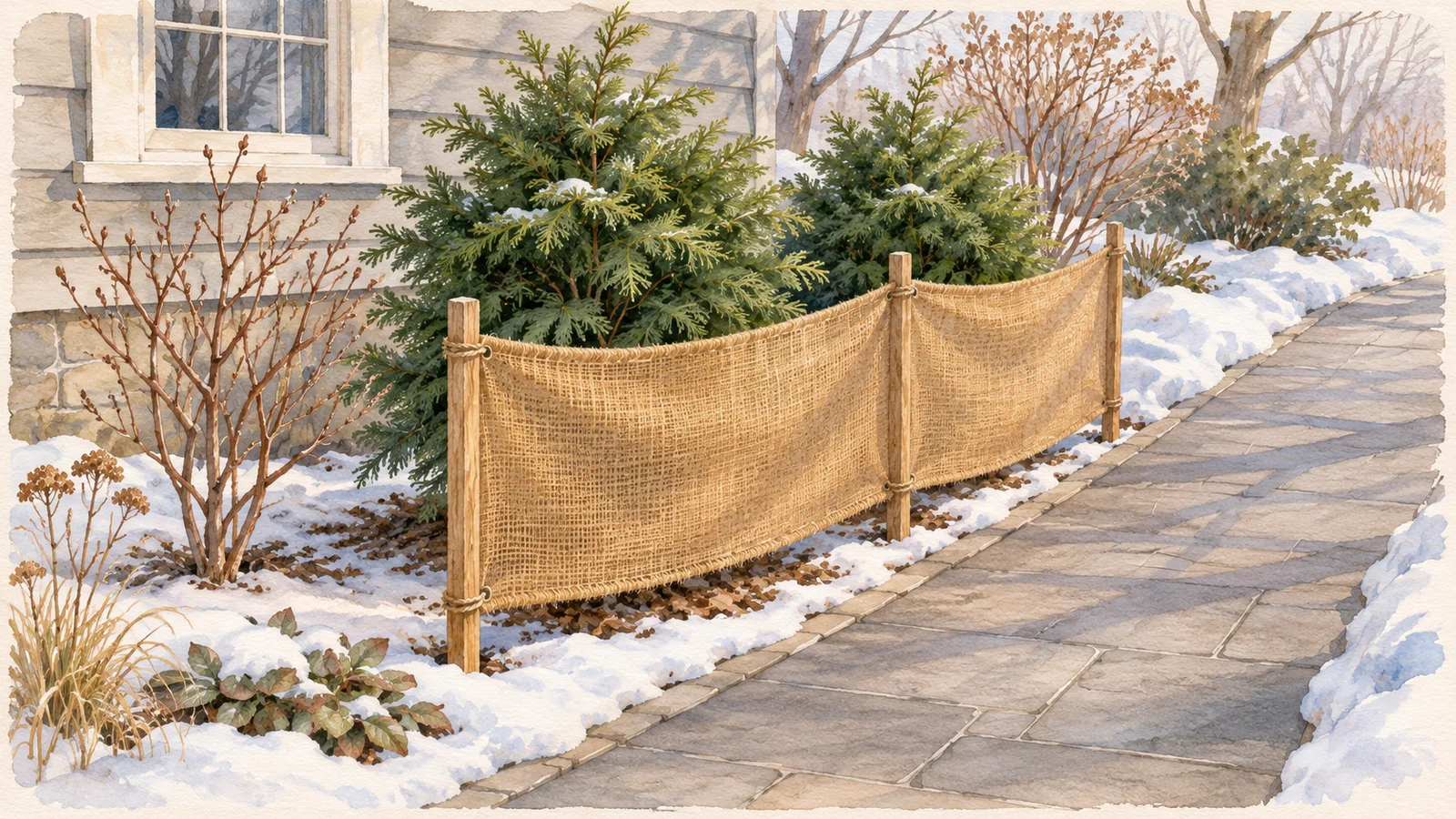
A seasonal burlap screen or snow fence can intercept some spray before it reaches a sensitive plant. Position it between the source and the foliage, with room for the plant and without obstructing the walkway or sightlines. Use the evergreen winter-screen guide for supports and clearance. A screen is protection from exposure, not a container for piling more snow against the shrub.
Check the arrangement after storms. A snow pile may have grown beyond its intended space, or runoff may now pass around a frozen mound into a bed. Adjust your own clearing pattern where practical. Changes to public-road drainage or snow operations belong with the responsible road authority, not an improvised garden barrier.
Read the pattern before treating brown foliage
Salt spray injury may be stronger on the side facing a salted road. Needles can brown from their tips, buds may fail and twig growth can suffer. Soil salt injury may show as weak growth or scorched leaf margins later. None of those signs proves salt is the cause: drought, winter burn, damaged roots and waterlogging can look similar.
Photograph the whole plant and the affected side, then record nearby salting, snow piles and drainage. Compare protected branches with exposed ones. Wisconsin Extension recommends soil or plant-tissue testing to confirm suspected salt injury; contact your local Extension office or a diagnostic laboratory for sampling instructions. Ask specifically about soluble salts rather than assuming a routine fertility test includes them.
For an evergreen shedding older interior needles while its outer tips remain healthy, compare the seasonal needle-drop guide before blaming the driveway. The position of the damage matters as much as its color.
Let drainage determine the spring response
Water can move dissolved salts below roots only when it can pass through the soil. University of Vermont Extension notes that spring rain may do some of this work naturally. Extra irrigation can help in a dry spring, but a frozen or waterlogged bed is not ready for a flushing treatment.
Check that the ground has thawed and drains freely. If water stands, stop adding more and seek advice about the drainage and soil-test results. There is no useful universal number of watering cans for every bed.
UC IPM’s salinity guidance distinguishes soluble-salt problems from soils with excessive sodium. Do not spread gypsum or fertilizer as a general cure for brown plants. Let a laboratory recommendation determine whether an amendment is appropriate; adding a product does not replace the need for suitable drainage.
When replacing a repeatedly injured planting, consider its position as well as its species. Vermont Extension recommends choosing more tolerant plants where exposure cannot be avoided. Ask for choices suited to your climate and site, and distinguish tolerance to spray from tolerance to salty soil. Even a tolerant shrub still benefits from less salt reaching it each winter.
Sources
- The effects of deicing salts on landscapes (University of Minnesota Extension). Accessed November 15, 2026.
- Winter Salt Injury and Salt-tolerant Landscape Plants (University of Wisconsin–Madison Division of Extension). Accessed November 15, 2026.
- Managing Salt in the Landscape (University of Vermont Extension). Accessed November 15, 2026.
- Nutrient and Mineral Excesses, Salinity, and Salt Toxicity (UC Statewide Integrated Pest Management Program). Accessed November 15, 2026.
- As Minnesota prepares for a cold, snowy winter, MPCA urges smart salting practices (Minnesota Pollution Control Agency). Accessed November 15, 2026.
- Dealing with Snow in the Garden (Chicago Botanic Garden). Accessed November 15, 2026.