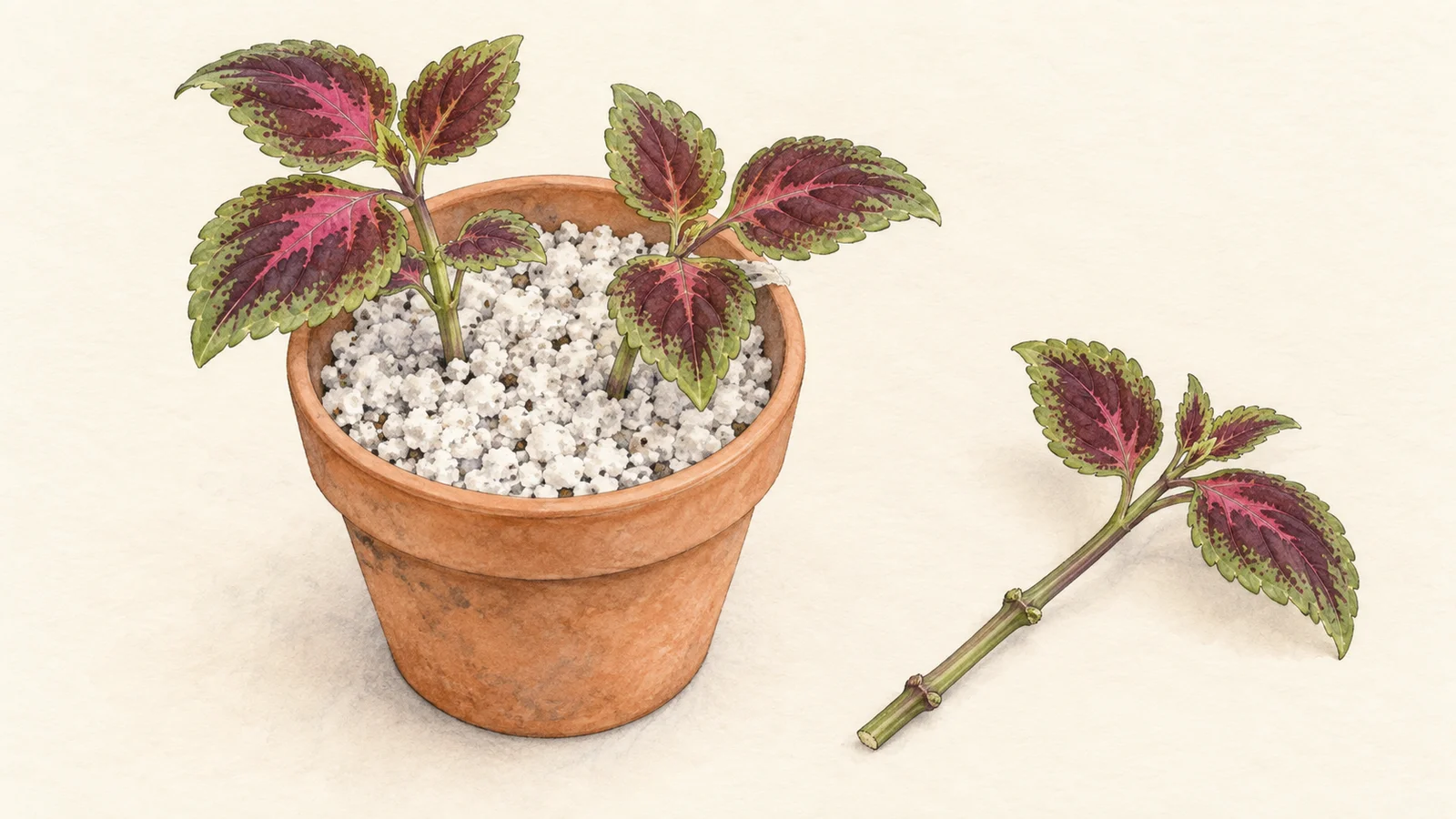
A few coleus stem tips take up much less room indoors than the whole summer container. Root them while the parent still has healthy growth, and you can keep a small plant through winter instead of trying to fit a sprawling patio display beside a window.
Start before cold weather damages the leaves and stems. Coleus is particularly cold-sensitive, as Minnesota Extension’s profile explains. The useful date depends on your weather: this is not a task to postpone until October if your garden gets cold earlier. If frost has already blackened the plant, begin with healthy indoor stock another time rather than trying to root damaged tissue.
Choose the stem before you choose the pot
Look for a vigorous, nonflowering tip with firm leaves and no visible insects. Turn the leaves over and inspect the joints where they meet the stem. NC State lists aphids, whiteflies and spider mites among coleus problems indoors; taking a smaller piece does not guarantee that pests stay outside. Keep the new starts apart from your other houseplants while you observe them.
Check the plant’s label, too. Some newer coleus carry propagation restrictions. If the label says propagation is prohibited, choose a different plant for this project. Save a label or note the name of the parent so you can identify your cutting later; a pink center and green edge alone do not establish a cultivar.
Coleus has opposite leaves on an angular stem. The place where a pair joins is a node. Take a stem tip that includes several nodes, rather than pulling off a single attractive leaf. Illinois Extension’s cutting guide explains why the stem and its growing points matter.
Set up a small rooting space
Gather a clean sharp cutting tool, a pot with drainage holes, fresh perlite, a pencil or similar dibber, and a clear bag large enough to cover the pot without squashing the foliage. A few short supports can hold the bag away from the leaves. Put a tray underneath to protect the windowsill, then empty any runoff.
The method below follows Iowa State’s annual-cutting guidance, which uses moist perlite. Moisten it before inserting stems. The particles should be wet enough to support a moist rooting zone, without the pot sitting in water. Do this preparation first so the cut tips can go straight into their new container.
Clean the tool before cutting; the pruning-shear guide explains cleaning and disinfection. NC State notes that coleus leaves can cause contact dermatitis. Wear gloves if your skin is sensitive, avoid rubbing your face while handling cuttings, and wash your hands afterward. Keep the plant and loose trimmings out of children’s reach.
Make the cutting and keep leaves above the medium
Take a tip about 3–4 inches long, cutting just below a node. Remove the leaves from its lower half and any flowers or buds. Keep a small leafy tip. There should be bare stem to insert and leaves left above it; do not push a cluster of leaf stalks under the surface.
Make a hole in the moist perlite, insert the lower stem with a bare node below the surface, and gently firm the medium around it. Space neighboring cuttings so their leaves do not pile over one another. Water lightly, allow drainage, and put the clear bag over the supports. Rooting hormone is optional for these readily rooted cuttings; this method does not depend on a particular product.
Place the covered pot in bright indirect light. Direct sun through a bag can overheat the small enclosure. Leave a slight opening for ventilation, following Illinois Extension’s coleus propagation advice. Check the perlite regularly and add water when needed to keep it moist. Condensation on the bag is not a substitute for checking the medium itself.
Look for roots, not a deadline
Remove fallen, discolored or moldy leaves promptly. A stem that becomes soft and dark should come out of the shared pot. Do not keep adding water to a wet container simply because a leaf droops; inspect the stem, moisture and light together.
Rooting speed varies with the cutting and conditions. Minnesota gives roughly 2–3 weeks for coleus rooted in water, while Iowa’s broader annual-cutting guidance allows 4–6 weeks. Use those as a reason to check, not a promised finishing date. A very gentle tug may reveal resistance, but repeated pulling can disturb new roots. When inspecting a cutting, support it and the surrounding medium rather than lifting it by a leaf.
Once roots have formed, gradually open the bag farther to accustom the leaves to ordinary room humidity before removing it completely. The RHS softwood-cutting guide recommends increasing ventilation during this transition. Keep checking moisture as the cover comes off.
When roots are about an inch long and the plant is comfortable without its cover, move each cutting into its own small draining pot of fresh potting mix. Set it at the same stem depth and water it in. Give it bright light, then watch how the mix dries as the plant becomes established. A much larger pot adds wet medium that the small root system does not yet occupy.
Keep the new plant growing through winter
A rooted coleus needs a bright indoor position. A shaded summer border and a dim room are different growing environments. If growth becomes long and sparse, reassess the light before reaching for fertilizer; the grow-light guide can help with a dark window.
Keep it away from cold drafts and check the pot before watering. After establishment, pinch a growing tip above a leaf node to encourage branching, and remove flower spikes if foliage is your goal. Continue checking leaf undersides rather than waiting for obvious damage.
In spring, keep the plant indoors until frost risk has passed and conditions have warmed. Minnesota recommends outdoor planting once soil is above 60°F. Ease the plant back into outdoor light gradually, using the summer-transition guide. Match the final exposure to the cultivar: some coleus tolerate sun, while others need shade.
Sources
- Coleus (University of Minnesota Extension). Accessed October 2, 2026.
- How to Propagate Annuals from Cuttings (Iowa State University Extension and Outreach). Accessed October 2, 2026.
- How to Overwinter Plants (Iowa State University Extension and Outreach). Accessed October 2, 2026.
- Cuttings (University of Illinois Extension). Accessed October 2, 2026.
- Clone Your Plants (University of Illinois Extension). Accessed October 2, 2026.
- Coleus scutellarioides (North Carolina Extension Gardener Plant Toolbox). Accessed October 2, 2026.
- Cuttings: softwood (Royal Horticultural Society). Accessed October 2, 2026.