A seed packet that asks for sixty days of cold, moist treatment has given you a task to finish before ordinary sowing begins. Putting the unopened packet in the refrigerator may keep the seeds cool, but it does not supply the moisture that instruction calls for.
Cold-moist stratification gives certain dormant seeds a period of damp, chilled conditions before they can germinate readily. It is useful for some temperate perennials and woody plants, not a universal improvement for every packet. Start with the name of the plant and its germination instructions, then give each batch a labeled place in the refrigerator.
Check which treatment the seed actually needs
Look for the botanical name, the recommended pretreatment and the conditions needed afterward. A common name such as coneflower or milkweed is not enough to assign every species the same schedule. If the packet is unclear, ask the supplier or consult a species-specific propagation reference before wetting the seeds.
Iowa State Extension’s perennial guide shows how different the requirements can be: some perennials need no pretreatment, others benefit from chilling, and some require both a seed-coat treatment and a cold period. Scarification, which alters a hard seed coat, is a different operation from stratification. Do not add soaking, cutting or hot-water treatment merely because another species needs it.
For a first batch, choose identified seed with a straightforward cold-moist instruction. Leave species requiring alternating warm and cold stages for a time when you can follow that full sequence. Seeds collected from an unknown plant are a poor starting point: you cannot choose the treatment or a suitable eventual planting place confidently.
Count backward from a usable sowing date
Write down when you can provide the next stage: containers, suitable germination temperatures and enough light for emerging seedlings. Then count backward by the prescribed chilling period. A sixty-day treatment followed by indoor germination needs space under lights when those sixty days end, even if the outdoor beds are still frozen.
Illinois Extension describes refrigeration at 33–40°F, about 1–4°C, for cold stratification, with duration depending on the plant. Check the actual shelf temperature with a refrigerator thermometer. Do not substitute the freezer for the refrigerator or assume extra months will improve every seed lot.
Keep untreated seed under its recommended storage conditions until the planned start. Ordinary dry storage and an active moist treatment serve different purposes. Mark the date the seeds become moist and chilled; that is the useful starting point for this batch’s record, rather than the date you bought the packet.
Set up a small, clearly labeled batch
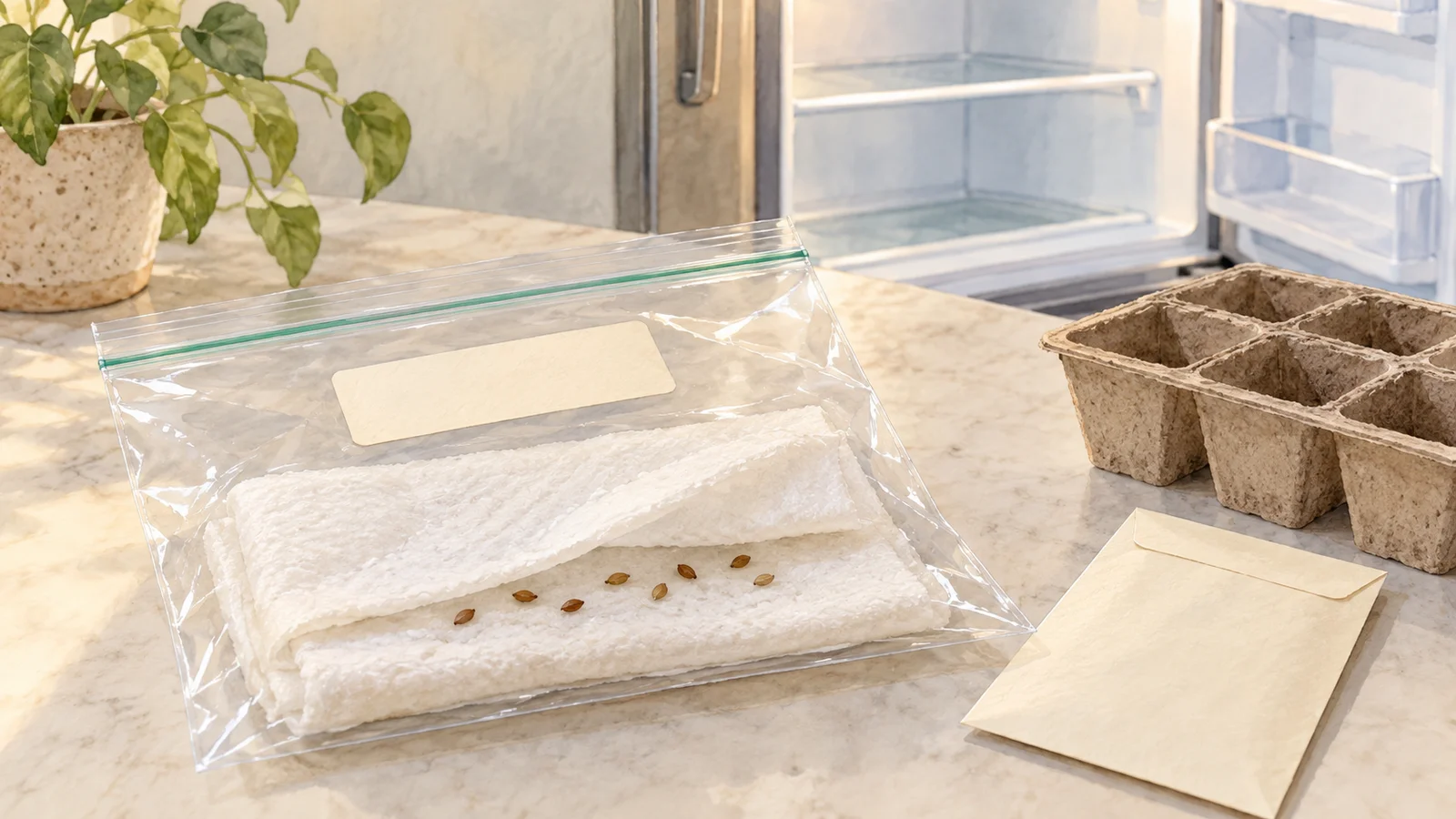
Use a clean resealable bag or suitable lidded container. For seeds whose instructions allow a paper-towel method, dampen a clean towel and squeeze out excess water. It should feel moist without dripping. Spread the seeds so you can inspect them, fold the towel around them and place it in the bag. Close it to slow moisture loss, without squeezing the towel into a sodden ball.
A moist sand or other specified medium may suit a different seed. NC State’s propagation handbook describes moist chilling in a closed container and stresses checking that the medium stays moist rather than wet. Use the medium in your chosen protocol; there is no need to bury every kind of seed in the same homemade mixture.
Label the outside with the botanical name, source, start date, required duration and planned sowing date. Keep different species in separate bags. Set them in a designated tray so they are easy to find and distinct from food. Keep sowing seeds, especially any treated seed, away from children and do not use them as edible sprouts.
Check moisture and look for early roots
Make a regular reminder to inspect the bags. Look for a drying towel, pooled water, mold or an emerging root. A transparent bag helps you check without repeatedly tipping tiny seeds onto the counter. Open it when needed to inspect the contents and correct moisture, then close it again.
The University of Florida’s propagation teaching resource explains that stratification requires moisture, aeration, cold and time together. It also notes that seeds in one population do not necessarily finish dormancy at exactly the same moment. The date on the label is a treatment guide, not a promise that every seed will respond together.
If a root emerges early, prepare to sow that seed rather than leaving it to tangle through the towel. Illinois Extension advises planting seeds that sprout during storage. Handle them gently and keep the root from drying during transfer. Follow the species’ sowing-depth instructions; a tiny seed that needs light should not receive the same covering as a large seed meant to be buried.
Move from chilling to growing
Have clean pots, seed-starting medium and labels ready before opening the batch for sowing. Transfer the identification and dates to the pot labels. Provide the germination temperature and light specified for that plant, and keep the medium appropriately moist. Chilling does not replace those next requirements.
Uneven emergence is not automatically failure. University of Maryland Extension cautions that native seeds may germinate at different rates, and that some species need more complicated handling than dry-stored beginner seeds. Record what emerges and when instead of discarding a whole flat because the first seedling appeared alone.
If nothing happens, revisit identification, seed age, the treatment record and sowing conditions. A germination check answers a different question from breaking dormancy. Keep the packet and your notes together so a supplier or Extension adviser can help distinguish an incomplete treatment from a seed lot that was no longer viable.
Sources
- Seed stratification: What seeds require cold treatment (University of Illinois Extension). Accessed October 28, 2026.
- How to Grow Perennials from Seed (Iowa State University Extension and Outreach). Accessed October 28, 2026.
- Extension Gardener Handbook: Propagation (NC State Extension). Accessed October 28, 2026.
- Seed Dormancy: Stratification (University of Florida IFAS propagation teaching resource). Accessed October 28, 2026.
- Collecting & Sowing Native Plant Seed (University of Maryland Extension). Accessed October 28, 2026.