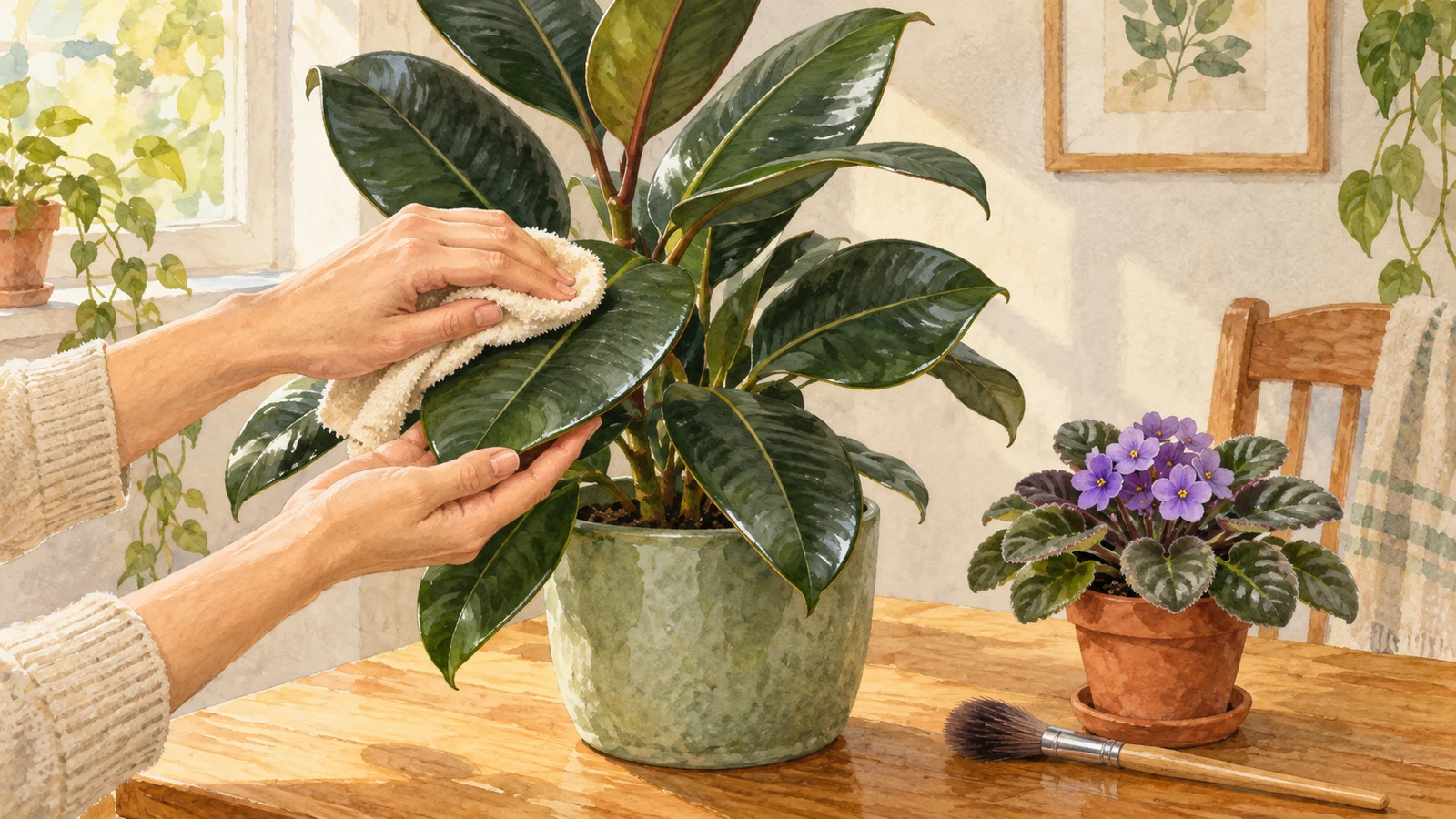
A dusty rubber plant leaf and a fuzzy African violet leaf need different handling. Before reaching for a spray bottle, look at the surface: is there loose dust, a sticky patch, or a mark that belongs to the leaf itself? That small inspection determines whether to wipe, brush or stop and investigate.
For ordinary dust, start with plain water and a soft cloth, or a soft brush for hairy foliage. A glossy finish is unnecessary. The aim is to lift off the deposit while leaving the leaf intact.
Start with one leaf
Choose a mature leaf that is easy to reach. Look over its upper face, then support it while checking underneath. Notice whether nearby leaves have the same pattern. A uniform layer across exposed surfaces looks different from a few cottony clumps tucked into the joints between leaves and stems.
Set out a bowl of room-temperature water, a clean soft cloth and a spare cloth. Put the pot somewhere stable, with room to turn it without dragging stems across furniture. There is no need to clean the whole collection at once; beginning with one plant makes it easier to notice what the cloth is removing.
NC State Extension’s container-plant guidance explains that accumulated dust interferes with light reaching the foliage. It recommends a moistened soft cloth for smooth leaves and a soft brush for hairy ones. Cleaning helps with a surface deposit; it cannot supply the light missing from a dim room.
Smooth leaves: support, then wipe
On broad, smooth foliage such as a rubber plant, dampen the cloth and wring it out. Support the leaf with your free hand so the wiping motion does not pull on its stalk. Pass the cloth gently across the surface, working around folds rather than trying to flatten them. Turn to a clean part of the cloth as it picks up dirt.
Clean the underside with the same light touch. Rinse the cloth when it looks dirty instead of carrying that dirt to the next leaf. Iowa State Extension says clear water is enough in nearly all routine cleaning situations. Household detergents can damage the protective surface and leave discolored or brown areas.
If a patch does not lift with a gentle pass, pause. Increasing pressure until something comes off is a poor way to find out whether you are removing dirt or tissue. Take a closer look in good light before doing anything else.
Small leaves can be rinsed; fuzzy leaves can be brushed
A plant with many small, smooth leaves may be easier to rinse in the sink than to wipe leaf by leaf. Check the water temperature and pressure with your hand before moving the foliage beneath it. Iowa State recommends lukewarm water and a gentle stream; a forceful jet is unnecessary for dust. Keep the pot secure while you turn the plant.
Afterward, let excess water drain before returning the pot to its saucer or decorative container. Check that container later and empty collected water. A cleaning rinse should not leave the roots standing in a reservoir. If the potting mix is already wet, wiping the leaves gives you more control over where the water goes. The winter watering guide can help when a pot is drying more slowly than expected.
For an African violet or other fuzzy-leaved plant, use a clean, soft artist’s brush or makeup brush. Support the leaf and brush lightly to lift loose dust. Do not bear down on the hairs. Keep this brush for plants, free of cosmetics or paint. Brushing is a useful way to remove dust without having to wet the foliage; it does not mean every drop of water inevitably harms every hairy leaf.
Sticky patches deserve another look
Cleaning time is also inspection time. Minnesota Extension recommends checking both leaf faces and watching for insects, eggs, webbing and honeydew, the sticky material produced by certain sap-feeding pests. Look along stems and around the pot as well.
If you find pests, separate the plant from its neighbors and identify the problem before choosing a treatment. Use a fresh cloth or towel as you work; do not carry the same dirty wipe through the collection. The early pest-signs guide helps distinguish common clues. Removing a visible deposit is not proof that an infestation is finished.
Stickiness alone does not identify an insect. The Royal Horticultural Society notes that some plants can produce sticky deposits in response to growing conditions, and some naturally produce whitish deposits. Check the plant’s identity before treating an unfamiliar pale surface as grime.
Leave permanent marks alone
Brown tissue, yellow patches and raised corky areas are not a cleaning target. The RHS describes several causes of leaf damage, including watering problems and unsuitable conditions. A cloth cannot diagnose those causes or turn dead tissue green again. Note whether the mark changes or new leaves develop the same problem.
Skip leaf-shine products and milk; Minnesota Extension advises against both. A cleaned leaf can remain naturally matte. Once the loose dust is gone, return the plant to its usual suitable position and check it again when you water. Let visible buildup guide the next cleaning rather than polishing a spotless plant on a fixed schedule.
Sources
- Dust has accumulated on the foliage of my houseplants. How can I clean the plants? (Iowa State University Extension and Outreach). Accessed September 17, 2026.
- Extension Gardener Handbook: Plants Grown in Containers (NC State Extension). Accessed September 17, 2026.
- Managing insects on indoor plants (University of Minnesota Extension). Accessed September 17, 2026.
- Leaf damage on houseplants (Royal Horticultural Society). Accessed September 17, 2026.