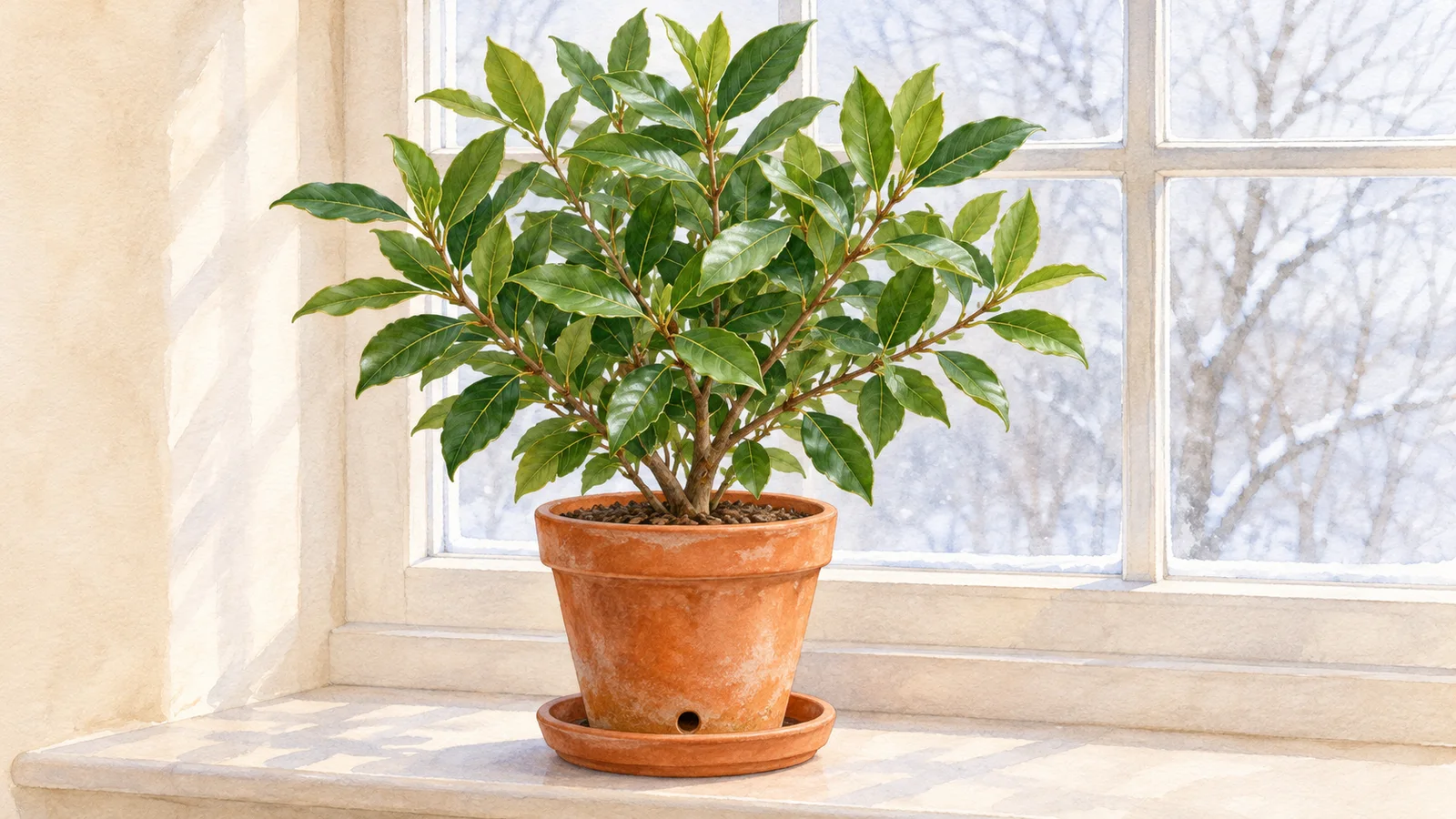
A bay laurel can keep its leaves through winter without producing much new growth. That is a useful expectation for a plant brought into a house: keep the existing canopy healthy, take an occasional leaf for the kitchen, and save the bigger growth push for a brighter season. A sunny, cool place and a pot that drains are more useful than frequent feeding.
Bring home the right bay
Choose a plant labeled Laurus nobilis, also called sweet bay or bay laurel. Buy it as a culinary herb from a supplier who can confirm its identity. The word “laurel” on its own is not enough, and a leaf that resembles a grocery-store bay leaf is not a reliable identification. Keep the nursery label with the pot rather than depending on memory months later.
An established young plant is a practical starting point. Illinois Extension notes that seed germination is slow and unreliable and cuttings can be difficult to root. There is no need to begin with a large trained topiary: a small branching shrub is easier to move, inspect and fit near a window.
Plan a place pets cannot reach. ASPCA lists Laurus nobilis as toxic to cats and dogs; chewing it can cause vomiting or diarrhea, and swallowing many whole leaves can obstruct the digestive tract. Contact a veterinarian promptly if a pet eats it. Being a culinary herb for people does not make the plant pet-safe.
Choose the winter position before the cold arrives
In a cold-winter climate, treat container bay as a plant to bring indoors. Iowa State Extension recommends moving it inside before nights drop below about 40°F (4°C). Use your forecast, not Iowa’s calendar dates. A sheltered porch that still freezes is not equivalent to an indoor winter spot.
Give it the brightest window available, preferably with direct sun. A cool room around 50–65°F (10–18°C) is a useful target from Iowa State’s guidance. Check the temperature beside the plant overnight; the center of the room may tell a different story from a cold sill. Leave the foliage clear of the glass and keep the pot away from a heater’s hot airflow.
Bay can also overwinter under cooler conditions, but care has to match the setting. Wisconsin Extension distinguishes a cool, resting plant from one in a warmer room, where it needs more sun and water. Do not apply instructions for a barely moist, dormant plant to a bay sitting in warm sunshine all day. For an ordinary living space, begin with good light and assess the pot’s moisture repeatedly.
Let the pot tell you when to water
Use a container with open drainage holes and a well-drained potting mix. If the plant sits inside a decorative cover pot, lift it out to water and let it drain before putting it back. Empty the saucer rather than allowing the base to stand in collected water. A pot can look dry on top while the lower mix remains wet.
Feel the upper inch of mix and notice the pot’s weight. When that surface layer has dried and the pot is lighter, check a little deeper before deciding to water. If it is still distinctly moist beneath the surface, wait and check again. When water is needed, wet the root ball evenly and allow the excess to escape. Avoid repeated little splashes that leave you unsure what happened below the surface.
The interval will change with light, room temperature, pot size and the amount of foliage. Record what you find for the first few checks instead of setting a weekly watering reminder that automatically means “add water.” An established bay in a cool room may use little water; one near a sunny window can dry more quickly. Neither situation calls for keeping the mix constantly wet. The RHS bay guide identifies winter waterlogging as a root-rot risk.
Do not move a sound plant into a much larger pot just to prepare for winter. When repotting is actually needed, go only slightly larger and use fresh suitable mix. The RHS suggests refreshing container-grown bay every two or three years, but a new purchase does not automatically need that work on arrival.
Inspect before treating a yellow leaf
Bay is slow growing, and extra fertilizer will not replace winter light. Reduce feeding substantially while growth is minimal, as Illinois Extension advises. Resume an appropriate growing-season program when the plant is actively growing; follow the fertilizer’s label rather than borrowing another herb’s dose.
If leaves start yellowing, check moisture and drainage first. Note whether the pot stays heavy, whether water is trapped in its outer container and whether conditions changed after the move indoors. Yellowing alone does not establish a nutrient deficiency. A photograph of the plant and a few notes about watering can be more useful for diagnosis than trying several treatments at once.
Look along woody stems and both sides of the leaves for attached bumps. Wisconsin Extension identifies scale as a particular indoor bay problem. Keep a suspect plant apart from the rest of your collection and confirm the pest before treating it; the scale identification guide explains what to look for. Because you may harvest these leaves, any pesticide must be labeled for the edible plant and intended indoor use, with its harvest restrictions followed. Do not use an ornamental-only treatment and assume washing will make the leaves suitable for food.
Take a few leaves; keep the canopy
Harvest mature leaves from a healthy, established plant as needed, without stripping a small winter canopy. Wash leaves before kitchen use. Remove whole bay leaves from the finished dish before serving: they remain stiff even after cooking. If the plant is struggling or has been treated with a product that restricts harvest, leave it alone until the problem and any label restrictions are resolved.
Save major reshaping for the appropriate growing season; the RHS places heavy pruning in mid- to late spring. Once frost risk has passed, return the pot outdoors gradually rather than moving shade-adapted leaves straight into strong sun. The outdoor transition guide gives a gradual approach. Until then, keep the winter checks simple: good light, a draining pot, a look for scale, and water only when the mix calls for it.
Sources
- Bay Laurel (University of Illinois Extension). Accessed November 5, 2026.
- How do I grow bay laurel? (Iowa State University Extension and Outreach). Accessed November 5, 2026.
- Sweet Bay, Laurus nobilis (University of Wisconsin–Madison Division of Extension). Accessed November 5, 2026.
- How to Grow Bay (Royal Horticultural Society). Accessed November 5, 2026.
- Bay Laurel (ASPCA Poison Control). Accessed November 5, 2026.
- Understanding Pesticides (University of California Statewide IPM Program). Accessed November 5, 2026.