Recipes
Umeboshi Onigiri: Small Rice Balls with a Tart Center
Shape warm Japanese rice around a small umeboshi filling, add nori just before eating, and chill any rice balls you are saving promptly.
Jump to recipe ↓Recipe
- Total time
- About 15 minutes, plus cooking rice
- Method
- Assembly
- Difficulty
- Easy
- Allergens
- Check umeboshi and nori labels for added ingredients and your allergens
About 4 small onigiri (2 snack portions)
Allow about 15 minutes starting with cooked rice; time and yield are estimates. Cook the rice first according to its packet or rice cooker instructions. This card measures cooked rice, not dry rice. Uses US measuring spoons (1 tablespoon = 15 ml).
Equipment: Kitchen scale, rice paddle or spoon, small bowl, teaspoon and tablespoon measures, clean kitchen scissors, plate, and food-safe wrap labeled suitable for contact with warm food; a shallow container for any rice balls you will refrigerate.
Ingredients
- 400 g freshly cooked plain Japanese short-grain rice, still warm; no sushi-vinegar seasoning
- 1 tablespoon finely chopped umeboshi flesh, all stones removed; use less to taste
- 1 full sheet plain toasted nori, cut into 4 strips
- ⅛ teaspoon fine salt, optional and divided among all 4 rice balls
Method
Prepare the filling and work surface
Wash hands with soap for 20 seconds and use clean utensils and a clean surface. Remove all hard stones from the umeboshi, chop the flesh and measure it. Taste a little with rice; reduce the filling and omit salt if it is very salty. Cut the nori into four strips with clean scissors. Keep it dry. Set out four fresh pieces of food-safe wrap suitable for warm food.
Convert a measurement for this stepPortion the warm rice
Use the paddle to divide the freshly cooked rice into four approximately 100 g portions on a clean plate. Let it lose just enough heat to handle comfortably through the wrap; do not squeeze steaming-hot rice. Shape while still warm. If saving any, plan to refrigerate promptly, ideally within one hour of cooking the rice; do not leave a pot of rice cooling on the counter.
Convert a measurement for this stepEnclose a small plum center
Place half of one rice portion on a piece of wrap. Make a shallow hollow with the spoon, add up to ¾ teaspoon plum flesh, and cover completely with the rest of that rice portion. Add one quarter of the optional salt. Gather the wrap and gently press into a rounded triangle, turning it between your palms. Keep the grains intact and the filling enclosed. Repeat for the other three portions, using fresh wrap for each.
Convert a measurement for this stepWrap with nori and eat, or refrigerate
Remove the plastic wrap and fold a nori strip around each rice ball you will eat now. For later, leave nori separate, put the rice balls in a single layer in a shallow container and refrigerate promptly at 40°F (4°C) or below, ideally within one hour of cooking the rice. Cover once chilled and eat within 24 hours, keeping them cold until eating. Discard rice balls left unrefrigerated for over two hours, or one hour above 90°F (32°C). Salt and plum are not substitutes for chilling.
Convert a measurement for this step
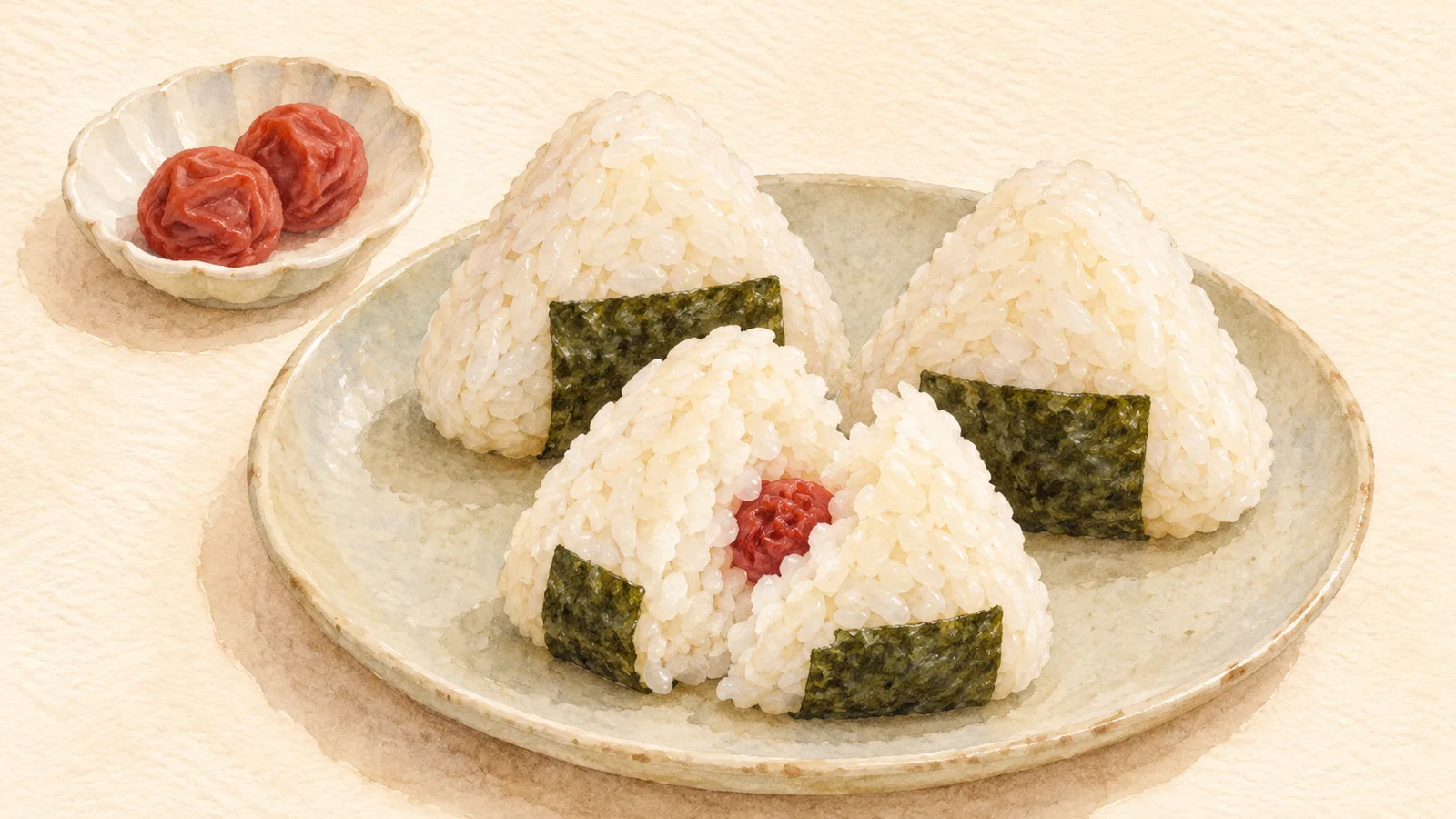
A pocket of tart umeboshi makes a small rice ball taste complete. Keep the filling modest: the first bite should still be soft rice, with the plum’s sharpness arriving as you reach the middle. A strip of nori gives your fingers somewhere to hold it and adds a crisp edge if you wrap just before eating.
These onigiri start with freshly cooked Japanese short-grain rice. They are not sushi rice, so there is no vinegar-and-sugar seasoning. The recipe makes four small rice balls from cooked rice; allow additional time to cook the rice according to its packet or your rice cooker’s instructions.
A little plum goes a long way
Umeboshi are salted, pickled ume, commonly called Japanese pickled plums. They vary in size, sourness and saltiness, and some preparations are sweetened. Check the label for ingredients and storage instructions. Remove every hard stone before measuring the flesh; a whole plum is not a reliable measuring spoon.
Taste a little plum with a spoonful of the rice before filling. The card’s tablespoon of flesh is divided among four onigiri. If your umeboshi is especially assertive, use less and omit the optional salt. Do not increase the filling simply to use up a large plum.
Namiko Hirasawa Chen’s onigiri guide describes the warm-rice shaping method and classic plum filling. Her umeboshi onigiri article also shows a mixed-through version; here the plum stays in a small central pocket.
Give the rice a gentle shape
Aim for a rice ball that holds when lifted without crushing the grains into paste. A rounded triangle is enough; there is no need to sharpen every corner. If filling breaks through the side, cover it with a little of that portion’s rice before pressing again.
Use food-safe wrap suitable for warm food and clean utensils to reduce direct hand contact. Japan’s Ministry of Agriculture, Forestry and Fisheries specifically recommends wrap or cooking gloves when making onigiri. Wash your hands first even when you use a barrier. Wrap does not protect your hands from burning-hot rice, so let a small portion become comfortably warm before shaping it.
For crisp seaweed, keep the nori dry until the rice balls are ready to eat. Wrapping earlier gives a softer sheet that clings to the rice; that is a texture choice, not a sign that anything has gone wrong.
Eat soon, or chill promptly
Salt and umeboshi do not make this recipe safe to leave on the counter. The Food Standards Agency’s rice guidance recommends rapid chilling, ideally within one hour, and eating refrigerated rice within 24 hours. Make room in the fridge before starting if you are saving any.
Keep chilled onigiri cold until eating. Refrigeration firms the rice, so freshly made rice balls have a different texture from tomorrow’s lunch. Do not leave them out for hours to soften. The rice storage guide explains why reheating cannot reliably rescue rice that was mishandled.
FoodSafety.gov gives the refrigerator target of 40°F (4°C) or below and the two-hour discard limit, shortened to one hour above 90°F (32°C). The earlier one-hour chilling goal for rice still applies.