Recipes
Plain Rice Congee for a Savory Bowl
Simmer white jasmine rice into a soft porridge, adjust the thickness at the pot and finish each bowl with optional ginger and scallions.
Jump to recipe ↓Recipe
- Total time
- About 1–1½ hours (estimate)
- Method
- Stovetop
- Difficulty
- Easy
- Allergens
- No major allergen ingredients in the plain base; check added toppings
About 4 bowls (estimate)
Allow about 1–1½ hours; timing and yield are estimates and depend on the rice, pot and desired thickness. Use standard US cup measures. Keep the simmer attended and prepare the optional garnish before heating the pot. The plain base has no major allergen ingredients; check any added toppings.
Equipment: Heavy pot of at least 4 quarts with a lid, measuring cups, fine-mesh strainer, heatproof spoon, ladle, knife and board for optional garnish, and a food thermometer for reheating leftovers.
Ingredients
- 3/4 standard US cup uncooked white jasmine rice
- 8 standard US cups (about 1.9 liters) water, plus extra hot water as needed
- 1/4 teaspoon salt, optional; adjust to taste at the end
- 5 g fresh ginger, washed, peeled and cut into very fine threads, optional garnish
- 1 scallion, rinsed, trimmed and thinly sliced, optional garnish
Method
Rinse the rice and prepare the garnish
Rinse the rice in a fine-mesh strainer under cool running water, then drain. Prepare the optional ginger and scallion on a clean board and keep them in separate small dishes for serving. Set the pot on the stove with its handle safely positioned and have the stirring spoon ready.
Convert a measurement for this stepBring the water and rice to a gentle boil
Bring the 8 cups of water to a boil in the pot. Add the drained rice carefully, stir along the bottom to separate the grains, and return to a gentle boil. Reduce the heat to maintain a quiet simmer. Set the lid partly open and watch for foam; uncover and lower the heat if it starts climbing.
Convert a measurement for this stepStay nearby and simmer until the grains break down
Keep the simmer attended, stirring across the bottom regularly and more frequently as it thickens. Allow roughly 45–90 minutes of simmering as an estimate, not a doneness test. Add hot water a little at a time if the mixture becomes thick before the rice is tender. Continue until the grains are very soft, many have broken apart, and a cooled spoonful has no firm rice centers. Do not leave the pot to run another burner task.
Convert a measurement for this stepAdjust thickness and seasoning
Once the rice is soft, stir firmly if you want fewer intact grains. Add hot water gradually for a looser bowl, or simmer a little longer while stirring for a thicker one. The porridge should pour from a ladle rather than sit as a firm mound. Taste a cooled spoonful and add the optional salt to taste. Leave it slightly looser than your preferred serving texture because it thickens as it stands.
Convert a measurement for this stepTurn off the heat, serve and chill any leftovers
Turn off the burner. Ladle into bowls and offer the optional ginger and scallion separately; serve promptly. Transfer leftovers promptly into small, shallow containers and refrigerate, ideally within one hour, at 40°F (4°C) or below. Use within 24 hours. Reheat only once, adding a little water and stirring until steaming throughout and at least 165°F (74°C) on a food thermometer. Discard congee left out more than two hours, or one hour above 90°F (32°C).
Convert a measurement for this step
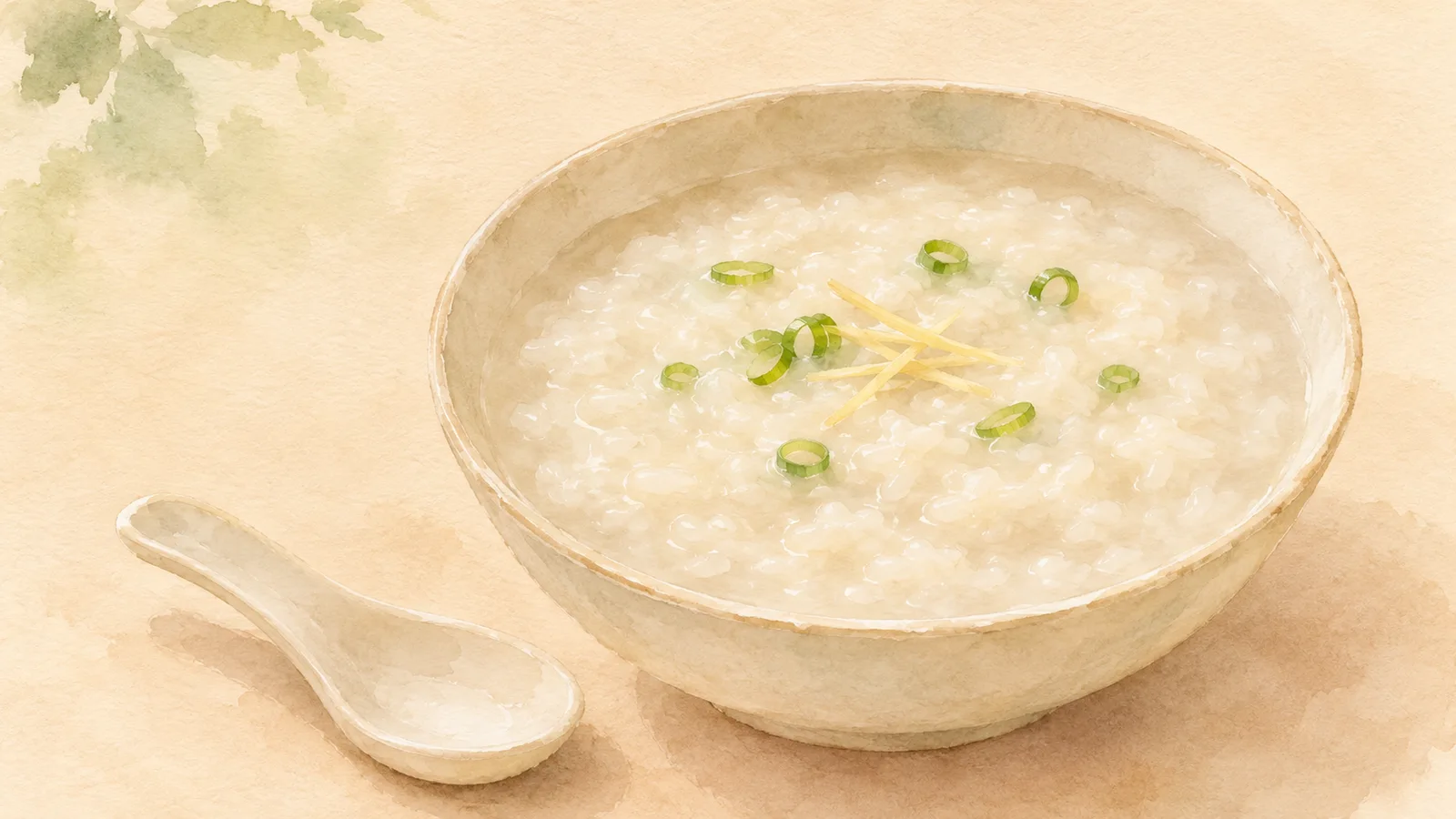
Rice congee is ready when the grains have softened into the liquid and a ladleful pours back into the pot as porridge. It can be thick enough to hold a few scallion rings or loose enough to sip from a spoon. Start with the rice and water; decide on that final thickness near the end, when the grains have had time to break down.
This plain version uses white jasmine rice, with ginger and scallions offered at the table. The rice-to-water starting point comes from Daddy Lau’s congee at Made With Lau: one rice-cooker cup, about 3/4 of a standard US cup, to eight US cups of water. Here the chicken, marinade and bouillon are omitted. Use the standard cup measure in the card, not a full US cup of rice in place of a rice-cooker cup.
Give the pot room
A pot with generous headroom is easier to manage than a small saucepan filled almost to the rim. Rice foam can climb as the water boils; a lid set partly open helps you see what is happening. Keep the heat low enough for a gentle simmer and remain nearby. If foam rises, uncover the pot and reduce the heat immediately.
As the liquid thickens, run the spoon across the bottom and into the corners more frequently. Maggie Zhu’s stovetop congee guide emphasizes watching for overflow and stirring toward the end to prevent sticking. A heavy pot helps distribute heat, but it does not remove the need to watch and stir.
Choose the texture after the rice softens
Do not judge the bowl by the water level alone. While the grains still have firm centers, a thick pot needs more hot water and more cooking, not serving. Once the rice is very soft, stir firmly to break it up further if you prefer a smoother porridge. Leave more grain texture if that is what you enjoy.
There is no single useful water ratio for every congee. Short-grain rice, a wide uncovered pot and a longer simmer will behave differently from this jasmine-rice version. Zhu’s guide uses short-grain rice and offers several starting ratios for different consistencies. Use the quantities for the rice you have chosen, then adjust at the pot. The timing here is an estimate, not a tested promise.
Congee also becomes thicker as it stands. Finish it slightly looser than you want in the bowl, then serve promptly. Stir in a little hot water if it tightens before serving. Ginger adds a sharp bite, so offer the thin threads separately and start with a small pinch. Scallions can go on each bowl just before eating; keep unused garnish away from the steaming pot.
Save only what you can chill promptly
Move leftover congee into small, shallow containers promptly; do not leave the cooking pot on the counter to cool. The Food Standards Agency’s rice guidance calls for rapid chilling, ideally within one hour, refrigerator storage for no more than 24 hours and only one reheating. These rice-specific limits apply even though the bowl contains no meat.
Keep it at 40°F (4°C) or below. Reheat only the portion you will eat, adding a little water and stirring to distribute the heat. It must be steaming throughout and reach 165°F (74°C) on a food thermometer, following USDA’s reheating guidance. Discard food left out for more than two hours, or one hour above 90°F (32°C), under USDA’s leftover-handling guidance. Reheating cannot make poorly stored rice a safe bet.