Recipes
Tomato and Egg Stir-Fry
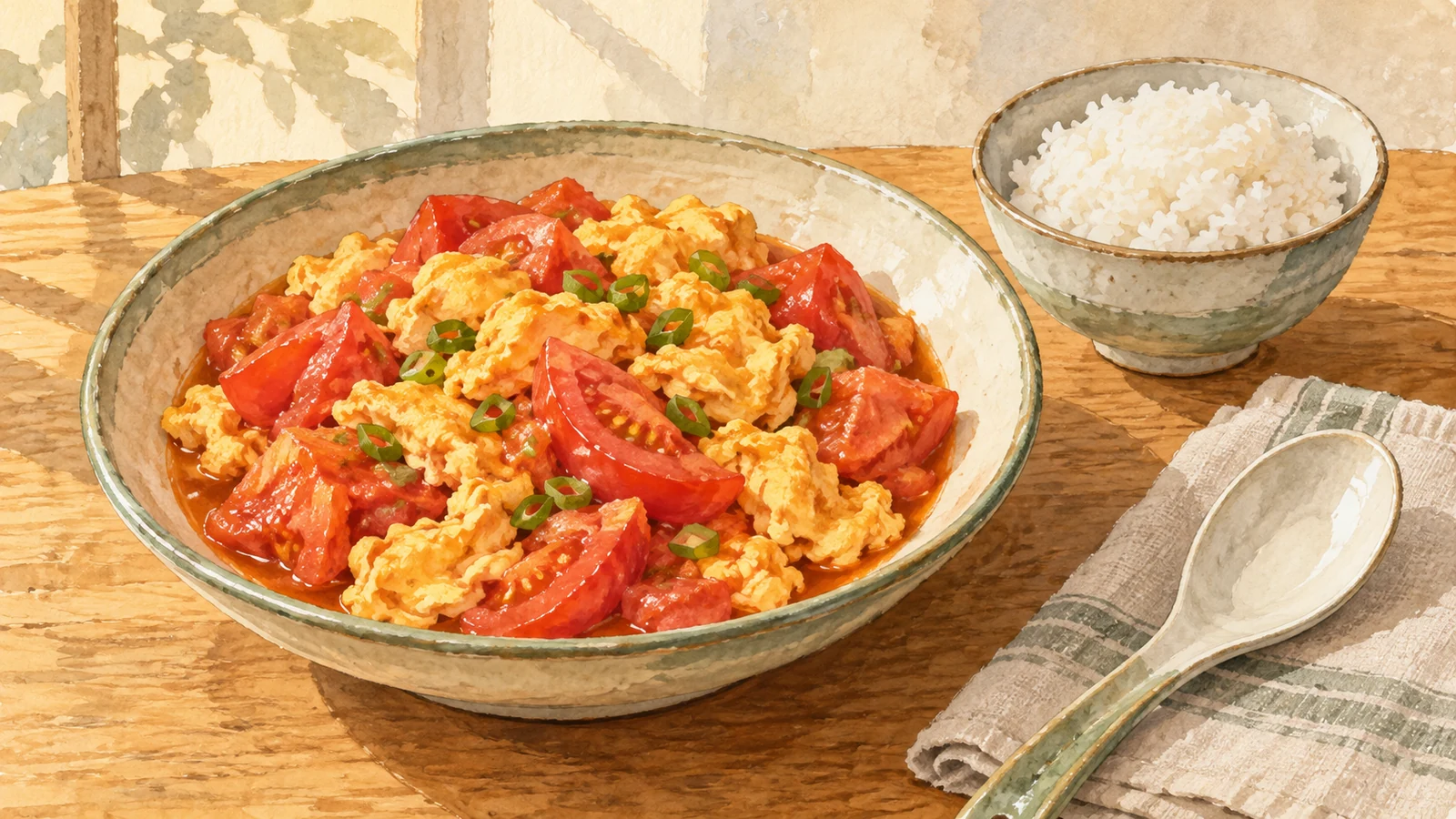
Golden scrambled eggs, softened tomatoes and a little scallion, with enough tomato sauce to spoon over rice. A simple Chinese home-style dish made in an ordinary skillet.
Jump to recipe ↓Recipe
- Total time
- About 20 minutes
- Method
- Skillet
- Difficulty
- Easy
- Allergens
- Egg
About 2 servings with rice
Allow roughly 20 minutes, plus rice cooking. Have rice cooked before starting the stir-fry, or choose the combined rice cook-along. Follow the cooking cues and temperature check rather than a fixed timer.
Equipment: 10–12-inch nonstick skillet, spatula, bowl, clean plate and food thermometer.
Ingredients
- 450 g ripe tomatoes (about 1 lb), hard stem cores removed
- 4 large eggs
- 1 scallion, white and green parts sliced separately
- 2 tablespoons neutral cooking oil, divided
- 1/2 teaspoon fine table salt, divided
- Up to 1 teaspoon sugar, optional
- 1–3 tablespoons water, only if needed
- Freshly cooked rice, to serve
Method
Get everything ready
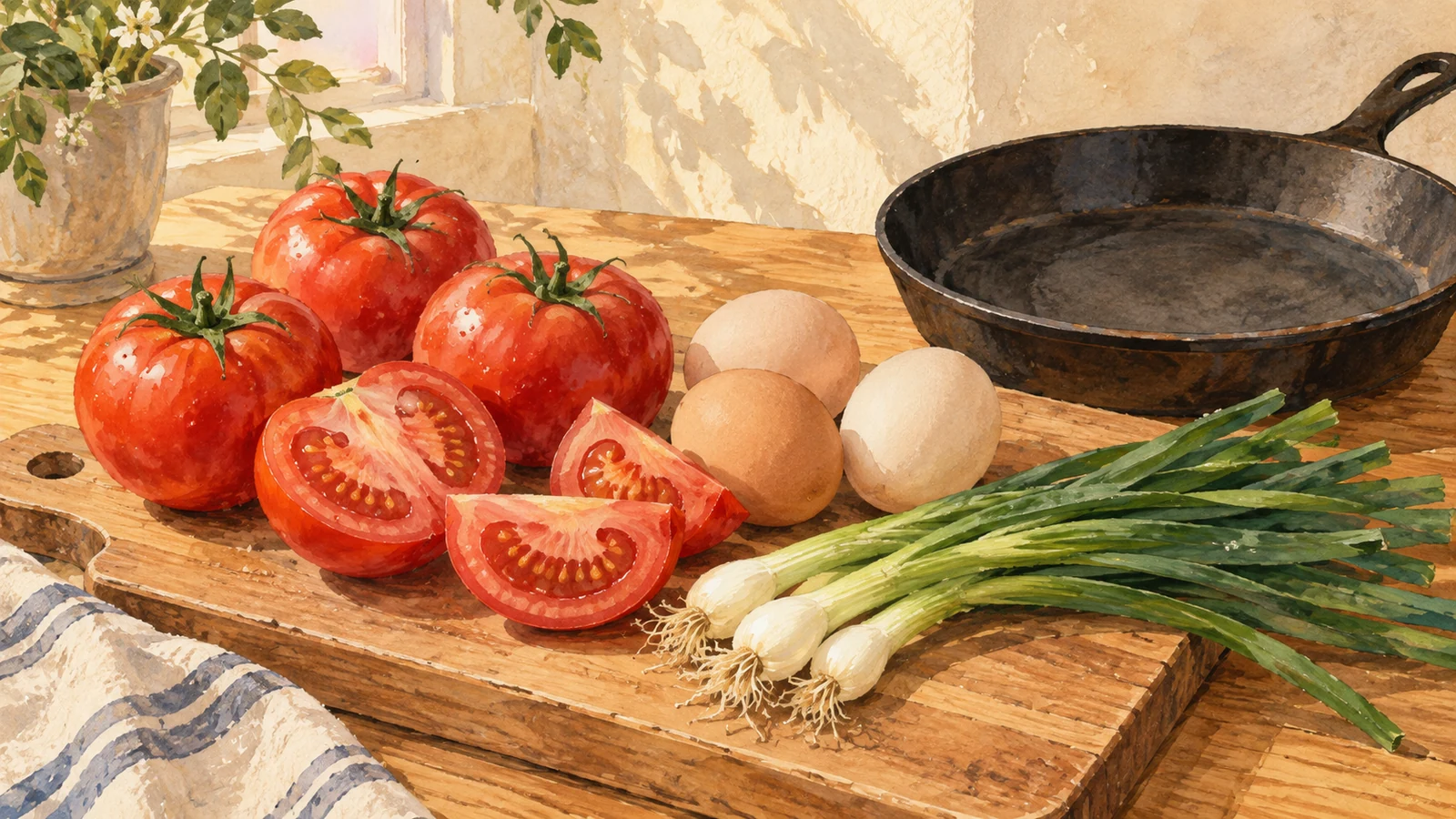
Wash the tomatoes and scallion. Cut the tomatoes into roughly 2 cm wedges, keeping their seeds and juice. Slice the scallion, keeping the whites separate from the greens.
Convert a measurement for this stepBeat the eggs
Beat the eggs with 1/4 teaspoon of the salt until the whites and yolks are evenly mixed. Wash hands and utensils after contact with raw egg. Have a separate clean plate ready for the cooked eggs.
Convert a measurement for this stepMake broad curds
Warm 1 tablespoon of oil in the skillet over medium heat; do not let it smoke. Pour in the eggs and use the spatula to draw the setting egg into broad curds. Once set and no longer runny, move them to the clean plate. Continue straight on with the tomatoes.
Convert a measurement for this stepGive the tomatoes the pan
Add the remaining tablespoon of oil, scallion whites, tomatoes and remaining 1/4 teaspoon salt. Cook over medium heat, stirring occasionally, until the wedges soften and release juice. If they catch before releasing liquid, lower the heat and add 1 tablespoon water. Repeat only if needed, using no more than the listed 3 tablespoons.
Convert a measurement for this stepKeep enough sauce for the rice
Let a watery mixture simmer uncovered until the liquid becomes a light tomato sauce; do not cook it dry. Taste a cooled spoonful before returning the eggs. If it is too tart for your taste, add sugar in 1/4-teaspoon increments, up to 1 teaspoon. Sugar is optional, not an automatic addition.
Convert a measurement for this stepFold, then check
Return the eggs, add the scallion greens and fold gently, breaking up only the largest curds. Cook the combined egg dish to 160°F (71°C), checking several places with a food thermometer without touching the pan.
Convert a measurement for this stepSpoon it over rice
Turn off the burner. Serve promptly with freshly cooked rice, sharing the tomato juices between the portions. Do not leave the eggs in the hot skillet while waiting for the rice to cook.
Convert a measurement for this step
Let the tomatoes make the sauce
The rice wants the juices as much as it wants the eggs. Give the tomatoes time on their own, then bring the two parts together. That keeps the egg curds out of the pan while you decide whether the tomato mixture needs a splash of water or a little more simmering.
Cook the eggs and tomatoes in a skillet; no wine, ketchup or starch is needed. Maggie Zhu’s tomato and egg stir-fry shows a similarly simple approach and discusses scallions as an alternative to garlic.
A splash is a decision, not a ritual
Keep a little water beside the stove, but look in the pan before adding it. Juicy tomatoes may supply enough liquid themselves. Firmer tomatoes can start sticking while their centers are still hard; lower the heat and add a measured splash instead of trying to scorch them into softness.
If there is already plenty of thin liquid, adding more sends you in the wrong direction. Leave the eggs on their clean plate and simmer the tomatoes uncovered until the juices are less watery. The aim here is spoonable tomato sauce, not jam.
There is more than one way to season this dish
Sarah Leung’s Chinese tomato egg stir-fry includes sesame oil and Shaoxing wine. Daddy Lau’s tomato and eggs takes another route, using ginger, ketchup and a starch slurry. Those are distinct recipes, not missing ingredients you need to buy for this one.
Use the quantities in the recipe card together rather than borrowing the sugar from one version and the water from another. Taste the tomato sauce before returning the eggs, and leave the sugar out if you already like its balance.
You can use supermarket scallions or greens from a windowsill pot. To grow your own, follow the green-onion growing guide.
Put leftovers away while you clear the table
Refrigerate leftover tomato and egg in shallow containers within two hours, or within one hour if the room is above 90°F (32°C). Keep the refrigerator at 40°F (4°C) or below, use the egg dish within 3–4 days and reheat it to 165°F (74°C). These are the FDA’s egg-dish handling guidelines, which also support the 160°F cooking endpoint used above.
Rice has separate handling considerations; the egg-dish storage window is not a storage recommendation for mixed rice leftovers. This recipe calls for rice cooked fresh for serving. The dish contains eggs; check any additional seasoning you choose for other allergens.
Adapted from the culinary sources linked above; not personally kitchen-tested.