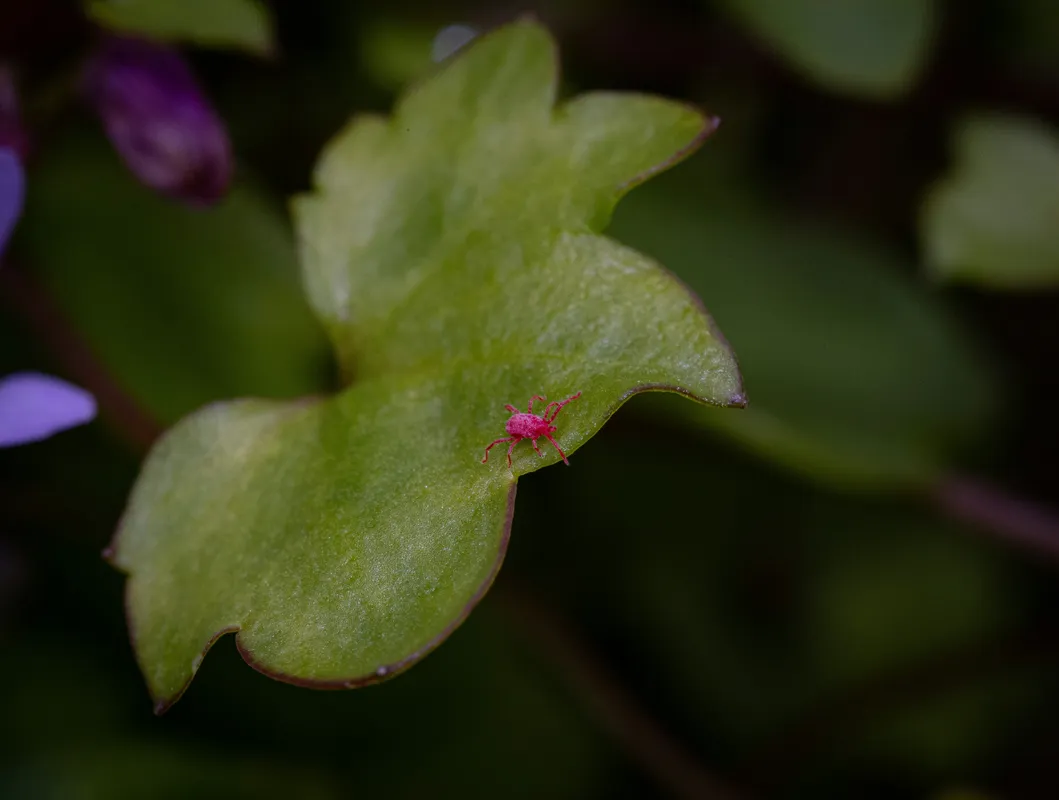
Spider mites are tiny arachnids that feed by piercing plant cells. The first visible clue is often fine pale stippling, followed by bronzing, drying, leaf drop, or webbing as a population becomes heavy. Drought stress, thrips, some diseases, chemical injury, and ordinary dust can resemble part of that pattern. Treat only after finding live mites or a combination of signs strong enough to justify action.
Because eggs and mites can occupy protected leaf surfaces, control is a process rather than a one-time spray. Integrated pest management starts with a baseline count, isolation, physical reduction, and correction of plant stress. A pesticide is one possible later tool, not the definition of treatment.
Confirm live mites
Inspect the least healthy leaves and the leaves immediately above and below them. Spider mites usually feed on undersides, often near veins. Use a hand lens; adults are less than 1/20 inch long and appear as moving dots to the unaided eye. The University of Minnesota’s twospotted-spider-mite guide describes adults as tiny arachnids with eight legs and notes that severe feeding can produce bleaching, bronzing, webbing, and leaf drop.
Use three forms of evidence:
- Leaf pattern: fine, repeated stippling rather than one large bleached patch.
- Organisms: moving mites and, under magnification, round eggs or cast skins on the underside.
- Webbing: fine threads close to leaves, veins, petioles, or stem junctions, especially when feeding damage is also present.
For a white-paper test, hold plain white paper beneath suspect foliage, tap the leaf, and examine fallen specks with a lens. A moving speck supports a mite diagnosis; dust and loose potting particles do not move. The paper test is a sampling method, not species identification.
| Finding | Interpretation | Next check |
|---|---|---|
| Moving dots plus stippling | Spider mites likely | Inspect adjacent leaves and nearby plants |
| Webbing but no stippling or mites | Could be an ordinary spider | Trace web structure and repeat lens inspection |
| Silver streaks with black fecal dots | Thrips may be more likely | Tap foliage over paper and inspect for slender insects |
| Pale leaves with no organisms | Environmental or root problem possible | Review water, roots, light, temperature, and fertilizer history |
| Dry edges after a window move | Light or temperature injury possible | Compare the exposed and shaded sides of the plant |
Different mite species and beneficial predatory mites can be difficult to distinguish. If a valuable plant is declining but the evidence is ambiguous, send magnified photographs or a specimen to a local Extension office or plant clinic before selecting a pesticide.
Establish a measurable baseline
Photograph several reference leaves under the same light. On each, note whether live mites, eggs, webbing, or fresh stippling are present. Count mites in a small fixed viewing area if practical; a consistent rough count is more useful than an unsupported estimate for the whole plant.
Move the plant so its foliage cannot touch other plants. Check every nearby plant with the same paper-and-lens method, not just a visual glance. Wash hands and clean tools after working in the isolation area. Do not carry wet leaves or discarded foliage across the collection uncovered.
Keep the plant isolated while live mites or fresh damage continues. Old stippling and bronzing will not heal, so judge progress by live counts, new webbing, and the condition of leaves that expand after management begins.
Use the least disruptive effective controls first
Restore appropriate plant care
Water stress increases a plant’s susceptibility to mite injury, but “add humidity” is not a stand-alone eradication method. Check the root zone and water according to the species, allowing excess to drain. Do not keep the mix saturated, and do not fertilize a badly stressed plant simply to force new leaves. Place it in appropriate light and away from a hot, drying vent.
The goal is a plant capable of recovery, not an artificially wet room. Raising humidity beyond what the plant and building can tolerate may encourage other problems and does not remove eggs or feeding mites.
Wash accessible foliage
For a sturdy plant, direct a firm but non-damaging stream of water over stems and especially leaf undersides. Cover the potting mix so it is not washed out or waterlogged. The UC Statewide IPM spider-mite guide and Colorado State University houseplant guidance both support water sprays as a useful population-reduction method.
Wiping broad, durable leaves with a damp disposable towel can also remove mites and webbing. Change towels frequently so pests are not moved from leaf to leaf. Do not scrub pubescent, delicate, or easily bruised foliage. Prune leaves that are both heavily colonized and no longer contributing meaningful green tissue, but avoid stripping a weakened plant bare.
Water removal has no residual effect. Its value is immediate knockdown and better visibility during the next inspection, not a guarantee that all life stages are gone.
Consider biological control only in a suitable system
Commercial predatory mites can suppress spider mites in greenhouses and large interiorscapes. They require correct pest identification, temperature and humidity ranges, release rates, and freedom from incompatible pesticide residues. For one houseplant in an ordinary living room, sourcing and maintaining the correct predator may be impractical. Consult a reputable biological-control supplier or Extension specialist rather than releasing an unidentified organism.
If a pesticide is needed, it must list mites
An insecticide is not automatically a miticide. Some broad-spectrum insecticides control spider mites poorly and can worsen mite outbreaks outdoors by killing predators. UC IPM recommends selective products and notes that insecticidal soaps or horticultural oils can reduce mites when coverage is thorough.
Before buying anything, read the full label and confirm all of the following:
- spider mites or the identified mite group is listed;
- indoor houseplants and the plant type are allowed sites;
- the plant is not listed as sensitive;
- the directions allow the application method available at home;
- any edible use is explicitly permitted if leaves, herbs, or fruit will be consumed.
Commercial insecticidal soap and horticultural oil are formulated pesticides; dishwashing liquid and kitchen oil are not equivalent. Contact products must reach mites on leaf undersides, and some plants are injured by soaps or oils. Patch-test as the label directs and do not apply to a drought-stressed plant, in prohibited temperatures, or under prohibited light conditions.
The label controls dose, interval, maximum applications, protective equipment, ventilation, storage, and disposal. Repeat an application only at a label-permitted time and only when inspection still finds live mites or fresh activity. Shortening the interval or increasing concentration can injure the plant and violate the label without improving control.
Make each reinspection answer a question
At each check, examine the original reference leaves, new growth, and at least one previously clean neighboring plant.
| Result | Response |
|---|---|
| Live count falls and no new webbing appears | Continue isolation and nonchemical monitoring |
| Live mites remain in exposed areas | Improve washing or label-compliant contact coverage |
| Only old bronzing remains | Do not retreat based on permanent scars |
| Fresh injury appears but no mite is found | Reconsider the diagnosis before another application |
| Mites persist after correct use of a labeled product | Confirm species and resistance/coverage issues with Extension or a professional |
| Nearby plants become positive | Expand isolation and create separate baselines for each plant |
Do not declare eradication after one negative glance. End isolation after repeated examinations of old and new foliage, separated enough to reveal survivors or newly active stages, remain negative. Temperature and mite species change development speed, so no universal number of days or sprays applies.
Discarding and professional help
Sealed disposal is reasonable when most foliage is heavily webbed or dead, the plant is easily replaced, isolation is failing, or continued spraying would create unacceptable exposure in the home. This is collection protection, not a horticultural failure. Do not carry an uncovered infested plant through other growing areas or place it in compost beside susceptible plants.
Seek a local Extension diagnostician or licensed pest professional when mites cannot be distinguished from another cause, a large or valuable specimen cannot be treated safely, a school or shared workplace is involved, an edible crop limits legal options, or a labeled treatment has been applied correctly without a downward trend.
The EPA’s pesticide-label guidance explains that label directions are legally enforceable and define where, how, how much, and how often a pesticide may be used. Follow all instructions for ventilation, gloves or other protection, re-entry, and cleanup. Keep the original container and label. Under the EPA’s pet-safety instructions, children and animals must remain away for the label-specified period, and products should never be applied or stored near pet food or water. If exposure or a spill occurs, use the first-aid and emergency information on the label.
Sources
- Spider Mites (University of California Statewide Integrated Pest Management Program). Accessed August 5, 2026.
- Twospotted spider mites in home gardens (University of Minnesota Extension). Accessed August 5, 2026.
- Managing insects on indoor plants (University of Minnesota Extension). Accessed August 5, 2026.
- Managing Houseplant Pests (Colorado State University Extension). Accessed August 5, 2026.
- Introduction to Pesticide Labels (United States Environmental Protection Agency). Accessed August 5, 2026.
- Read the Label First: Protect Your Pets (United States Environmental Protection Agency). Accessed August 5, 2026.