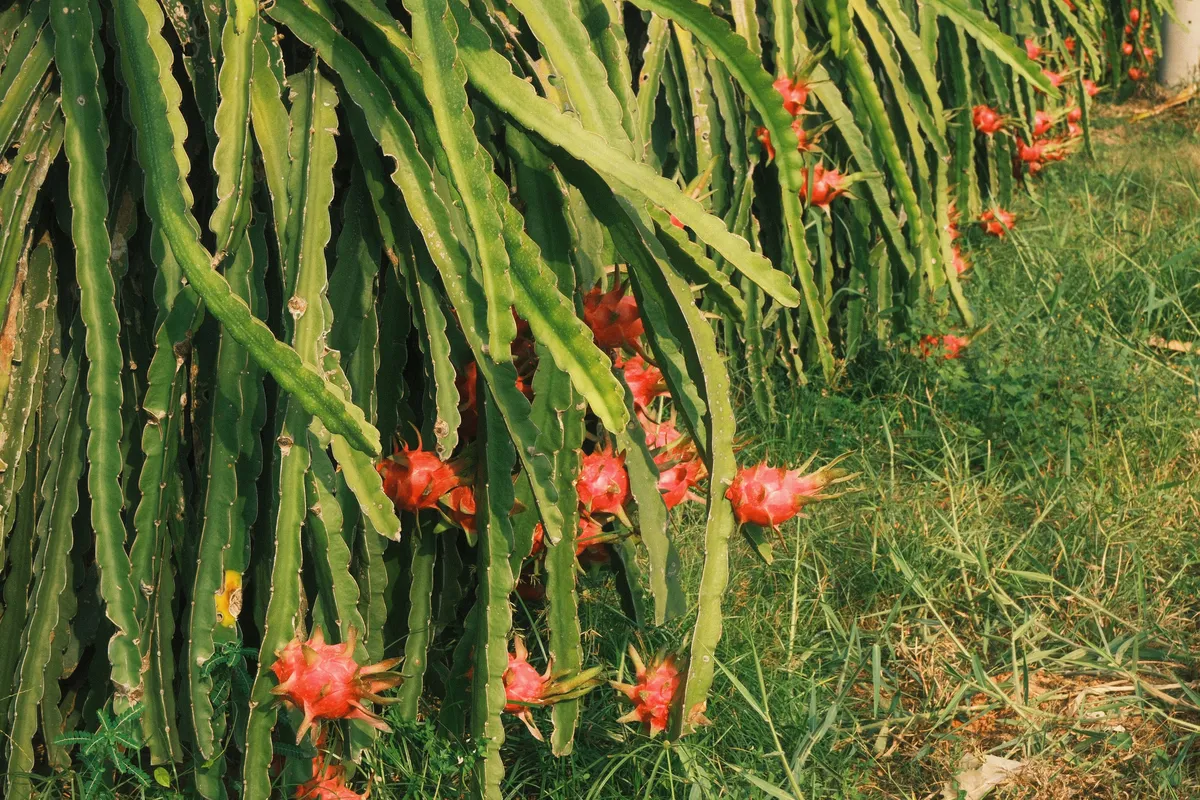
Dragon fruit is a climbing cactus, not a compact windowsill fruit plant. A container can make the root zone movable, but it does not remove the crop’s need for warm outdoor light, room to branch, a strong support, and suitable pollination. The first decision is therefore not the pot size. It is whether the site can support the mature plant safely.
For gardeners outside reliably frost-free climates, a container may help with winter protection. Fruiting is still a long-term project, and moving a heavy, trellised cactus can become the hardest part of the design. Plan the support, route, doorway clearance, and winter destination before planting.
Know what plant you are buying
Dragon fruit, pitaya, and pitahaya are market names applied to several climbing cacti and their hybrids. The accepted name for the common white-fleshed species is Selenicereus undatus according to Kew; older references and plant labels may use Hylocereus undatus.
Skin and flesh color do not tell you everything about growth or pollination. Before buying, ask for:
- the cultivar or selection name, not only “red” or “white” dragon fruit;
- whether it is reported to be self-compatible;
- whether the seller recommends a genetically different pollen partner;
- whether the plant is a rooted cutting, seedling, or graft;
- its cold-protection guidance and mature growth habit.
University of California Agriculture and Natural Resources emphasizes the diversity hidden behind the pitahaya name. Keep the original label and source information because those details become important when the plant finally flowers.
Decide whether the site is realistic
The UF/IFAS home-landscape guide describes pitayas as tropical and subtropical, vine-like cacti that can develop long, heavy stems. They perform best in warm, mostly frost-free conditions. Freezing exposure can damage them, while extreme sun and heat can also scorch stems in some environments.
A workable site has:
- strong outdoor light with climate-appropriate protection from severe heat or reflected sun;
- free air movement without a wind corridor that can topple the support;
- a level surface able to carry the wet container, plant, and trellis;
- access for watering, pruning, and harvest;
- clearance from power lines, walkways, doors, and neighboring property;
- a credible winter plan if freezes occur.
An indoor living room may keep a container above freezing, but ordinary room light rarely equals a productive outdoor site. Treat indoor overwintering as protection, not as a promise of year-round growth or fruit.
Build the support before planting
Dragon fruit stems climb with aerial roots and then hang over the top of a support. Mature growth can become a dense, heavy canopy. A decorative stake sized for a young cutting is not a finished trellis.
The University of Guam dragon-fruit guide and UF/IFAS both show robust post-and-top systems. For a container project, the support should resist tipping and should not depend on thin, exposed wire that can cut fleshy stems.
Use these design checks:
- Load path: The post and top frame must transfer weight to a stable base.
- Container stability: A narrow or lightweight pot can tip as the canopy grows.
- Stem contact: Broad, smooth contact points reduce abrasion.
- Maintenance access: Leave room to tie, prune, inspect, and harvest.
- Mobility: If the plant must move, decide whether the support moves with it and how that can be done without lifting an unsafe load.
For broader choices among arches, posts, panels, and trellises, use the outdoor-vine support guide. Dragon fruit needs a crop-specific structure even after that general decision.
Choose the container and root zone
There is no universal container size that guarantees fruit. Start with a stable container large enough for the current root system and the planned support, with multiple unobstructed drainage holes. Expect to reassess the root zone as the plant and canopy expand.
Use a clean, well-drained container medium rather than dense yard soil. North Carolina Extension describes S. undatus as a cactus that needs good drainage. Organic material can support growth, but a mix that collapses and stays saturated removes air from the roots.
Before filling the container:
- confirm that water can leave freely;
- cover large holes with mesh only if needed to retain mix, not to create a sealed layer;
- install or anchor the support without crushing future roots;
- keep the crown at the same depth it grew in the nursery pot;
- leave a watering space below the rim.
A tray may protect a surface, but drain it after watering. Do not let the container stand in collected runoff.
Plant a rooted cutting with realistic expectations
Seed-grown dragon fruit may vary from the parent and can take longer to reach fruiting age. Named plants propagated from cuttings give the gardener more useful information about the expected fruit and pollination behavior.
Choose a healthy rooted plant with firm stems, a sound root ball, and no soft, spreading lesions. Acclimate nursery-grown stems gradually if the new site has stronger sun.
Place the plant close enough to the post for gentle training. Use soft ties that do not constrict the stem, and inspect them as growth thickens. Direct the primary growth upward; once it reaches the top, laterals can be arranged to hang over the support.
Water for growth without keeping roots saturated
Dragon fruit is a cactus, but an actively growing and fruiting plant is not managed like a dormant desert display. It needs adequate water while also needing drainage and oxygen around the roots.
Check the root zone rather than watering by calendar. Water thoroughly when the medium has dried to the stage appropriate for the plant, climate, and season, then let excess water drain. Hot, windy weather and a small container can shorten the interval. Cool weather, low light, a large container, or a water-retentive mix can lengthen it.
UF/IFAS warns that excessive soil moisture favors disease, while drought during flowering and fruit development can reduce production. The target is neither permanently wet mix nor prolonged neglect.
Feed and prune by evidence
Container nutrients leave through plant uptake and drainage, but more fertilizer does not automatically produce more flowers. Begin with the plant seller’s cultivar guidance, a complete fertilizer labeled for container fruit crops, and local Extension advice. Follow the label; adjust only in response to growth, the medium, and any relevant test.
Train one or more strong stems to the top. After the canopy develops, remove dead, damaged, diseased, ground-touching, or badly crowded growth with clean tools. The goal is a supportable canopy with light and air, not the maximum number of stems.
The University of Hawaiʻi pitaya diagnostic resource is useful when spots, rots, or pest damage appear. Photograph symptoms, check irrigation and injuries, and identify the problem before choosing a treatment. Do not apply a generic oil, soap, or fungicide recipe to an unidentified lesion.
Plan for flowers and pollination
Dragon fruit flowers are large and open at night. Some cultivars set fruit with their own pollen; others are partly or fully self-incompatible. UF/IFAS recommends genetically different types where compatibility is uncertain and describes hand pollination during the night or early morning as an option.
When buying a second plant, two cuttings of the same clone are not genetically different pollen partners. Record cultivar names on durable labels. If flowers appear:
- note when each opens and how long it remains receptive;
- confirm compatibility information from the nursery or a credible cultivar source;
- protect collected pollen from moisture and contamination;
- use a clean tool if hand pollinating;
- label any controlled cross so results can be evaluated.
Flowering does not guarantee fruit. Heat, water stress, incompatible pollen, poor pollen transfer, and plant maturity can all affect the result.
Overwinter before the forecast becomes an emergency
In a climate with frost, choose the protected location before autumn. Reduce the canopy only as needed for safe movement, and inspect for pests before bringing the plant into a shared indoor growing area. Keep it away from cold glass and heating vents, and give it the strongest practical light.
Water use usually falls as light and growth decline. Continue checking the medium instead of following the summer interval. Do not leave a cool container saturated.
If the container, support, and canopy cannot be moved safely, the project is not truly portable. A protected greenhouse, permanent warm site, or a different crop may be the more realistic plan.
Harvest when the fruit is mature
The wait for fruit varies with cultivar, climate, pollination, and plant age. When fruit develops, follow cultivar-specific color and maturity guidance. UF/IFAS recommends harvesting well-colored, mature fruit with hand clippers while avoiding damage to the fruit and stem.
Use clean tools and support the fruit while cutting. Do not pull or twist against the fleshy branch.
A container dragon-fruit go/no-go checklist
Proceed when you can answer yes to all of these:
- The plant has a known identity or useful cultivar record.
- The outdoor site has sufficient warm-season light and safe clearance.
- The container drains and sits on a surface that can bear the wet load.
- The trellis is load-bearing and maintainable.
- There is a realistic frost plan where needed.
- Pollination compatibility can be checked before flowering.
- You are willing to prune and inspect a vigorous perennial cactus.
If several answers are no, solve the system before buying the plant. Dragon fruit can grow successfully in a container, but the container is only one component. Climate, structure, drainage, and pollination determine whether the project remains manageable and whether flowers have a credible path to fruit.
Sources
- Pitaya (Dragonfruit) Growing in the Florida Home Landscape (University of Florida IFAS Extension). Accessed August 25, 2026.
- Growing Dragon Fruit (University of Guam Cooperative Extension and Outreach). Accessed August 25, 2026.
- Selenicereus undatus (North Carolina Extension Gardener Plant Toolbox). Accessed August 25, 2026.
- Know Thy Pitahaya (University of California Agriculture and Natural Resources). Accessed August 25, 2026.
- Selenicereus undatus (Haw.) D.R.Hunt (Royal Botanic Gardens, Kew). Accessed August 25, 2026.
- Pitaya (University of Hawaiʻi at Mānoa Cooperative Extension). Accessed August 25, 2026.