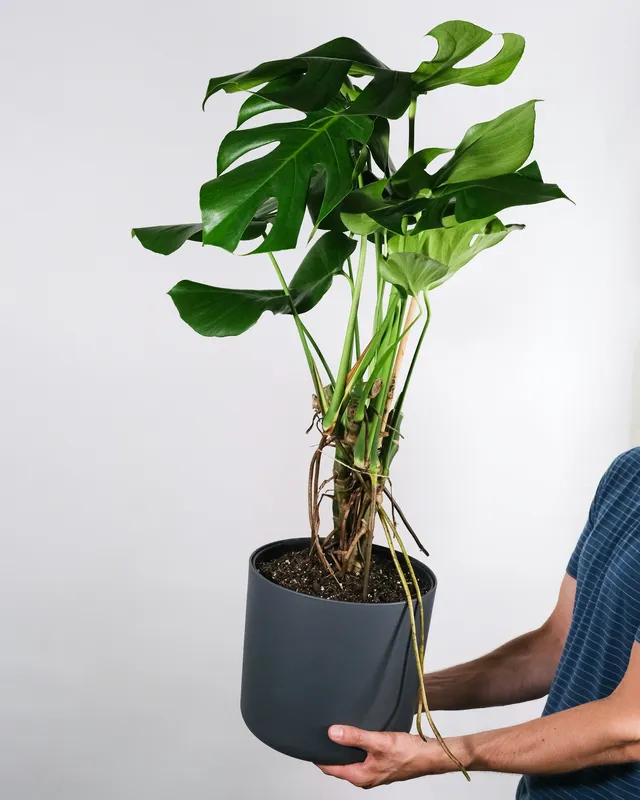
I have managed aerial roots on my own Monstera deliciosa, and the first thing I remind myself is that an aerial root is a normal climbing structure, not a disease or automatic evidence that the plant needs repotting. Indoors, I can leave one alone, guide it toward support, direct it into the potting mix when it reaches without force, or prune selectively when it creates a practical problem.
I make that choice from the plant’s stability, the root’s position, the support system, and household safety. Appearance alone is not a horticultural emergency. The botanical explanations and safety boundaries below remain grounded in the cited horticultural sources rather than one plant’s response.
What an aerial root is
Monstera deliciosa is a climbing vine in the arum family, Araceae. It is not a philodendron despite the common name “split-leaf philodendron.” In its native growth habit, roots formed along the stem attach to trunks and branches as the vine climbs. Penn State Extension describes these roots as attachment structures, and University of Wisconsin Extension notes that they grow downward and can root when they contact the ground.
An aerial root generally:
- Emerges from a node on the main vine, often near the base of a leaf
- Begins pale or greenish at the growing tip and becomes tan or brown with age
- Has a round, cordlike form rather than a flat leaf blade
- Lengthens toward a surface, support, or the floor
Do not confuse it with the petiole, which is the stalk connecting a leaf blade to the main stem, or with an axillary bud, which can produce a new shoot. Ties belong around the sturdy main stem, never tightly around a petiole or growing tip.
Choose an action deliberately
| Situation | Best initial option | Why |
|---|---|---|
| Root is healthy and not obstructing anything | Leave it | No intervention is required |
| Plant leans and has no support | Install a stable pole, plank, or trellis and guide the vine | Support addresses the structural problem |
| Flexible lower root naturally reaches the pot | Lay or guide the tip onto the mix | Lower aerial roots can enter the root zone |
| Root is approaching a wall, outlet, walkway, or furniture joint | Redirect early or prune selectively | Prevents attachment, damage, and trip hazards |
| Root is already attached to a wall or porous surface | Do not pull it off forcefully | Pulling can damage both root and finish |
| Root is dry and corky but plant is otherwise healthy | Leave or trim for access/appearance | An old root alone is not proof of low humidity or root disease |
| Root is soft, blackening, or foul-smelling | Inspect local moisture and the main root zone | Persistent wetness or tissue decay needs diagnosis |
| Goal is propagation | Take a stem cutting that includes a node and bud | An aerial root by itself is not a complete cutting |
Missouri Botanical Garden states that lower aerial roots can be directed into soil, while upper roots can be attached to a moss-like support or removed. That makes pruning an available option, not a requirement and not automatically the healthiest choice in every situation.
Leave healthy roots when space allows
Leaving an aerial root is the lowest-risk decision. It preserves a potential anchoring point and avoids making a wound. Long roots can rest along the floor only where they will not be stepped on, pulled by a vacuum, or reached by children or pets.
A dry brown surface can be normal maturation. Do not diagnose low humidity from an aerial root’s color alone, and do not coat it with oil, wax, rooting gel, or leaf-shine product. Check the plant’s leaves, potting mix, new growth, and room conditions as a whole.
Roots that search sideways often reflect the vine’s climbing habit rather than a deficiency. Aerial roots do not mean the underground roots are crowded. Inspect the root ball and drying behavior before deciding to increase pot size.
Guide the plant to stable support
Support the vine, not just the loose roots. A moss pole, bark slab, wood plank, or rigid trellis can work if it is tall and strong enough for the current plant and anchored against tipping. Wisconsin Extension recommends a strong bark or moss-covered support for the aerial roots, while Penn State lists moss sticks, trellises, bamboo stakes, and sphagnum-covered boards as options.
Set up support safely
- Identify the back of the vine, where aerial roots emerge, and face it toward the support.
- Anchor the support deeply without blindly driving it through the root mass. The safest time to position a large support is often during a necessary repot, when roots are visible.
- Secure the main stem at several points with broad, soft ties.
- Leave space for stem thickening and inspect ties monthly.
- Guide flexible root tips to the support without sharp bends; a rigid older root may crack if forced.
- Test the entire watered pot for stability before returning it to a shelf or traffic area.
A moist moss support can provide a surface roots enter, but it adds maintenance. Keep it evenly moist only if the structure was designed for that use, prevent runoff from saturating the pot continuously, and replace degrading material. A dry pole or plank can still provide physical support even if roots do not penetrate it.
Do not allow adhesive roots to establish on painted drywall, wallpaper, electrical cords, or valuable wood. Redirect them while the tips are young. If attachment has already occurred, cut the root between the plant and surface if necessary, then test a hidden area or consult the surface manufacturer before removal. Forceful pulling can tear paint, paper, wood fibers, or plant tissue.
Guide a lower root into the pot only when it reaches
A flexible root that naturally reaches the container can be laid across the surface and lightly covered at its tip. Do not bend a rigid root through a tight angle or bury the main stem. The pot must still drain freely, and the added root is not a reason to keep the entire medium constantly wet.
Avoid directing every root into a separate jar of water. That creates containers that can spill, attract algae, and keep individual roots in conditions unlike the main root system. It also does not replace correct watering of the potting mix. A coherent support and root-zone plan is easier to monitor than a collection of improvised reservoirs.
If roots cover the soil so densely that watering and inspection are difficult, reposition what can be moved gently and prune only enough to restore access. Repot only when the underground root ball or deteriorated mix justifies it.
Prune selectively when needed
Pruning is reasonable when a root creates a trip hazard, threatens a surface, prevents moving the pot, or conflicts with the chosen form. It may also be necessary to remove a clearly decaying section.
Use this method:
- Wear gloves and protect eyes from sap.
- Clean and sharpen pruners or scissors.
- Trace the root to its origin so a stem or emerging bud is not cut accidentally.
- Cut the root a short distance from the stem without slicing into the node.
- Remove only the roots needed to solve the problem.
- Clean the tool before using it on another plant.
Do not tear roots off by hand. Extensive simultaneous removal may reduce anchorage, especially on a large unsupported vine. Install support first when stability is the issue. A trimmed root may be replaced by new aerial growth later, so pruning is ongoing grooming rather than a permanent change in the plant’s biology.
Diagnose an abnormal-looking root in context
| Root appearance | Interpretation | Check next |
|---|---|---|
| Firm, tan or brown, with a lighter tip | Common mature aerial-root appearance | Whether it needs direction or support |
| Dry or shriveled end | Old injury, low local moisture, or normal tip death | New roots and leaf health; no emergency treatment by default |
| Broken tip after moving | Mechanical damage | Make a clean cut only if tissue is ragged |
| Soft, dark, wet tissue | Possible decay | Wet supports, standing water, and underground roots |
| Multiple roots stop growing with smaller leaves | Broader growth limitation | Light, temperature, watering, roots, and nutrition |
A soft aerial root on a wet pole may be a local problem; it does not confirm that all soil roots are rotten. Conversely, healthy-looking aerial roots do not rule out saturated potting mix. Slide out and inspect the root ball only when moisture behavior, odor, crown condition, or continuing decline supports that step.
Aerial roots and propagation are not the same thing
An aerial root alone does not contain everything needed to make a new vine. University of Minnesota Extension explains that a successful cutting or division must include a stem node and axillary bud; a leaf and petiole without a node will not produce new growth. An existing aerial root can help a node cutting establish, but it does not replace the node.
Before cutting a valuable plant, identify the node, bud, main stem, petiole, and root. Use clean tools and a well-drained propagation medium. A poorly planned cut can remove a leaf while leaving no viable growth point.
Child and pet safety
Monstera tissues contain insoluble calcium oxalate crystals, and sap may irritate skin or eyes. Keep pruned roots and other trimmings away from children and wash hands after handling. If plant material is chewed, do not induce vomiting; contact Poison Control in the United States at 1-800-222-1222 or the appropriate regional service for case-specific guidance. Difficulty breathing or swallowing needs urgent medical care.
The ASPCA Animal Poison Control Center lists Monstera deliciosa as toxic to dogs and cats, with oral irritation, drooling, vomiting, and difficulty swallowing among possible signs. Prevent pets from reaching dangling roots, and contact a veterinarian or animal poison-control service after chewing or ingestion.
Aerial-root checklist
- Confirm that the structure is an aerial root, not a petiole or new shoot.
- Leave it when it is healthy and safely contained.
- Support the main vine with an anchored pole, plank, or trellis.
- Redirect flexible roots before they attach to walls or furniture.
- Guide a lower root into the pot only without forcing it.
- Prune selectively with clean tools and gloves when access or safety requires it.
- Require a stem node and bud for propagation.
- Investigate soft tissue together with moisture, odor, and underground-root evidence.
Aerial roots are best treated as part of the vine’s structure. Manage them around a deliberate support plan rather than treating their mere presence as a problem.
Sources
- Monstera as a Houseplant (Penn State Extension). Accessed August 5, 2026.
- Swiss-Cheese Plant, Monstera deliciosa (University of Wisconsin–Madison Division of Extension). Accessed August 5, 2026.
- Monstera deliciosa (Missouri Botanical Garden Plant Finder). Accessed August 5, 2026.
- Propagating Monstera deliciosa (University of Minnesota Extension). Accessed August 5, 2026.
- Swiss Cheese Plant (ASPCA Animal Poison Control Center). Accessed August 5, 2026.