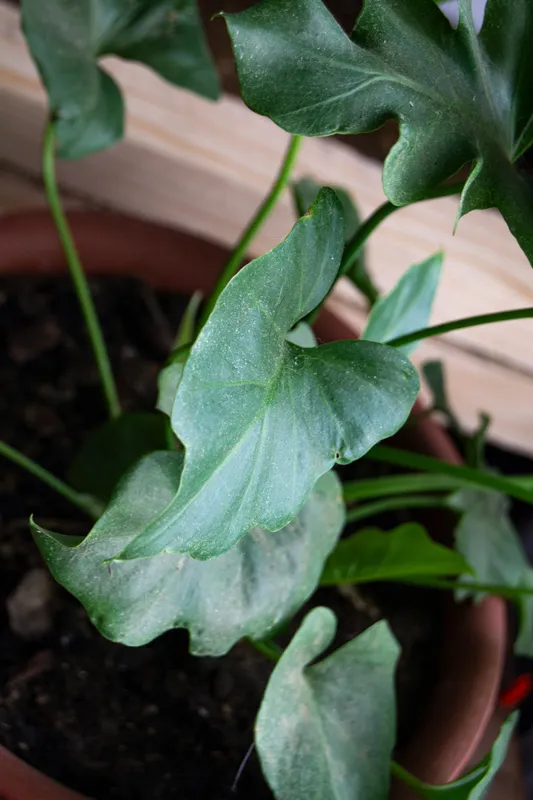
Yellow leaves, pale veins, brown margins, and slow growth can occur when a plant cannot obtain an essential nutrient. They can also result from saturated roots, drought, excess fertilizer, unsuitable pH, low light, temperature stress, pests, disease, or normal leaf aging. A leaf pattern is evidence to investigate, not proof that a particular nutrient is missing.
University of Delaware Cooperative Extension explains that different deficiencies can look alike and that water stress, insects, disease, or multiple deficiencies can make visual symptoms misleading. Check the roots and growing conditions before choosing a supplement; unnecessary fertilizer can add salt injury to the original problem.
Start with a precise observation
Before watering, feeding, repotting, or cutting, record what is actually present.
- Which leaves changed first? Mark whether symptoms began on old lower leaves, new growth, one side, or the whole plant.
- What is the pattern? Note uniform yellowing, green veins with pale tissue between them, dead margins, spots, distortion, or overall stunting.
- Is the pattern symmetrical? Nutrient-related symptoms often repeat across comparable tissue, while a sharply local patch may point toward injury, light exposure, or a living pest or pathogen.
- When did it begin? Compare the date with a move, seasonal light change, repot, fertilizer application, watering change, or pest event.
- Is new growth still progressing? One aging leaf is different from a pattern spreading through successive leaves.
Take clear photos in the same light and include the whole plant, affected leaves, unaffected leaves, pot, and root zone. If a diagnostic lab or Extension educator later helps, that context is more useful than an isolated leaf close-up.
Use mobility as a clue, not a verdict
Plants can move some nutrients from older tissue to newer growth more readily than others. When a mobile nutrient becomes unavailable, older leaves often show symptoms first. Problems involving less-mobile nutrients often appear first in new growth.
The University of Arizona Cooperative Extension and the Delaware guide group common patterns this way:
| First affected area | Possible nutrient pattern | Important lookalikes |
|---|---|---|
| Older leaves, generally pale | Nitrogen or another mobile-nutrient issue | normal aging, low light, wet roots, root loss |
| Older leaves, dead margins or mottling | Potassium or magnesium pattern | salt injury, drought, heat, root damage |
| New leaves, pale between green veins | Iron, manganese, or another less-mobile nutrient pattern | high root-zone pH, damaged roots, cold mix |
| New leaves distorted or growing points damaged | Calcium, boron, or other growth-point problem | pests, chemical injury, mechanical damage |
These groupings narrow questions; they do not identify a product to apply. A nutrient may be present in the pot but chemically unavailable because pH is unsuitable or roots are not functioning. Several issues can also occur together.
Rule out the common lookalikes
Root-zone moisture and oxygen
Yellowing, wilting, leaf drop, and stalled growth can all follow prolonged saturation. Iowa State University Extension lists yellow or brown leaves, wilt, leaf drop, fungus gnats, and crown or root rot among overwatering-related outcomes. A wilted plant in wet mix should not be assumed to need more water or food.
Check drainage openings, actual moisture below the surface, odor, and representative roots. Healthy roots vary by species, but soft dark tissue that slips apart is more concerning than firm tissue. Use the site’s root-rot diagnosis guide if the root zone is suspect.
Fertilizer and soluble salts
Too much fertilizer can injure roots and produce brown tips or margins, which occupy the same visual territory as several deficiency charts. Look for a recent rate change, repeated feeding without leaching, crust on the pot or mix, or fertilizer applied to a dry or stressed plant.
Do not respond to suspected salt injury by adding a different supplement. Pause fertilizer, verify drainage, and follow product and plant-specific guidance. The houseplant fertilizer guide explains how label rates, plant growth, and the potting system should shape feeding.
Light and temperature
Low light can slow growth, reduce water use, and cause older leaves to be shed. Sudden intense light can bleach or scorch exposed tissue. A cold root zone can limit uptake even when nutrients are present. Map symptoms to the side facing a window, lamp, heater, or draft and compare with a recent seasonal change.
Water source and root-zone chemistry
Hardness, alkalinity, sodium from a household softener, and accumulated fertilizer salts can change the root environment over time. Letting tap water stand does not remove every dissolved constituent. Check the water provider’s report where available and read the site’s water-quality guide before ranking water types or buying filtration equipment.
Pests, disease, and physical damage
Inspect leaf undersides, nodes, the crown, and the pot rim under strong light. Speckling, webbing, sticky residue, cottony material, fixed bumps, tunnels, or irregular lesions require identification rather than fertilizer. The UC Statewide IPM houseplant guide organizes common symptoms by possible environmental, pest, and disease causes.
Audit the feeding record
Write down:
- the exact fertilizer name and analysis;
- when it was last applied and at what measured rate;
- whether the product includes micronutrients;
- whether controlled-release fertilizer was already in the mix;
- how often water drains freely through the pot;
- how long the plant has occupied the current medium; and
- whether active growth has slowed with season or light.
An old mix is not automatically “depleted,” and a new mix is not automatically adequately charged for every plant. Some commercial mixes include starter fertilizer; others do not. A plant growing slowly in low light may need less fertilizer, not more. University of Florida IFAS Extension describes the different roles of essential nutrients, but those roles do not turn a visual symptom into a confirmed deficiency.
Decide whether testing is justified
For an inexpensive, replaceable houseplant with a clear care error, correcting the environment and observing new growth may be enough. Testing becomes more useful when the plant is valuable, symptoms are spreading, several plants share the problem, or a repeated fertilizer change has failed.
Garden-soil tests are not always designed for a soilless container mix. Before submitting material, ask the laboratory what it can analyze and how it wants the sample collected. Depending on the case, useful evidence may include:
- irrigation-water pH, alkalinity, or electrical conductivity;
- a saturated-media or other substrate test;
- plant-tissue analysis;
- examination for disease or pests; and
- the fertilizer and potting-mix labels.
Iowa State University Extension recommends combining observed symptoms with testing rather than assuming every plant problem is fertility-related. A local Extension office or diagnostic laboratory can help choose the right test for the material.
Make one justified change
After the strongest alternatives are checked, choose the smallest action supported by the evidence.
- If the root zone is saturated, correct drainage and watering before feeding.
- If the plant has been receiving excessive fertilizer, stop adding more and address salts according to the potting system and product instructions.
- If measured root-zone pH or water alkalinity is preventing uptake, correct that condition with crop-appropriate guidance rather than repeatedly adding the locked-out nutrient.
- If a complete fertilizer has been absent during active growth and the roots are healthy, resume a labeled complete-houseplant program at the appropriate rate.
- If a test confirms a specific deficiency, follow the laboratory or Extension recommendation rather than a generic internet dose.
Do not combine repotting, pruning, a water-source change, extra light, and several supplements on the same day. Multiple changes erase the ability to learn what helped and can overload a stressed plant.
Judge the response through new growth
Many damaged leaves will not become visually perfect after the underlying cause is corrected. Photograph a marked leaf, but judge the response primarily by the next leaves, roots, and growth rate. Set a reasonable review date based on the species and season rather than expecting an overnight color change.
Track the plant’s location, root-zone condition, feeding, and one chosen intervention. The optional Plant Recovery Journal can keep those observations together, but a dated note and consistent photos work too.
Escalate to a diagnostic service when symptoms continue across new growth, roots are deteriorating without a clear cause, or multiple plants in the same collection develop a shared pattern. The safest conclusion is sometimes “not yet identified.” That is more useful than treating a leaf chart as proof and creating fertilizer injury on top of the original problem.
Sources
- Identifying Nutrient Deficiencies in Ornamental Plants (University of Delaware Cooperative Extension). Accessed August 28, 2026.
- Identifying Plant Nutrient Deficiencies (Iowa State University Extension and Outreach). Accessed August 28, 2026.
- Diagnosing Houseplant Problems Related to Poor Culture (Iowa State University Extension and Outreach). Accessed August 28, 2026.
- Houseplant Problems (University of California Statewide Integrated Pest Management Program). Accessed August 28, 2026.
- Plant Essential Nutrients and Their Role (University of Florida IFAS Extension). Accessed August 28, 2026.
- Guide to Symptoms of Plant Nutrient Deficiencies (University of Arizona Cooperative Extension). Accessed August 28, 2026.