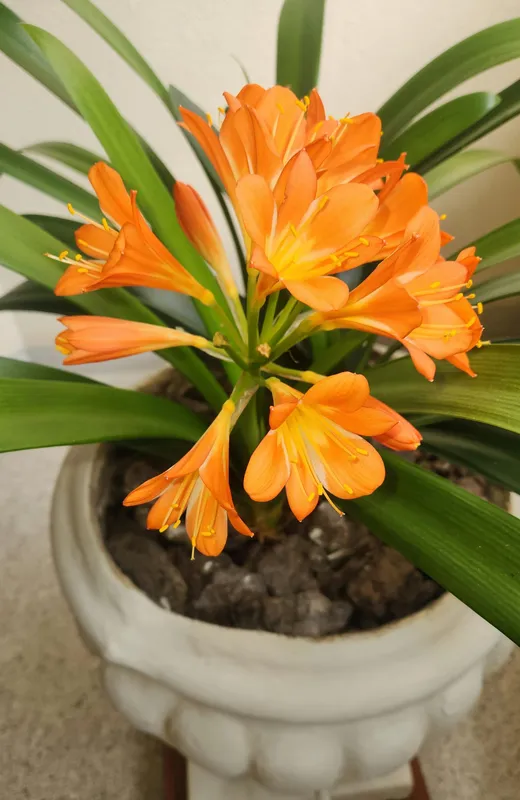
Clivia can spend years making handsome leaves while its owner waits for a flower stalk. A warm living room suits the foliage, but a mature plant often needs a cooler winter pause before it will bloom. Give it bright, filtered light, reduce watering during that rest, and keep it safely away from frost.
The familiar orange-flowered Clivia miniata has broad, arching leaves arranged in a fan. Its flowers rise together on a thick stalk above them. It belongs to the amaryllis family, but it grows from fleshy roots rather than the large exposed bulb you see when potting an amaryllis. You do not need to strip its leaves off or store it in a dark cupboard for winter.
Start with a plant old enough to flower
A small clivia is a long-term foliage plant before it becomes a flowering one. Longwood Gardens reports four to six years from seed to first flowers. That is a useful expectation when a seedling looks healthy but has never bloomed; another dose of fertilizer cannot turn it into a mature plant overnight.
If flowers are your main reason for buying one, ask whether the plant has flowered before. A flowering-size plant is the more direct choice than a young seedling. Check the leaves and their bases before bringing it home, and keep a new arrival separate from other houseplants while you watch for pests. Do not buy a struggling plant simply because it already carries a flower stalk.
Orange is the familiar color, but yellow and other selections exist. Choose for the plant you are actually buying; if the flower color matters to you, ask to see it in bloom.
A bright window, without scorching sun
Place the pot where the leaves receive bright, indirect light. An east-facing window or filtered light near another window can work, depending on shade outside. Deep inside a dim room, the plant may survive without giving you flowers. Strong direct summer sun can damage the leaves; move it back or use a sheer curtain if the sun becomes harsh.
University of Wisconsin Horticulture recommends bright, diffused light and notes that very low light rarely produces flowers. A shaded outdoor summer position is another option, provided the plant comes indoors before freezing weather. Check it for pests before moving it among indoor plants.
Look at the actual spot, not just the compass direction. A north window blocked by a porch is different from an open north window. If you move the plant for its winter rest, choose the light in that new location as carefully as the temperature.
Make the winter rest cool, not freezing
For an established, healthy plant, the Royal Horticultural Society’s clivia guide gives a practical indoor target: a bright position around 50°F (10°C) in winter, with very little watering. A spare room can be useful. A porch that freezes, or a pot pressed against icy glass, is not a safe substitute.
Use a thermometer near the pot to check the overnight low. The room’s daytime feel is not enough to judge a cold windowsill. Keep the plant out of radiator heat and cold drafts, and stop feeding while it rests.
Do not turn reduced watering into a rule to ignore the plant for months. Check the compost and leaves; supply a little water when needed to prevent complete drying and loss of firmness. Cool, wet roots are particularly vulnerable to rot, so empty any water left in the saucer. A calendar reminder should prompt a check, not an automatic drink.
Rest schedules vary with growing conditions. Longwood’s flowering guidance describes a colder, drier program timed for a flower show. At home, follow a consistent winter routine suited to your space instead of combining the coldest temperature from one schedule with the longest drought from another. Wisconsin recommends about two months of rest in fall or winter. That sustained change is different from one chilly night.
Return to growth gradually
When a flower stalk begins to develop, gradually increase watering and move the plant to a brighter, warmer growing position. Let the mix dry to the touch between thorough waterings and allow excess water to drain. Resume a suitable houseplant fertilizer during active growth, following its dilution directions; do not add fertilizer to compensate for a missing winter rest.
After the flowers fade, cut the spent stalk near its base if you do not want seeds. Keep the healthy leaves. They are part of the plant’s next growing season, not disposable wrapping around the flowers. Photographing the pot when the stalk appears can help you compare next year’s timing without expecting an exact anniversary.
Leave the roots room to settle
Clivia tolerates a crowded pot and does not need repotting every spring. NC State Extension notes that it may remain in one pot for years. When roots are tightly packed and repotting is necessary, use a container only a little larger, with drainage holes and a free-draining potting mix. Keep the base of the leaves at its previous level rather than burying it deeper.
Inspect crowded leaf bases for mealybugs and scale. Cottony patches or attached brown bumps need a closer look, not extra water. The mealybug guide can help with identification and careful treatment. Soft, collapsing growth in persistently wet mix is a different problem; check the roots and drainage before changing fertilizer.
Keep clivia away from pets that chew plants and children who might taste leaves or berries. The ASPCA lists clivia as toxic to cats and dogs; contact a veterinarian promptly after suspected ingestion. Wear gloves when handling damaged plant material, and wash your hands afterward. Choose the cool winter location with those household limits in mind, too.
Sources
- How to grow clivias (Royal Horticultural Society). Accessed October 8, 2026.
- Clivia (University of Wisconsin–Madison Extension). Accessed October 8, 2026.
- Clivia miniata (North Carolina Extension Gardener Plant Toolbox). Accessed October 8, 2026.
- Clivias (Longwood Gardens). Accessed October 8, 2026.
- How to Make Your Clivia a Blooming Winner (Longwood Gardens). Accessed October 8, 2026.
- Clivia Lily (ASPCA Poison Control). Accessed October 8, 2026.