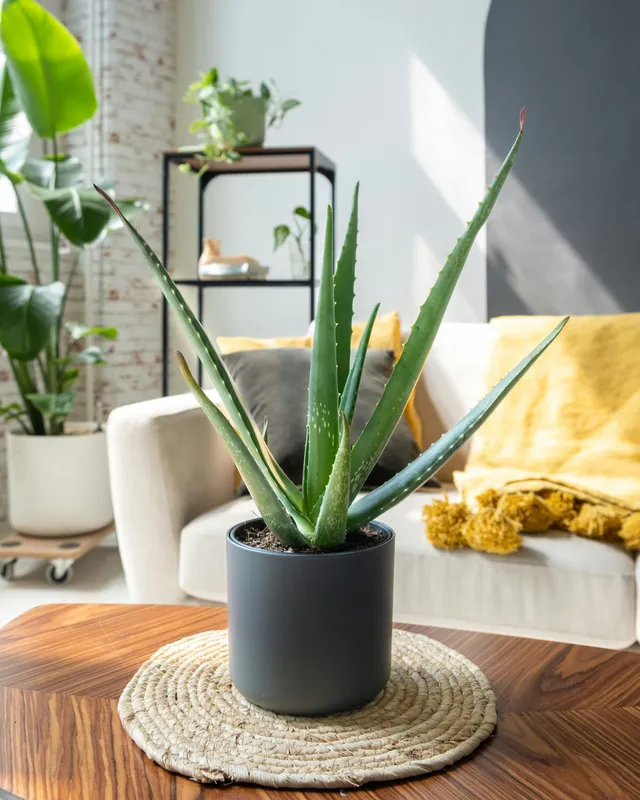
An aloe’s thick leaves store water, but its roots still need air. Put it in a dim corner and keep topping up the pot, and those sturdy leaves can become soft and unstable. A bright window and a pot that dries between waterings do much more for this plant than frequent attention with a watering can.
This is care for Aloe vera, also sold under the older name Aloe barbadensis. Check the plant label: “aloe” covers many species, and a similarly shaped succulent is not necessarily the same plant.
Give the rosette a bright place to grow
Start near a sunny window. The RHS Aloe vera profile recommends full sun and a south- or west-facing position; actual indoor light also depends on trees, buildings and the distance from the glass. A shelf across the room is a different growing space from the sill.
Introduce a plant from a shaded shop to stronger sun gradually. If it spends summer outdoors, follow the same gradual transition rather than moving it straight into an exposed midday spot. RHS hardening-off advice explains how staged exposure reduces scorch and temperature shock. Bring aloe back inside before frost, and keep leaves away from freezing glass or cold drafts.
Aloe does not need a humid enclosure. The RHS aloe guide recommends good light and ventilation and warns against continuously wet compost. Give the leaves room instead of squeezing the plant into a closed terrarium. A bright, dry room is a more useful starting point than a steamy, poorly lit bathroom.
Let the pot dry, then water it thoroughly
North Carolina Extension advises allowing aloe’s soil to dry completely between waterings, with less frequent watering in winter. “Every Sunday” cannot account for a cool room, a larger pot or a stretch of cloudy weather.
Check below the surface, not just the dusty-looking top. Feel the mix where you can reach without damaging roots and learn how light the pot feels when dry. If the upper layer is dry but the pot is still unusually heavy, investigate further before adding water. No single leaf color or moisture-meter reading tells the whole story.
When watering is needed, wet the mix thoroughly and let the excess drain away. Empty the saucer or outer decorative pot. Illinois Extension’s watering guidance stresses both complete watering and removal of standing water. Repeated small splashes make it harder to know which parts of the root ball are actually wet.
Keep checking through winter, but expect the interval to change as growth and drying slow. A calendar can remind you to inspect; it should not make the watering decision. If someone else cares for the plant while you are away, leave that distinction in their instructions.
Choose a draining pot without too much spare soil
Use a container with drainage holes and a free-draining cactus or succulent potting mix. A terracotta pot can be useful because porous clay dries more readily than plastic, but it still needs open drainage holes. A plant in plastic can also do well when its mix and watering suit the conditions.
If you use a decorative outer pot, make sure you can lift the inner pot out to water and empty it afterward. The attractive outer container should not become a hidden reservoir. For help matching the container to the root ball, see choosing the right pot.
Repot when roots have filled the container or the plant has outgrown it, preferably in spring. Choose a modest increase in size. The RHS succulent guide warns that excess soil in an oversized pot can remain too wet and encourage rot. A large pot is not a substitute for a stable position where the leaves will not be knocked.
Read a struggling plant before changing its care
Several problems can make an aloe look thirsty. Check the mix, the base of the plant and the recent conditions together:
- Shriveled leaves with dry mix: water may be overdue. Water thoroughly, drain, and watch the plant’s response rather than repeatedly topping up the pot.
- Soft leaves or a failing base with wet mix: more water can make matters worse. Remove the plant carefully to inspect the roots; the root-rot guide explains what to look for and what recovery can involve.
- Weak, misshapen growth in a dim position: improve the light gradually. Fertilizer cannot replace light.
- Discolored patches after cold exposure: review where the pot spent the night before assuming the problem is thirst.
Also look around the leaf bases for pests. Aloe can host mealybugs and scale. Keep an affected plant separate while you identify the problem; do not pour a homemade treatment into the rosette simply because a leaf has changed color.
Avoid adding fertilizer as an emergency response to a struggling plant. During active growth, use a suitable houseplant or succulent fertilizer according to its label. Reduce interventions when the plant is resting; concentrate first on light, drainage and the condition of its roots.
Separate offsets that already have roots
The little rosettes beside an established aloe are offsets, often called pups. They can become separate plants, but there is no need to remove every small one immediately.
Spring or early summer is a suitable time to divide them. Slide the plant out carefully and find where each offset joins the parent. Illinois Extension recommends retaining roots on the offset. Use a clean, sharp tool if separation requires a cut, and pot the rooted offset in a small draining container of cactus mix. Leave very small, unrooted offsets attached to develop further rather than treating a loose leaf as a ready-made new plant.
Wear gloves and wash your hands afterward. Keep the parent and new plants where you can inspect them without brushing or breaking their leaves.
Keep it out of reach of mouths
Aloe is an ornamental houseplant here, not a home remedy or a food crop. Its leaves can cause harm if eaten, and the latex can irritate skin. Do not offer cut leaves or sap to children or pets.
The ASPCA lists aloe as toxic to cats and dogs, with possible vomiting, lethargy and diarrhea. Contact your veterinarian promptly if a pet may have eaten it. If your cat can reach every sunny sill, choose from the cat-safe houseplant guide instead of relying on a higher shelf to prevent chewing.
Sources
- Aloe vera (North Carolina Extension Gardener Plant Toolbox). Accessed October 17, 2026.
- Aloe vera: Barbados aloe (Royal Horticultural Society). Accessed October 17, 2026.
- Aloe (Royal Horticultural Society). Accessed October 17, 2026.
- How to grow houseplant cacti and succulents (Royal Horticultural Society). Accessed October 17, 2026.
- Watering (University of Illinois Extension). Accessed October 17, 2026.
- Specialized Structures (University of Illinois Extension). Accessed October 17, 2026.
- Hardening off tender plants (Royal Horticultural Society). Accessed October 17, 2026.
- Aloe (ASPCA Poison Control). Accessed October 17, 2026.