Recipes
Canh Chua with Fish and Pineapple
A Vietnamese sour fish soup with tamarind, pineapple, tomato, okra and herbs, with gentle poaching and room to balance the broth.
Jump to recipe ↓Recipe
- Total time
- About 40 minutes
- Method
- Soup pot
- Difficulty
- Moderate
- Allergens
- Fish
About 3 servings with rice
Allow roughly 40 minutes. Use unsweetened tamarind pulp from a block, not a concentrated bottled paste. Have rice ready before the soup finishes; stay with the pot while the fish cooks.
Equipment: 3-litre saucepan, small heatproof bowl, fine sieve, knife, board, ladle and instant-read food thermometer.
Ingredients
- 450 g boneless firm white fish such as cod or catfish (about 1 lb), fully thawed if frozen
- 25 g unsweetened tamarind pulp from a pressed block
- 1 litre water, plus 100 ml hot water for extracting the tamarind
- 150 g peeled fresh pineapple, cut into small bite-sized pieces
- 250 g tomatoes, cored and cut into thick wedges
- 120 g okra, stems trimmed and pods cut into 2 cm pieces
- 75 g fresh mung bean sprouts, refrigerated until needed
- 3 garlic cloves, finely chopped
- 1 tablespoon neutral cooking oil
- 1 tablespoon fish sauce, plus up to 2 teaspoons to adjust
- 2 teaspoons sugar, plus up to 2 teaspoons to adjust
- 2 tablespoons chopped culinary rice paddy herb (ngò ôm) or Thai basil
- Freshly cooked rice, to serve
Method
Extract the tamarind
Cover the tamarind pulp with the 100 ml hot water in a heatproof bowl. Once cool enough to handle safely, press and stir it with a spoon until loosened, then push through a fine sieve. Keep the strained liquid; discard seeds and coarse fibers. Prepare all vegetables and wash the herbs. Rinse the sprouts under running water just before cooking; rinsing alone does not make raw sprouts safe.
Convert a measurement for this stepPortion the fish separately
Check the fish for bones and cut into chunks about 4 cm wide. Keep refrigerated while you start the broth. Wash hands and clean the board, knife and surfaces after raw fish contact. Keep a clean ladle and serving bowls away from the raw-fish plate.
Convert a measurement for this stepBuild a light sour broth
Warm the oil in the saucepan over medium-low heat. Stir in the garlic and cook until fragrant and lightly golden, not brown. Carefully add the litre of water, pineapple, 1 tablespoon fish sauce, 2 teaspoons sugar and half the strained tamarind liquid. Bring to a simmer. Add the okra and tomatoes and simmer gently until the okra is nearly tender, checking after about 4 minutes.
Convert a measurement for this stepLower the fish into the soup
Slide in the fish and bring the broth back to a gentle simmer. Add the sprouts and keep them submerged. Avoid vigorous stirring; move the pot gently if needed. Cook until the sprouts are thoroughly hot and softened and the thickest fish pieces reach 145°F (63°C). Begin checking the fish around 5 minutes, but continue until the temperature is reached. Do not use a rolling boil to hurry it.
Convert a measurement for this stepAdjust the bowl of broth
Once the fish is cooked, turn the heat low and taste a cooled spoonful of broth. Add reserved tamarind a teaspoon at a time for more sourness, the extra sugar in small pinches if too tart, or the extra fish sauce a little at a time if underseasoned. You do not need to use every reserved amount. Turn off the burner, stir in the herbs and ladle gently into bowls. Serve promptly with rice.
Convert a measurement for this step
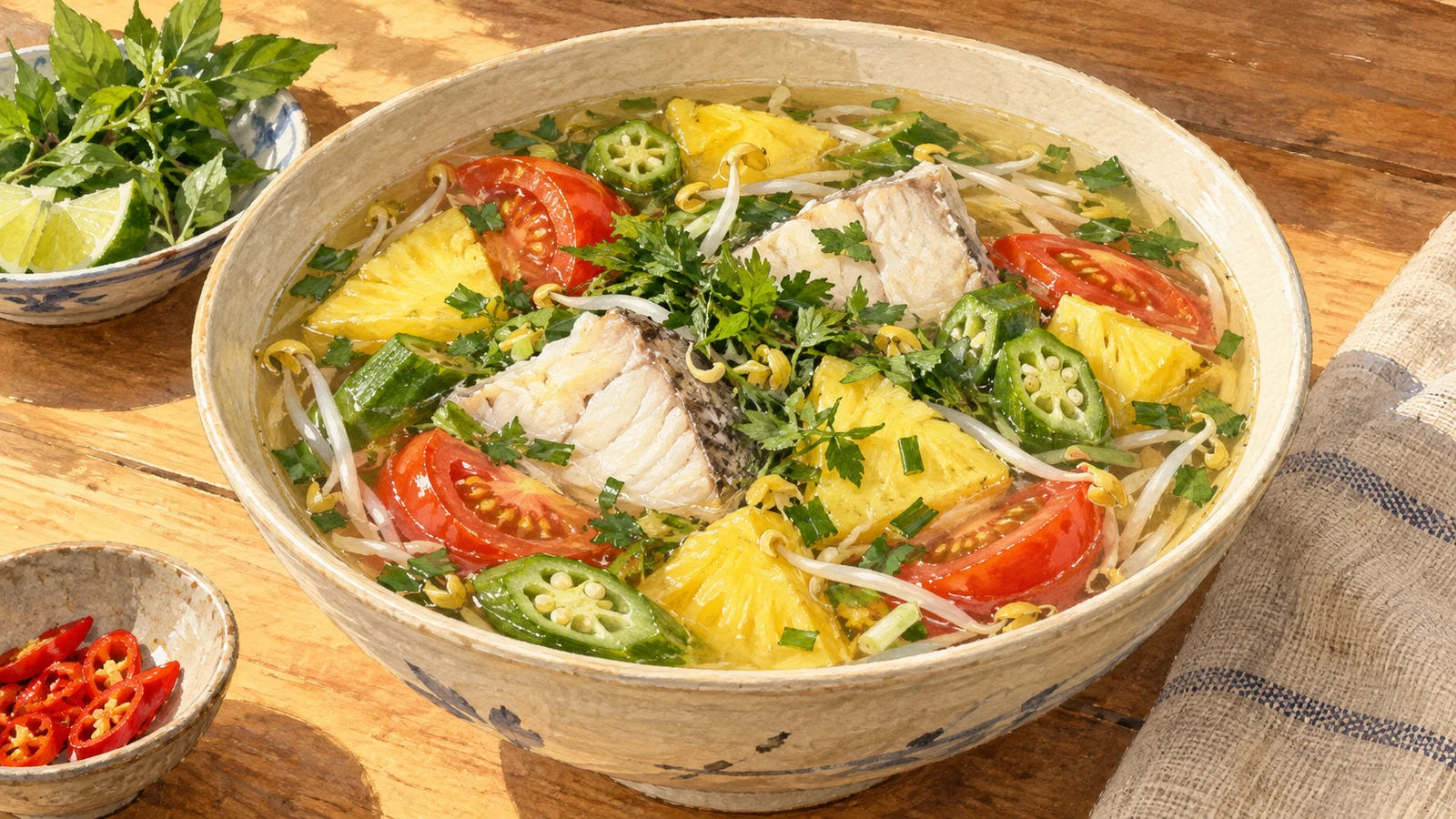
Sourness comes in several strengths
Tamarind is the ingredient to identify before you begin. Use unsweetened tamarind pulp sold in a sticky, fibrous pressed block. Bottled pastes and concentrates vary too much to substitute by the same weight. Extracting a small amount and adding it gradually leaves room to balance the broth against the pineapple you actually bought.
The soup should be bright enough to notice beside rice, with sweetness supporting the sourness rather than turning it into pineapple syrup. Taste the broth before adding more of everything. If it already has enough salt, another splash of fish sauce is not the answer to a lack of acidity.
Adapted from canh chua recipes by Vicky Pham and chef Peter Nguyen.
Choose the herb you can identify
Ngò ôm brings its own fragrance. Thai basil is a useful alternative but not an identical flavor. Buy either as a culinary herb; do not gather an unknown water plant for soup. If you want to grow a correctly identified grocery bunch, see rooting ngò ôm.
This version does not require bạc hà stems. Do not add ornamental elephant-ear stems as a substitute for something you have seen in another canh chua recipe.
Keep the fish intact and the soup cold afterward
Make room for the ladle rather than stirring through the fish. The FDA’s seafood guidance gives 145°F (63°C) as the cooking endpoint. Refrigerate raw fish promptly and use within two days or freeze it.
Keep the sprouts in the hot soup until thoroughly cooked, not scattered raw on top. FDA guidance on sprouts explains why washing alone cannot remove all of their potential contamination.
Refrigerate leftover soup in shallow containers within two hours, or one hour above 90°F (32°C). Use within 3–4 days and bring reheated soup to a rolling boil, with fish reaching 165°F (74°C), following USDA leftover guidance. The vegetables will soften further. Fish and fish sauce are allergens; check the sauce label for additional ingredients.