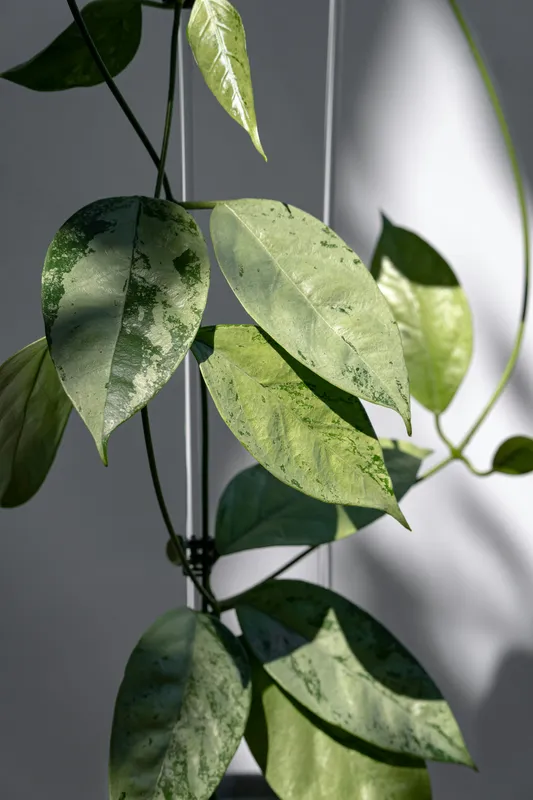
After a hoya’s flower cluster falls, a short, rather bare stalk remains on the vine. Leave it there. That flower spur, or peduncle, can bloom again over several years. Snipping it off while tidying the plant removes a place where future flowers could form.
Hoya carnosa, often called wax plant, has thick, fleshy leaves and clusters of small white to pale pink flowers with red centers. This guide is for that species. A narrow-leaved Hoya linearis or another hoya may need different care; check the plant label before applying a routine to an entire collection.
Give the vine a bright place to grow
Choose bright, filtered light, with protection from strong summer sun. The RHS species profile recommends this indoor position and a support for its climbing stems. A hoop or small trellis gives the vine room to wind upward; a high shelf lets it trail. Place it where you can still reach the pot to check moisture.
Keep it away from heaters and cold drafts. Once flower buds form, avoid moving it to a different light exposure: a sudden change can lead to bud drop. If the current spot is too dim, improve the light before the next budding period rather than repeatedly shifting a budding plant between windows.
Check the mix before reaching for water
Use a container with drainage holes and a loose, fast-draining potting mix. Hoya carnosa is an epiphyte, adapted to growing on other plants rather than in dense garden soil. NC State Extension advises letting its mix dry between waterings; both excessive wetness and excessive dryness can cause leaf loss.
Check below the surface, not just the dry crust on top. A finger inserted about two inches into the mix can help you tell whether it is still damp. When the mix has dried sufficiently, water thoroughly with room-temperature water, let the excess drain and empty the saucer or outer pot. Do not leave the roots standing in runoff.
There is no dependable “every Saturday” interval. Pot size, pot material, light and temperature all change how quickly water is used. The University of Illinois watering guide explains these differences. Check regularly as the seasons change, and do not wait for repeated wilting as your normal signal to water. A wilted plant in wet mix needs investigation, not another drink.
Keep the flowering points intact
Look at where a flower cluster joins the vine before you prune anything. Keep the short spur after flowering, even though it no longer looks decorative. If you need to shorten an overgrown plant, first identify those flowering points and plan the cuts around them. Wear gloves when handling cut stems; hoya sap can irritate skin.
Flowering also depends on maturity and growing conditions. A young plant may take years to begin. Lack of flowers is a reason to assess light and routine care, not to keep cutting, repotting or adding fertilizer. There is no date by which every plant must bloom.
The RHS growing guide recommends light feeding and retaining old flower stalks. Use a suitable houseplant or orchid fertilizer according to its label while the plant is growing, rather than repeatedly adding extra feed to force buds.
Repot when the roots need room
A hoya does not need a larger pot each year. Repot when it outgrows the current one, preferably outside a period of budding or flowering. Choose a pot only modestly wider than the rootball, with drainage, and fresh airy mix. A large volume of unused wet compost is not helpful to the roots.
If the plant is manageable but you are unsure how to assess its rootball, use the repotting guide. Check stems and leaf joints for cottony mealybugs while you handle it; isolate an infested plant and follow the mealybug guide.
Take a stem cutting, not a flowering spur
If you want a second plant, choose a healthy, pest-free shoot in spring or early summer. Keep the flowering spurs on the parent plant. Use clean, sharp scissors and wear gloves to avoid sap on your skin.
Take a short section of stem with at least two nodes, the points where leaves join it. Remove the lower leaves and keep a few at the top. The Illinois Extension cuttings guide explains how to recognize nodes and prepare a leafy stem.
Hoyas can root in water. Stand the lower stem in a clean container of water with the remaining leaves above the surface, in bright indirect light. Check that the stem remains in water and watch for roots. Once it has plenty of roots, move it into a small pot of suitable draining mix. Keep the newly potted cutting watered while it establishes; do not treat its developing root system like a large settled plant.
With pets in the room
The ASPCA lists Hoya carnosa as non-toxic to cats and dogs. Keep the pot secure and trailing stems out of reach of animals that chew or pull plants. That listing is for this identified species, not a reason to assume every plant sold under a loose common name is the same.
Sources
- Hoya carnosa (North Carolina Extension Gardener Plant Toolbox). Accessed October 22, 2026.
- Hoya carnosa: wax plant (Royal Horticultural Society). Accessed October 22, 2026.
- How to grow hoya (Royal Horticultural Society). Accessed October 22, 2026.
- Watering (University of Illinois Extension). Accessed October 22, 2026.
- Cuttings (University of Illinois Extension). Accessed October 22, 2026.
- Honey Plant (ASPCA Poison Control). Accessed October 22, 2026.