Kitchen skills
Stir-Frying Vegetables in an Ordinary Skillet
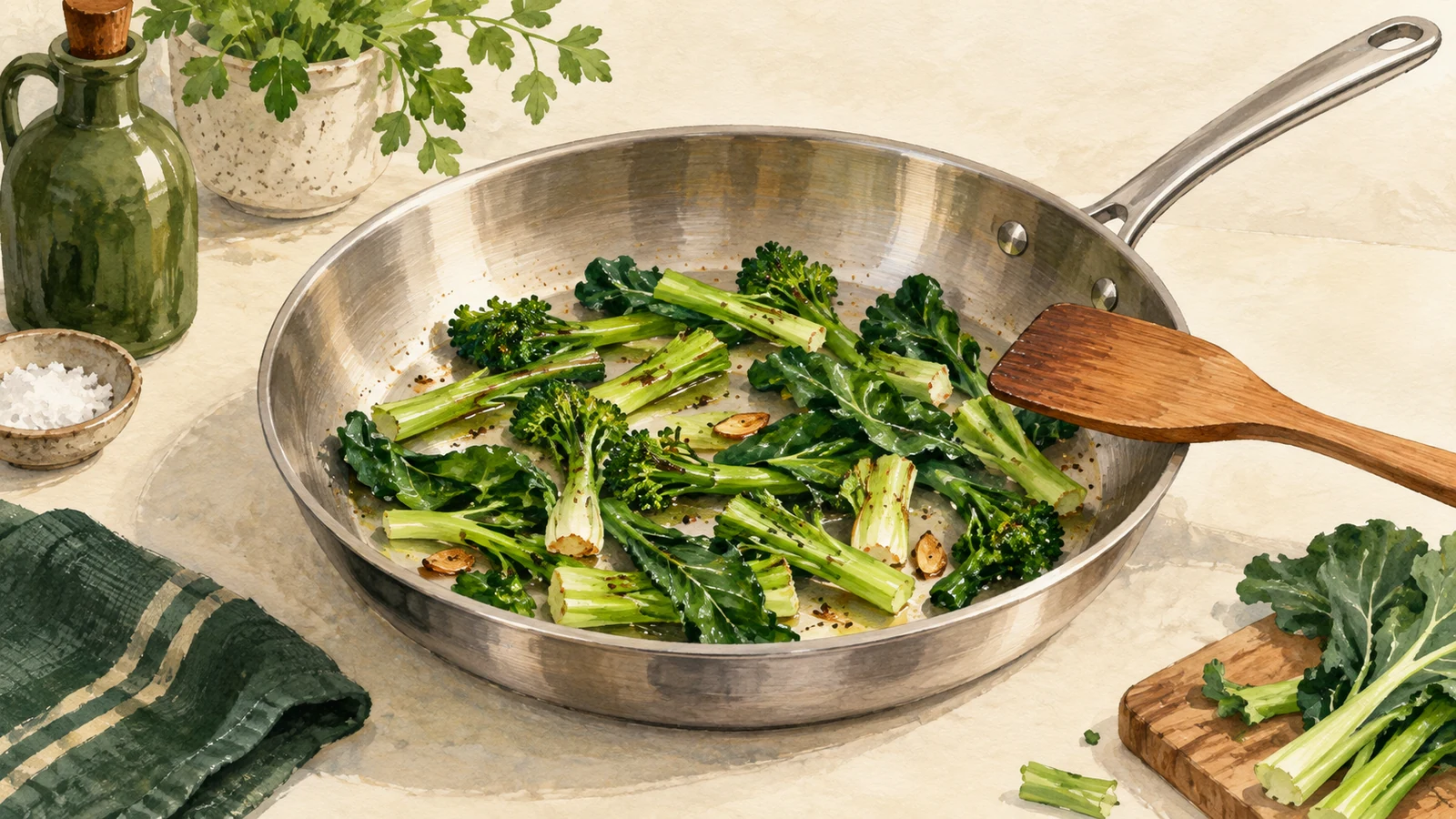
An ordinary broad skillet can cook crisp-tender vegetables, but it does not become a restaurant wok by wishing. Its advantage is visible surface area. Its limit is how quickly a home burner can restore heat after cool, wet food lands in the pan.
This source-based technique combines the dry-produce and advance-preparation guidance in Whole Foods Market’s stir-frying primer, the crowding guidance in Bon Appétit’s home stir-fry notes, and University of Illinois Extension’s guidance that a large skillet can stand in for a wok. It does not claim a comparative kitchen test or restaurant wok heat.
Begin with dry vegetables and an empty counter
Wash produce under running water, then dry it thoroughly. Surface water must turn to steam before the skillet can begin to brown a cut edge. Have the aromatics, sauce, serving plate and spatula ready before the pan heats, because the active part moves quickly.
Separate dense stems, thick slices and florets from tender leaves. The gai lan, bok choy and choy sum guide shows why a bundle of greens is not one uniform piece. The gai lan with oyster sauce recipe gives that particular vegetable its own complete method.
Calibrate the batch to your skillet
For a 12-inch skillet on an ordinary home burner, begin with about 8 ounces (225 g) of prepared vegetables rather than a full family-size heap. That is a starting estimate, not a universal capacity. The right batch leaves visible metal between many pieces and lets steam escape. A smaller or lighter pan may need less.
Heat the dry skillet over medium-high until it is thoroughly hot, then add a thin film of neutral oil. Add one batch and spread it out. If the sound drops immediately to a quiet simmer, liquid pools, and the vegetables become uniformly soft without colored edges, the pan is steaming. Remove some food to the plate and let the skillet recover before continuing.
Searing looks different: moisture flashes away, the food sizzles, and the side touching the metal develops a few browned spots while the vegetable keeps structure. Move the pieces often enough to prevent scorching, but give a cut face a moment against the pan before turning it.
Give stems a head start, then add leaves
Cook dense pieces first. When a stem has begun to brighten and soften but still resists at the center, add the leafy portion. Very sturdy vegetables may need a spoonful of water and a brief covered steam to become tender; uncover afterward and let the added water evaporate before sauce goes in.
Garlic and other fine aromatics can burn before a thick stem cooks. Add them after the first batch has begun to soften, or clear a small space where you can see and move them. Add a measured sauce near the end. A large early pour lowers the pan temperature and can turn the whole batch into a braise.
Read the food, not a restaurant fantasy
The result should match the vegetable and the dish. Bok choy leaves will wilt; gai lan stems should become tender enough to bite; cabbage can keep more snap. Taste a piece from the thickest group and stop when it reaches the texture you want. A home skillet will not reproduce the heat, shape or smoke of a high-output restaurant wok, but careful moisture and batch control can still make a clear, lively vegetable dish.