Recipes
Black Sesame Shortbread with a Sandy Crumb
Small, buttery black sesame cookies made with five ingredients. Ground and whole seeds give different textures; chilled dough and pale golden edges guide the bake.
Jump to recipe ↓Recipe
- Total time
- About 1 hour 15 minutes, plus cooling
- Method
- Bake
- Difficulty
- Moderate
- Allergens
- Milk · Wheat · Sesame
About 12 cookies
Allow roughly 75 minutes including a 30-minute chill, plus complete cooling. Contains wheat, milk and sesame; egg-free dough is still not safe to eat raw.
Equipment: Kitchen scale, mixing bowl, spatula, mortar or small spice grinder, rolling pin, baking parchment, 7.5 cm round cutter, large baking sheet (about 46 × 33 cm), wire rack and oven mitts.
Ingredients
- 113 g unsalted butter, softened but still cool, not melted
- 30 g powdered sugar, sifted
- 1/8 teaspoon fine salt
- 125 g all-purpose flour
- 20 g toasted black sesame seeds, divided
Method
Crush half the sesame
Grind 10 g of the toasted seeds to coarse crumbs, stopping before they turn into a paste. Leave the other 10 g whole.
Convert a measurement for this stepBring the dough together
Stir the butter, powdered sugar and salt until smooth, not fluffy. Fold in the flour and both portions of sesame just until a clump holds together when pressed. Scrape the bowl so no dry pockets remain. Do not taste the raw dough; wash hands and flour-dusted equipment after handling.
Convert a measurement for this stepRoll between parchment
Press the dough into a flat disc, sandwich it between two sheets of baking parchment and roll to an even 6 mm (1/4 inch). Move the covered sheet of dough onto a tray that fits in the refrigerator.
Convert a measurement for this stepChill until firm
Refrigerate the covered dough for at least 30 minutes. It should lift from the parchment without smearing; if it is still soft, keep chilling.
Convert a measurement for this stepHeat the oven and cut rounds
Heat a conventional oven to 350°F (175°C) with a middle rack. Peel away the top parchment and cut 7.5 cm (3 inch) rounds. Place them on the cool parchment-lined baking sheet, leaving about 2 cm between cookies. Press the scraps together, reroll to the same thickness and cut the remainder. Keep the cut cookies refrigerated until the oven is ready.
Convert a measurement for this stepWatch for pale golden edges
Put the tray in the fully heated oven. Start checking at 10 minutes; the bake will usually take about 10–14 minutes. The centers should look set rather than glossy-wet and the edges should be lightly golden. Continue in short intervals if needed. The sesame makes the dough grey, so do not wait for the entire top to turn brown.
Convert a measurement for this stepLet the crumb settle
Turn off the oven and use oven mitts to remove the tray. Leave the cookies on it for about 5 minutes, then lift them gently to a rack. Let them cool completely before serving or sealing in a container.
Convert a measurement for this step
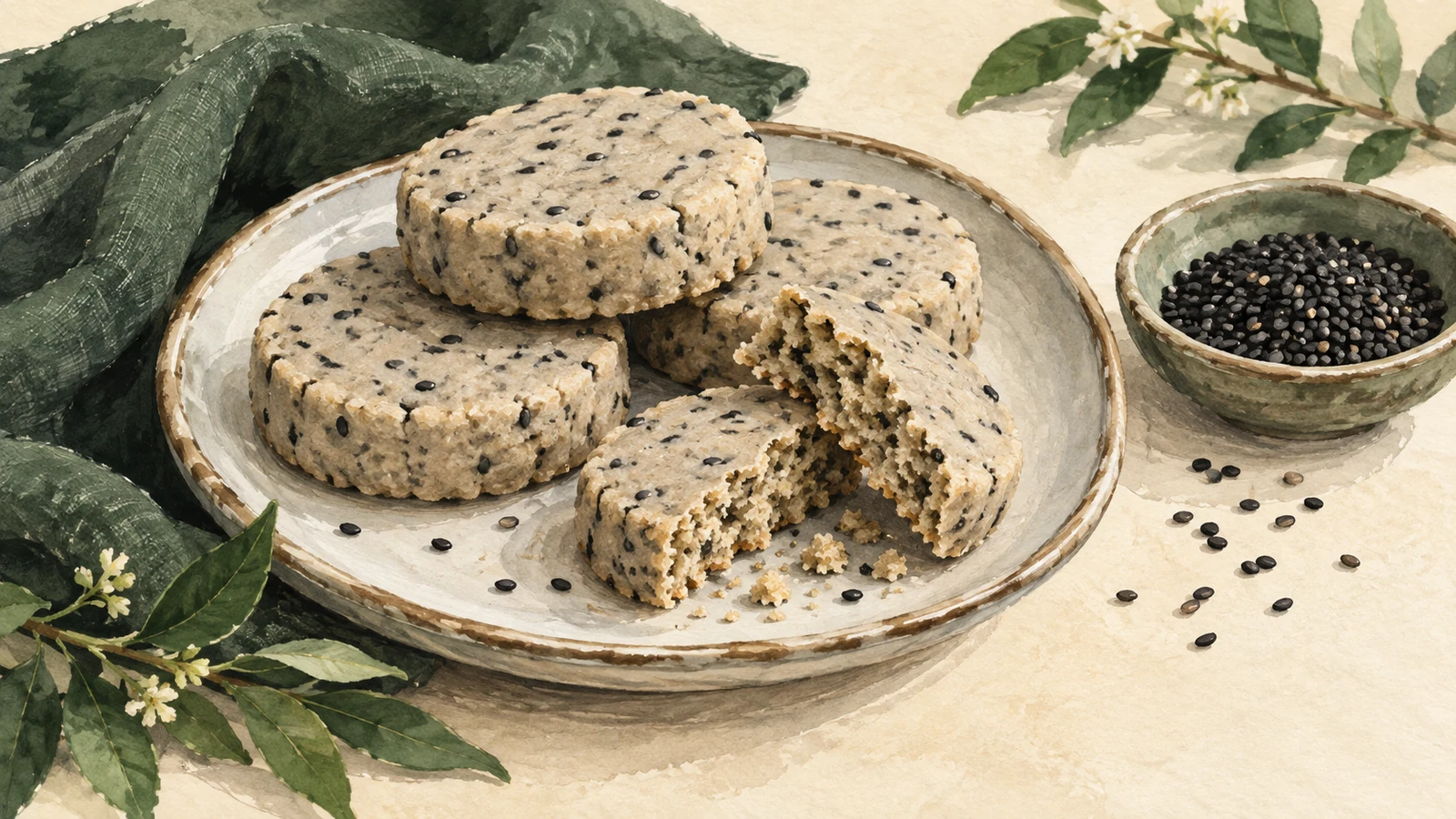
Black sesame does two jobs in this dough. Crushed seeds spread their flavor through the butter; whole seeds leave little crisp points in the crumb. The result is a modest-looking cookie with a toasted aroma, not a sugar-coated showpiece.
The egg-free quantities are scaled from Lily Ernst's black sesame shortbread, with part of the sesame crushed and the dough chilled before cutting.
Stop before seed crumbs become seed butter
A mortar gives good control over a small amount of sesame. With a grinder, use brief pulses and look between them. You want fragments that can disperse, not an oily paste clinging to the sides.
Keep the second half whole. That contrast is the point of dividing the seeds, so there is no need to chase a uniform charcoal color. Namiko Hirasawa Chen’s sesame cookies also distinguish ground seeds from whole ones; her dough includes egg and almond meal, unlike this shortbread.
Sesame paste, sesame oil and toasted seeds are not interchangeable measurements. Each would change how much fat or dry material goes into the dough.
The dough tells you when to pause
If the parchment peels away with a smear of butter on it, the dough needs more cold, not another handful of flour. If a chilled edge cracks, let the sheet stand briefly until it can be handled, then press the crack closed. Both problems can occur in the same kitchen on the same day.
Weigh the flour. A packed cup can add enough extra flour to turn a workable dough into dry crumbs. King Arthur’s cookie guidance explains how flour measurement, butter temperature and chilling affect the result.
Rolling between parchment keeps the counter tidy without working extra flour into every reroll. Elizabeth LaBau’s shortbread method uses a similar thin cut and chilling step. Use baking parchment on the tray, not waxed paper.
Keep the tray in view
Thin cookies give you little distance between a lightly colored edge and a dark underside. Check a cookie near the tray’s edge as well as one in the middle. If your oven colors one side faster, rotate the tray carefully at the first check.
Fresh from the oven, shortbread is fragile. Do not judge its final crispness by squeezing a hot cookie, and do not leave the tray baking until every cookie feels hard. Give the butter-rich crumb time to set on the tray and finish cooling on the rack.
No egg does not mean edible raw dough. FDA’s flour advice applies here: flour can carry harmful bacteria before baking. Keep raw dough away from ready-to-eat food and wash flour off hands and utensils.
Store fully cooled cookies in a tightly closed container away from heat. For the best texture, plan to enjoy them over the next few days; freeze well wrapped if keeping them longer. Do not close warm cookies in a tin and trap steam beside the crumb you just baked.