Ingredients
Choose Udon by Its Form Before You Cook
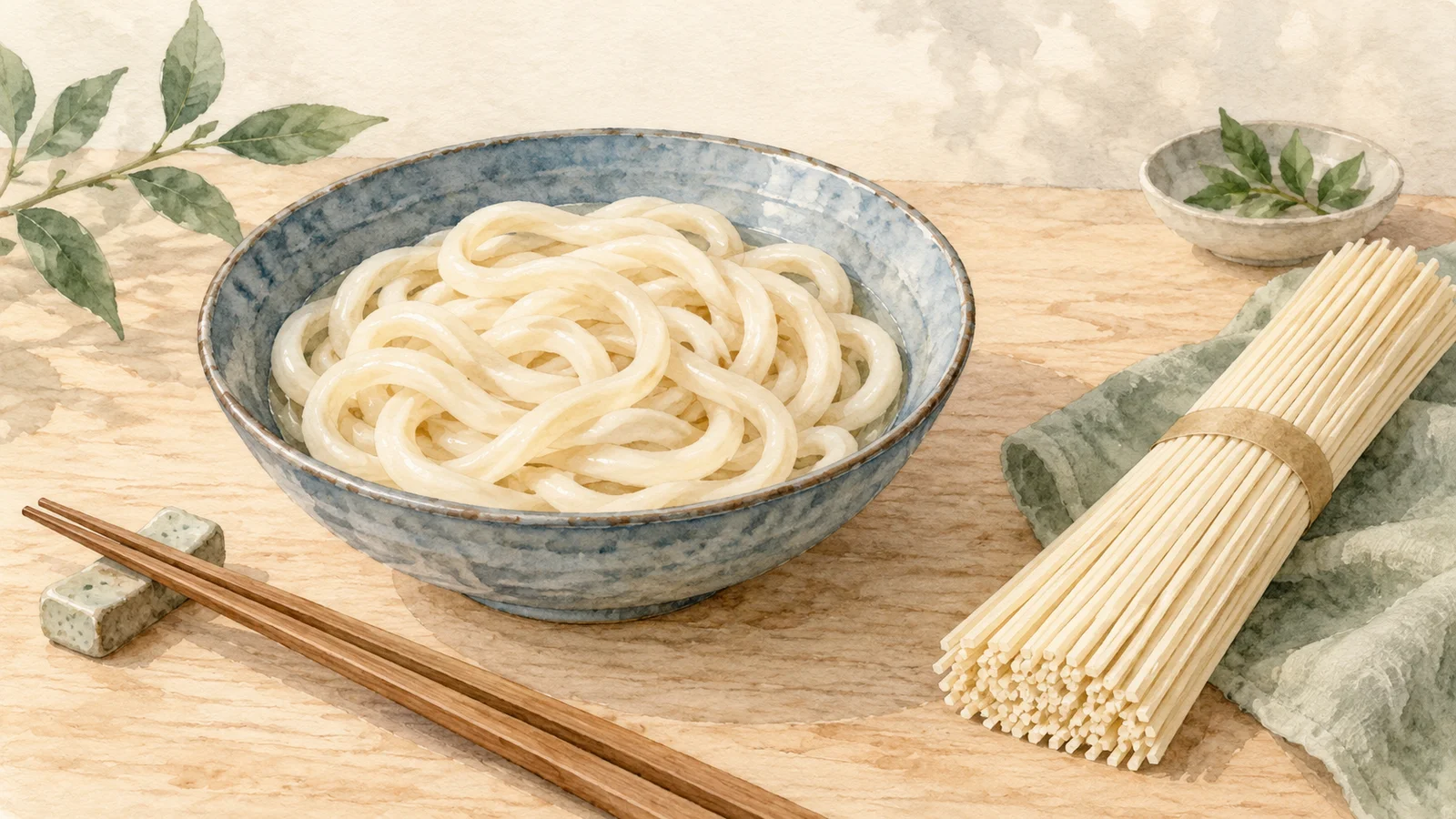
A brick of frozen udon and a bundle of dry udon can both become dinner, but they do not enter the pot at the same stage. One may already be cooked; the other still needs to absorb water and cook through. The word “fresh” is not enough to tell you which job is ahead.
Start with the dish you want, then read the packet for two things: whether the noodles are raw or precooked, and how that particular product should be heated. This small check prevents a quick noodle supper from turning into either tough dough or a soft tangle.
What you are bringing home
Ordinary udon is made from wheat flour, water and salt. Its shape varies: some styles are thick and rounded, while others are thinner and flatter. Namiko Hirasawa Chen’s udon guide describes that range. Do not assume a pale noodle is rice-based or gluten-free; check its ingredients and allergen statement.
| Form | What to check | What it means for dinner |
|---|---|---|
| Dried | Cooking directions and the dry portion weight | Allow a full boiling step before the noodles meet the finished sauce or broth. |
| Fresh, raw | A clear instruction to cook the dough | Flexible strands still need cooking; softness in the packet is not doneness. |
| Precooked, chilled or shelf-stable | Storage directions and reheating method | The noodles may need only warming and loosening. Keep refrigerated products cold; shelf-stable packaging is a different product. |
| Frozen | Whether the contents are raw or already cooked | Follow the instructions from frozen if specified. A frozen block is not proof of precooking. |
Read the serving information as carefully as the time. A recipe calling for a weight of cooked or frozen precooked noodles is not automatically asking for the same weight of dry noodles. Water already makes up part of the precooked product. Use the recipe’s stated form, or its explicit dry-noodle substitution, rather than matching the number on the scale alone.
Frozen does not always mean a one-minute job
Many commercial frozen udon portions are cooked before freezing. TableMark’s general udon FAQ explains that its noodles are boiled, cooled and rapidly frozen. It advises heating them even when they will be served cold, then chilling them in cold water. Letting that sort of block thaw on the counter is not its recommended preparation.
Raw noodles can also be frozen. Chen’s homemade udon method freezes uncooked portions and then boils them from frozen. Those noodles need a substantially longer cook than a precooked block. The two instructions describe different starting materials, not a disagreement about the same noodle.
For a precooked block, ease the strands apart only as they loosen during the instructed heating step. Pulling hard on a still-frozen clump can break them. If the label allows microwaving, follow its portion size, wattage and container directions; do not assume doubling the portions means doubling the time. TableMark specifically warns that heating two portions together can be uneven.
Give raw and dried noodles their own pot
Have the colander and serving bowls ready before the noodles finish. Use enough boiling water for the strands to move, and follow the packet’s timing rather than borrowing a number from another udon recipe. Thickness and preparation differ.
With raw fresh noodles, a bendable strand still contains uncooked flour. The FDA advises against tasting raw flour or dough. Cook according to the instructions before checking a cooled strand for the texture you want. Wash hands, utensils and work surfaces after handling raw dough.
Some methods call for rinsing after boiling to remove surface starch, followed by a brief warming for a hot dish. Chen uses that sequence for homemade udon. Follow the method for your noodles and intended dish instead of treating rinsing as either always necessary or always wrong. Drain thoroughly before adding a measured sauce so the water in the colander does not become an unplanned ingredient.
For curry udon, prepare the noodles separately and ladle the finished broth over them near serving time. For miso butter corn udon, use the specified frozen noodle quantity, reserve the requested cooking water, and finish gently in the skillet. Both recipes already provide the quantities and sequence; changing the noodle format should not turn the broth or sauce into a guessing exercise.
Keep the remaining portions ready for another meal
Store unopened noodles as their label directs. Reseal dry noodles against moisture, return frozen portions to the freezer promptly, and follow after-opening directions for soft packed noodles. A tightly sealed packet is not by itself permission to store a refrigerated product in the pantry.
Once cooked, refrigerate leftovers promptly in shallow containers at 40°F (4°C) or below. USDA’s leftover guidance sets a two-hour limit out of refrigeration, or one hour above 90°F (32°C), and a refrigerated storage window of three to four days. Discard food left out too long. Reheat leftovers to 165°F (74°C), checking with a food thermometer. These limits apply to the noodles as well as the meat or vegetables around them.