Kitchen skills
Slice Beef Across the Grain for Stir-Fries
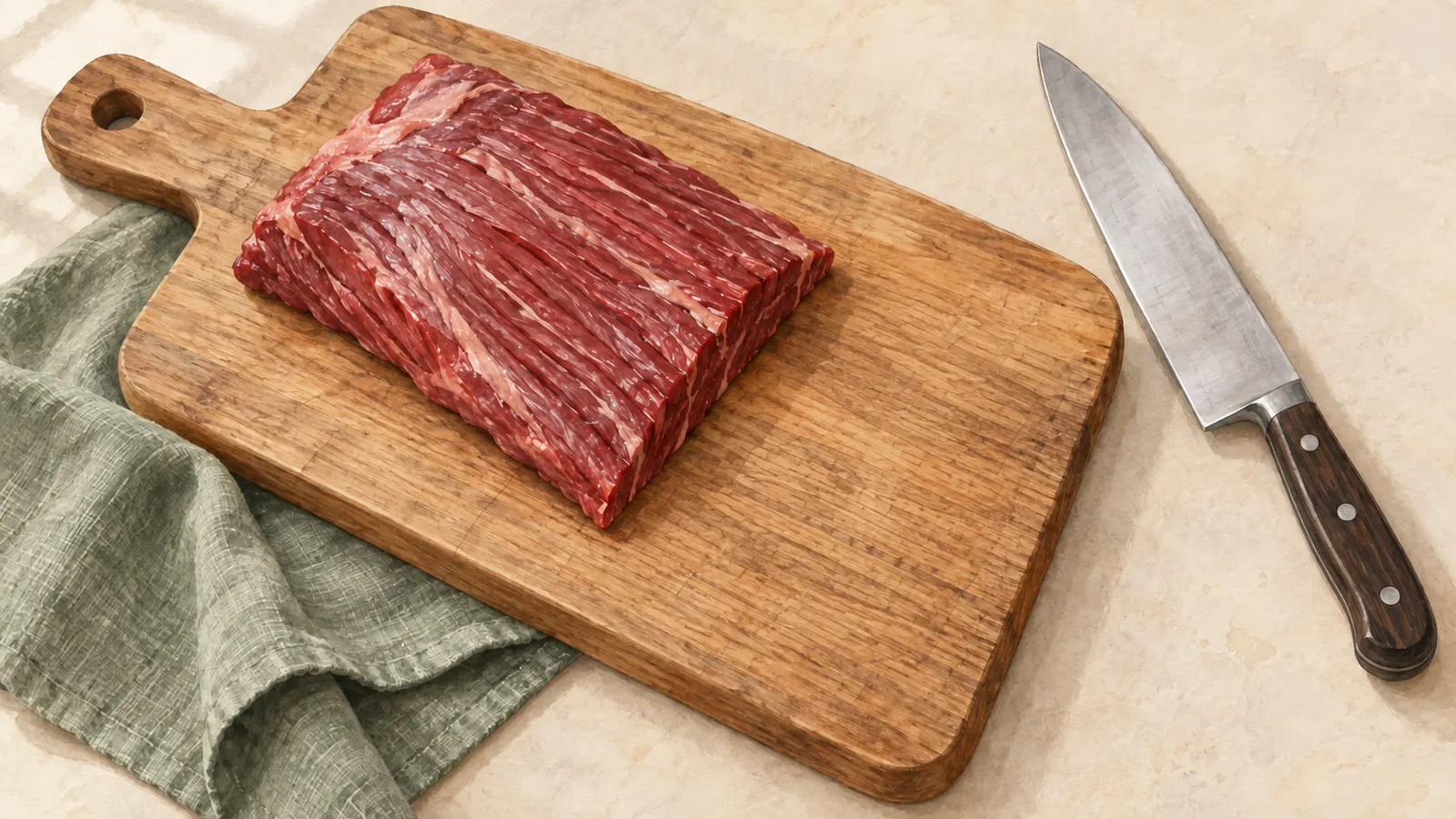
Before you reach for a marinade, turn the beef on the board. Those long lines running through the meat tell you where to cut. A thin slice can still be chewy if it carries a long bundle of muscle fibers from one end to the other.
For a stir-fry, the useful question is not simply “How thin?” It is “Which way are the fibers running, and will this cut shorten them?” Decide that while the meat is still in a piece large enough to read.
Find the lines inside the meat
Look closely at the surface for parallel strands. Flank steak makes them relatively easy to see. A seam of fat or the outside edge of the steak is not a reliable guide to their direction.
J. Kenji López-Alt explains the distinction at Serious Eats: cutting across the muscle fibers shortens the lengths left in each bite. Cutting alongside them leaves longer strands. This matters especially in clearly grained cuts such as flank; it does not mean every piece of beef has equally obvious grain.
Turn the meat until your intended slices cross those strands at roughly a right angle. Recheck after separating a larger piece into smaller sections. Do not assume every section still faces the same way.
Make a manageable piece before making thin slices
Choose the cut specified by the dish you plan to cook. Cutting technique cannot make every inexpensive roasting cut behave like the beef in a quick stir-fry recipe.
Bill Leung’s beef-preparation guide shows a useful two-stage approach: divide a large flank steak into manageable strips, then make the final small slices across the grain. Those first dividing cuts and the final eating slices do different jobs. Follow the fibers again before the final cut.
If the meat folds and slides under the knife, briefly firm it in the freezer until it holds its shape but remains sliceable. Leung describes partial freezing for this purpose. Check the actual piece rather than trying to cut a rigid frozen block.
Use a stable board and a sharp knife, keeping fingertips out of the blade’s path. If you need force to push through, stop and reassess the meat’s firmness and your setup.
Check the first few pieces
Use your recipe’s thickness and shape. Leung’s stir-fry examples use slices around ⅛–¼ inch (3–6 mm), but a noodle dish may call for narrower strips. Aim for a consistent batch rather than alternating thick wedges with paper-thin ends.
Lay the first few slices beside one another. Are they similar in thickness? Do the visible fibers run a short distance through each slice, or along most of its length? Correct the direction now, before the whole steak is cut.
The beef japchae recipe gives the beef, noodles and vegetables their own preparation and cooking steps. Keep that complete method nearby; the cut pieces are only the beginning of dinner.
Keep the raw-meat job separate
Prepare ready-to-eat vegetables on a clean board away from raw beef and its juices. USDA advises against washing raw meat, because splashes can spread contamination. Slicing needs no rinse or sinkful of water.
After cutting, wash your hands and clean the knife, board and work surface with warm soapy water. Sanitize food-contact equipment with a product intended for that use, following its label. Bring out a clean plate for cooked food.
If cooking will wait, cover and refrigerate the sliced beef promptly. USDA’s beef guidance also places marinating in the refrigerator. A bowl of marinade belongs there while the rest of the meal is being organized, not beside a warming stove.