Kitchen skills
Thicken a Stir-Fry Sauce Without Lumps
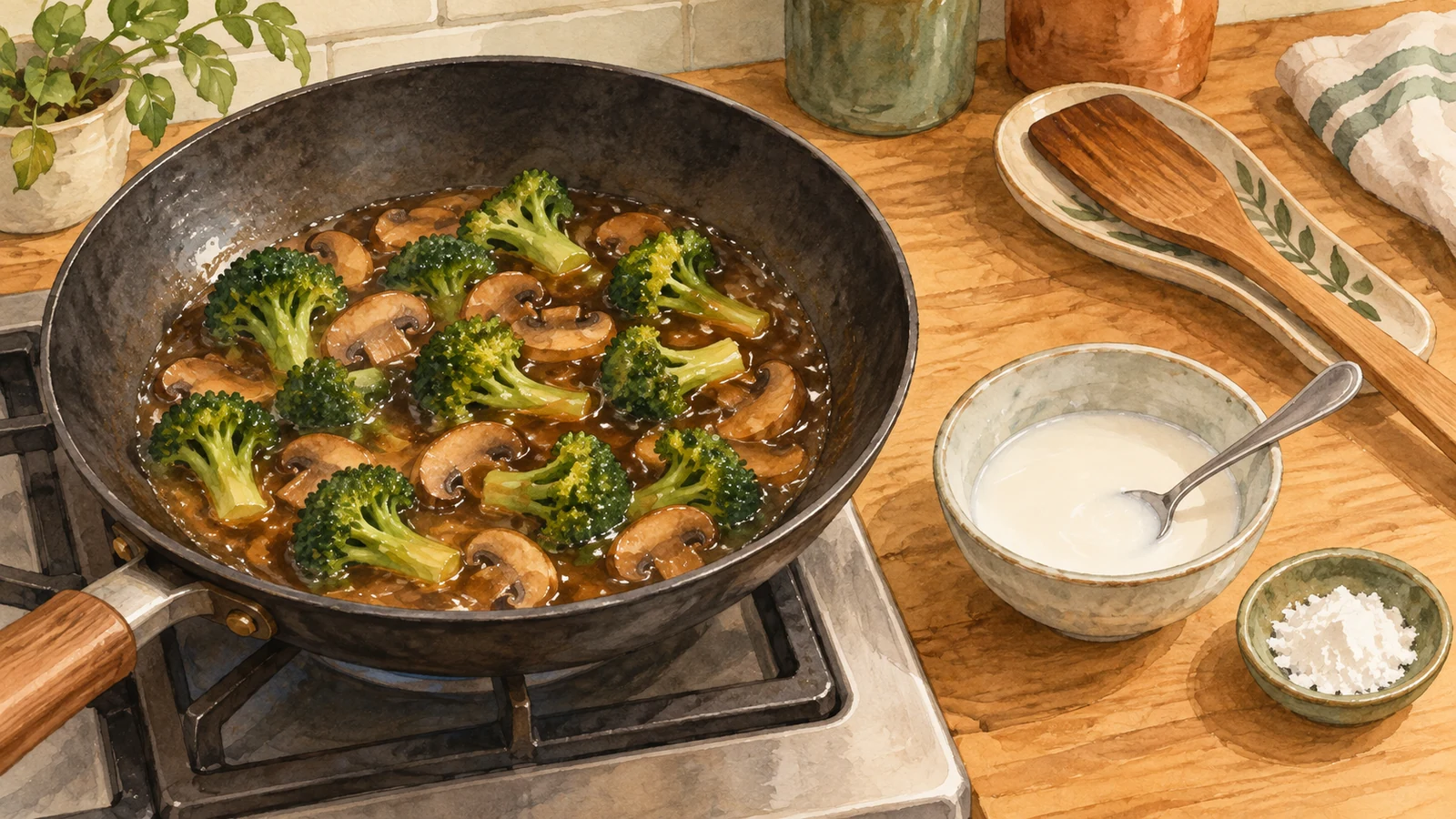
The vegetables are ready, but the sauce runs straight off them. A little cornstarch can make that sauce cling. The tricky part is stopping before a light coating becomes a sticky blanket.
Keep the starch in a small bowl until the dish is nearly finished. That gives you a separate decision: how much thickening does the liquid actually need now? A pan with wet mushrooms or a generous splash of stock may need a different amount from the same dish cooked drier.
Start in the bowl, not the pan
A slurry is starch dispersed in cool liquid, then stirred into a hot liquid to thicken it. The Institute of Child Nutrition’s sauce training demonstrates this sequence. Sprinkling dry cornstarch into hot sauce gives the outside of each clump a chance to thicken before its center mixes in. Make a smooth mixture first, then distribute it through the sauce.
For an easy-to-pour slurry, Namiko Hirasawa Chen at Just One Cookbook recommends one part starch to two parts cold or room-temperature water by volume. For example, a teaspoon of starch mixed with two teaspoons of water makes a small amount to work with. This is a mixing ratio, not a dose for every pan of food. Use the starch quantity in your chosen recipe as the starting estimate.
Scrape the bottom of the bowl as you stir. If the slurry waits while you cook, stir it again immediately before pouring; the starch settles. A watery top and a firm white layer underneath will not give you the same result as a uniformly milky mixture.
Give each addition time to work
Have the food, sauce and serving dishes ready before this last stage. Keep your attention at the stove; thickening is a short, active job.
- Bring the sauce to a simmer as directed by the recipe. If it is boiling violently, lower the heat enough to stir safely.
- Re-stir the slurry, then drizzle in only some of it while moving the sauce continuously with a spatula or spoon. Do not pour it all into one stationary spot.
- Let the sauce return to a simmer, stirring, before deciding whether it needs more. The cold slurry needs heat to do its job.
- Stop adding when the sauce lightly coats the food while still moving freely around it. You do not have to empty the bowl.
Bill Leung’s cornstarch guide emphasizes judging the pan rather than treating a recipe’s slurry amount as compulsory. It also warns that prolonged cooking can undo the thickening. Once the texture is right and the dish is fully cooked, finish and serve instead of leaving it bubbling while you start another task.
Why stirring matters
Starch thickens a watery sauce as its granules absorb liquid and swell. The Exploratorium’s explanation of starch-thickened sauces describes how stirring keeps the starch moving and the temperature more even. That is why a smooth slurry still needs movement after it enters the pan.
Think of the bowl and the pan as doing different jobs. Cool water separates the dry particles so they can be distributed. Heat in the sauce develops the thickened texture. Adding more powder cannot substitute for mixing the first addition properly.
Correct the texture in small steps
Still thin: check that the sauce has returned to a simmer before adding more. If it has, stir the remaining slurry again and add another small amount. Make a fresh slurry if needed; keep dry powder out of the hot pan.
Too thick: stir in a little water or suitable unsalted stock, then reassess. Chen recommends gradual dilution, which lets you loosen the sauce without immediately swinging back to a watery pan. Taste once a sample has cooled enough, because dilution also changes the seasoning.
Lumpy: stop adding starch. Stir through the sauce and look for concentrated blobs; a second pour will not fix the first one. For the next batch, check the bowl’s bottom, pour more slowly and keep the hot liquid moving.
A slurry is useful when the dish calls for a lightly thickened sauce. It does not turn crowded, waterlogged vegetables into a well-seared stir-fry. If that is the recurring problem, work on dry vegetables and smaller skillet batches before changing the starch amount.