Ingredients
Dried Shiitake and the Broth in the Bowl
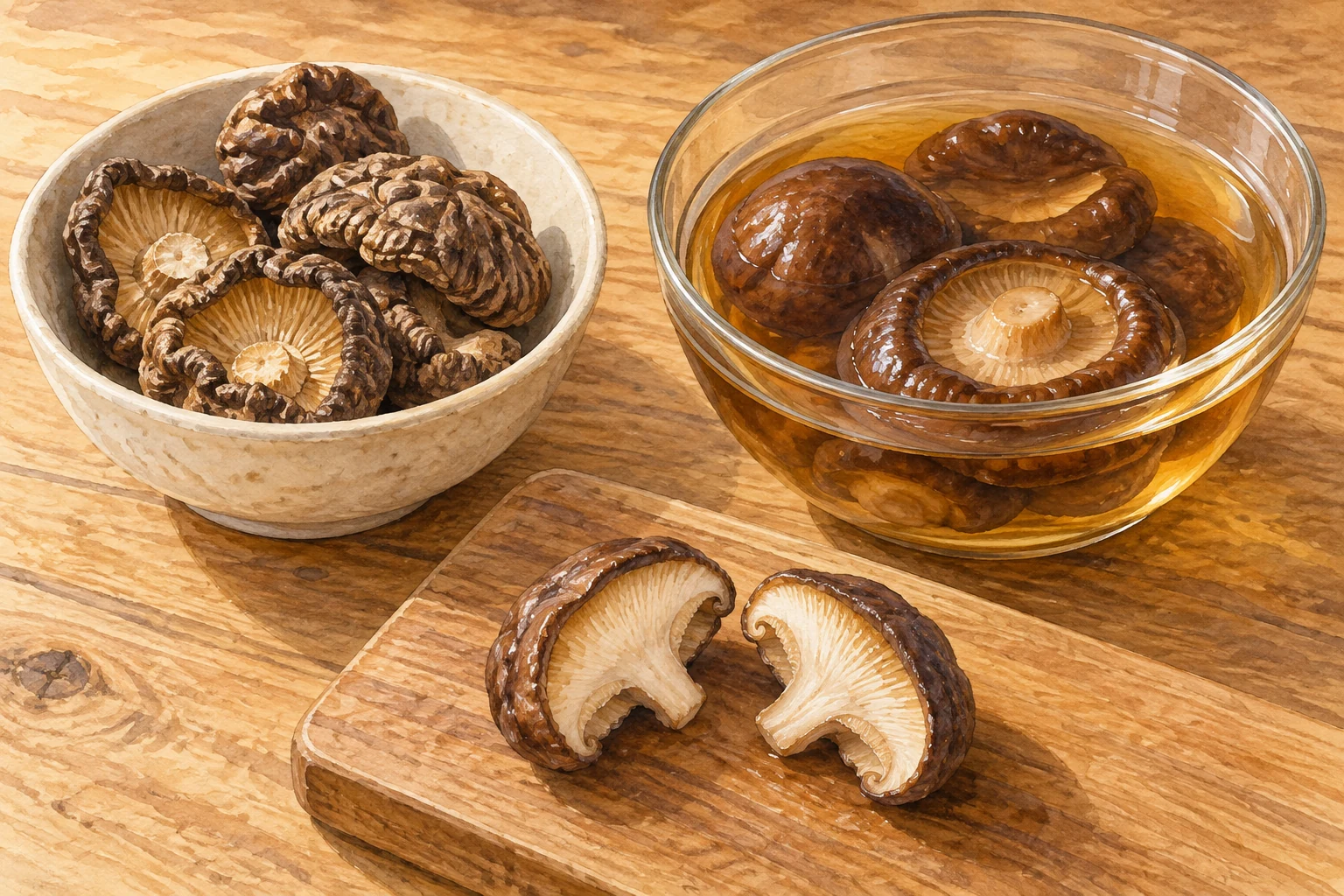
The bowl looks like a way to soften mushrooms. By the end, it holds two ingredients: plump shiitake caps and amber liquid that can flavor a cooked broth. Pouring everything through the sink loses the second one.
Keep a small bag of dried shiitake for meals where mushroom flavor belongs throughout the dish, not only in the occasional bite. The caps can go into the food; their soaking liquid can become part of the liquid you were already going to add.
Start the soak in the refrigerator
Rinse the dried caps briefly under running water to remove surface debris. Put them in a clean container with enough cold drinking water to cover them, hold floating caps down with a small clean plate, cover and refrigerate at 40°F (4°C) or below.
This is a task for the night before, not the moment the pan goes on. Shiitake grower Sugimoto gives a refrigerated range of roughly 5–24 hours, depending on the mushroom. Thin caps and thick caps will not finish together.
Feel near the point where the stem joins the cap. An outer edge can be supple while that thicker center is still hard. Continue soaking in the refrigerator if there is a firm, dry core; a clock alone cannot tell you that the whole mushroom has hydrated.
Do not leave the bowl on the counter overnight. The Hong Kong Centre for Food Safety warns that bacteria can multiply during extended room-temperature soaking. Keeping it cold from the beginning avoids having to remember when a short soak became a long one.
Separate the caps from the grit
Lift out the mushrooms rather than pouring the sediment back over them. Remove the tough stems and cut the caps to suit dinner: thin slices for a broth, larger pieces for a braise. If a cap still has trapped grit, rinse that area before cutting.
Strain the soaking liquid through a fine strainer lined with a clean coffee filter or food-safe cloth, and leave visible sediment behind. Namiko Hirasawa Chen’s shiitake dashi method likewise keeps the mushroom liquid and filters it before use.
Soaked does not mean cooked. Cook the caps thoroughly in the dish; do not nibble them raw to check texture. ANSES warns that raw or undercooked shiitake can cause an intensely itchy skin reaction. Use the soaking liquid in cooked preparations too.
Spend the liquid where you want the flavor
For noodle soup, replace part of the recipe’s broth with strained mushroom liquid rather than adding an extra bowlful on top. The same idea works in a braise. Keeping the total liquid quantity steady avoids accidentally turning a sauce into soup.
Its strength depends on the mushrooms and how much water you used, so there is no universal one-for-one flavor match with stock. Start with a portion, finish cooking, then taste a safely cooled spoonful. Mushroom liquid also contributes a different flavor from chicken stock or bonito dashi; it is not an invisible substitution.
In vegetable curry udon, it can replace some of the vegetable broth. Keep the fresh brown mushrooms in that recipe unless you also plan to adjust their quantity and cooking separately.
If dinner changes, keep the soaked mushrooms and strained liquid refrigerated and use them promptly, or freeze them for a later cooked dish. Discard mushrooms with slime or an abnormal smell, but do not treat a normal smell as proof that a forgotten warm soak is safe. For the next batch, set the covered bowl beside tomorrow’s ingredients in the refrigerator, where it is harder to overlook.