Ingredients
Choosing a Mango for What You Want to Eat
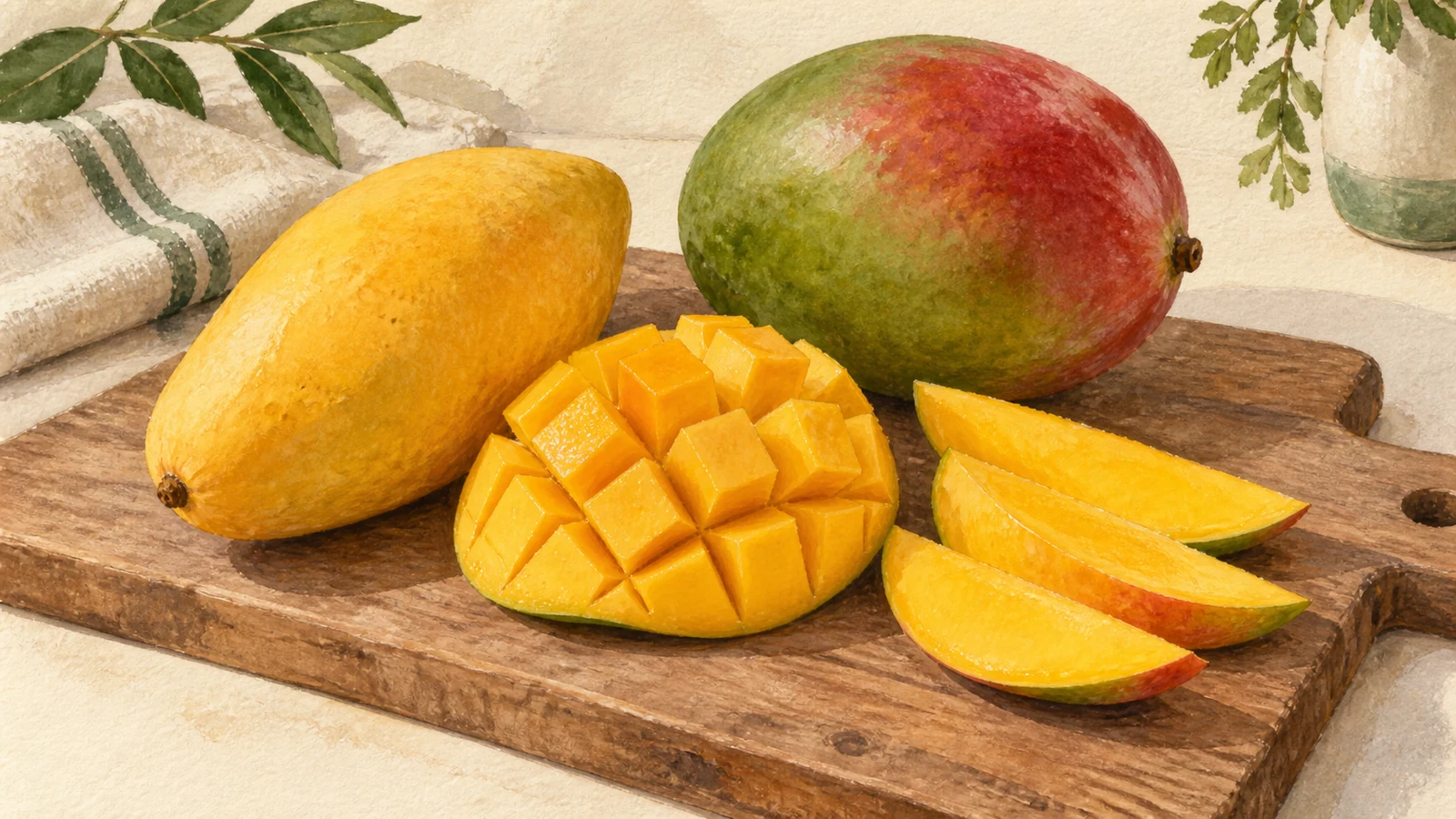
A mango for a crunchy salad and a mango for eating over the sink are different purchases. One needs resistance under the knife; the other should yield to a spoon. Shopping becomes easier when you decide which texture you want before judging the fruit.
Red skin is not a promise of sweetness. Some mangoes stay green when ripe, and some are brightly colored while still firm. The National Mango Board recommends judging ripeness mainly by feel, with a gentle squeeze rather than a hard thumb pressed into one spot.
Three destinations for one fruit
For a crisp, tart salad: seek a firm green mango sold for that use. Ask the produce seller if the variety is intended to be eaten unripe. Do not choose a soft dessert mango and expect thin strips to stay crisp after dressing.
For slices or neat cubes: choose fruit that gives slightly but still holds its shape. Cut it shortly before serving, or refrigerate the prepared fruit. If you are buying for several days from now, firmer fruit gives you more room to wait.
For spooning, blending or mashing: a softer, sound ripe mango is useful. Cut a small piece and taste before adding sugar to a drink or dessert. You may need less sweetness than expected. Softness from ripening is not the same as mold, leaking decay or a fermented smell; discard spoiled fruit.
Do not buy an entire bag at the same stage unless you intend to use it together. A ready-to-eat mango and two firmer ones are a more flexible purchase than three ripe fruits competing for tonight.
The stringiness may be the variety
Honey mangoes, often labelled Ataulfo, are small and oblong with a relatively smooth flesh. Kent and Keitt also tend to have fewer fibers than Tommy Atkins. A ripe Tommy Atkins can still contain noticeable strings; that does not prove you cut it too early. The Mango Board’s variety comparison explains these texture differences.
If you dislike fibers in a smooth sauce, choose a less fibrous variety when available. If the mango you have is stringy, blend and pass the puree through a sieve rather than trying to soften the fibers with more ripening. For a chunky salsa, cut smaller pieces so long strands do not dominate each bite.
Check the sticker or ask the produce staff for the variety. Shape and color are useful clues, but not a dependable identification system when several kinds share a display.
Follow the flat seed
Wash the whole mango under running water and dry it before cutting, even though you will discard the peel. Use a stable board and clean knife. FDA recommends washing produce before peeling so dirt is not carried inside by the blade.
The seed is a broad, flat oval running lengthwise through the fruit. Cut a cheek from each side, guiding the knife alongside that plane. If you hit the seed, stop and reposition rather than forcing the knife through it.
Lay a cheek skin-side down on the board. Make shallow lines in the flesh for slices, or a grid for cubes, without cutting through the skin. Scoop the flesh out with a spoon. Keep the cheek on the board, not in your palm, while scoring it. Trim any accessible flesh from the center piece with the fruit supported securely.
The Mango Board’s cutting guide illustrates the seed and cheek arrangement. It also advises against pushing mango onto the rim of a drinking glass: the glass can break and the wet fruit can slip.
Let ripening happen, then slow it down
Keep a firm whole mango at room temperature while it ripens. A paper bag can help it along; check daily rather than assigning it a guaranteed finishing date. Move ripe whole fruit to the refrigerator to slow further softening. The Mango Board allows up to five refrigerated days for whole ripe mangoes, depending on their condition when stored.
Cut fruit belongs in a covered container in a refrigerator at 40°F (4°C) or below. Aim to use it within three days, the window in the cutting guide. If you have more than you can use, freeze pieces separately on a lined tray, then transfer them to a freezer container. Loose frozen pieces are easier to portion than one solid mango-shaped block.